ai-ml-dl
Artificial Intelligence, Machine Learning, and Deep Learning
A comprehensive learning repository and knowledge base for AI, ML, DL, and Data Science.








📌 Overview
This repository serves as a centralized hub for mastering the core pillars of modern data intelligence. It includes structured notes, theoretical foundations, and practical insights into:
🗺️ Visualizing the Ecosystem
The following illustration demonstrates the hierarchical and overlapping relationships between Artificial Intelligence, Machine Learning, Deep Learning, and Data Analytics.
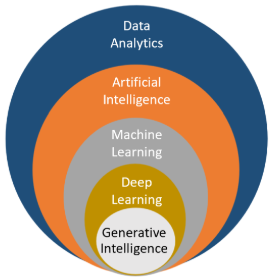
Source: Anang B. Singh (LinkedIn)
📊 High-Level Comparison: AI vs ML vs DL
Understanding the nuances between these fields is critical for applying the right technology to the right problem.
| Feature | Artificial Intelligence (AI) | Machine Learning (ML) | Deep Learning (DL) |
|---|---|---|---|
| Core Concept | AI simulates human intelligence to perform tasks and make decisions. | ML is a subset of AI that uses algorithms to learn patterns from data. | DL is a subset of ML that employs artificial neural networks for complex tasks. |
| Data Requirements | May or may not require large datasets; it can use predefined rules. | Heavily relies on labeled data for training and making predictions. | Requires extensive labeled data and performs exceptionally with big datasets. |
| Human Intervention | Can be rule-based, requiring human programming and intervention. | Automates learning from data and requires less manual intervention. | Automates feature extraction, reducing the need for manual engineering. |
| Scope | Can handle various tasks, from simple to complex, across domains. | Specializes in data-driven tasks like classification, regression, etc. | Excels at complex tasks like image recognition and NLP. |
| Complexity | Algorithms can be simple or complex, depending on the application. | Employs various algorithms like decision trees, SVM, and random forests. | Relies on deep neural networks with numerous hidden layers. |
| Resources | May require less training time/resources for rule-based systems. | Training time varies with algorithm complexity and dataset size. | Demands substantial computational resources (GPUs) and time. |
| Interpretability | Often offers interpretable results based on human rules. | Models can be interpretable or less interpretable based on the algorithm. | Often considered “black boxes” due to complex architectures. |
| Applications | Virtual assistants, recommendation systems, expert systems. | Image recognition, spam filtering, predictive analytics. | Autonomous vehicles, speech recognition, advanced AI research. |
Source: Analytics Vidhya
🛠️ Stack & Tools
To maintain and visualize the knowledge within this repository, the following tools are utilized:
- Language: Python 3.x
- Modeling: FreePlane (Open-source mind mapping tool for structured thinking)
💬 Connect & Contribute
Suggestions and questions are always welcome! You can engage with the project through the following channels:
- Email: xiaoqizhao@outlook.com
- Discussion: GitHub Discussion Board
License
Distributed under the GPL-3.0 License. See LICENSE for more information.