protege_pizza
🍕 Mastering Ontology Engineering with Protégé and Pizza.owl
Executable Knowledge Architecture (EKA)
From Pizza.owl to Executable Knowledge
An open-source ontology engineering learning and knowledge-development platform built around the Protégé Pizza.owl tradition, extending hands-on OWL modeling into semantic governance, reasoning, knowledge graphs, and Executable Knowledge Architecture (EKA).







💡 Looking for the complete, professional guide? While this repository provides open-source snapshot code (the individual “pieces”), our structured multi-volume eBook series on Leanpub and Amazon Kindle provides the complete architectural framework, deep-dive explanations, and advanced engineering practices (such as Stage 4 Semantic Governance).
👉 Get the Full eBook on Leanpub or Get it on Amazon Kindle to support this project!
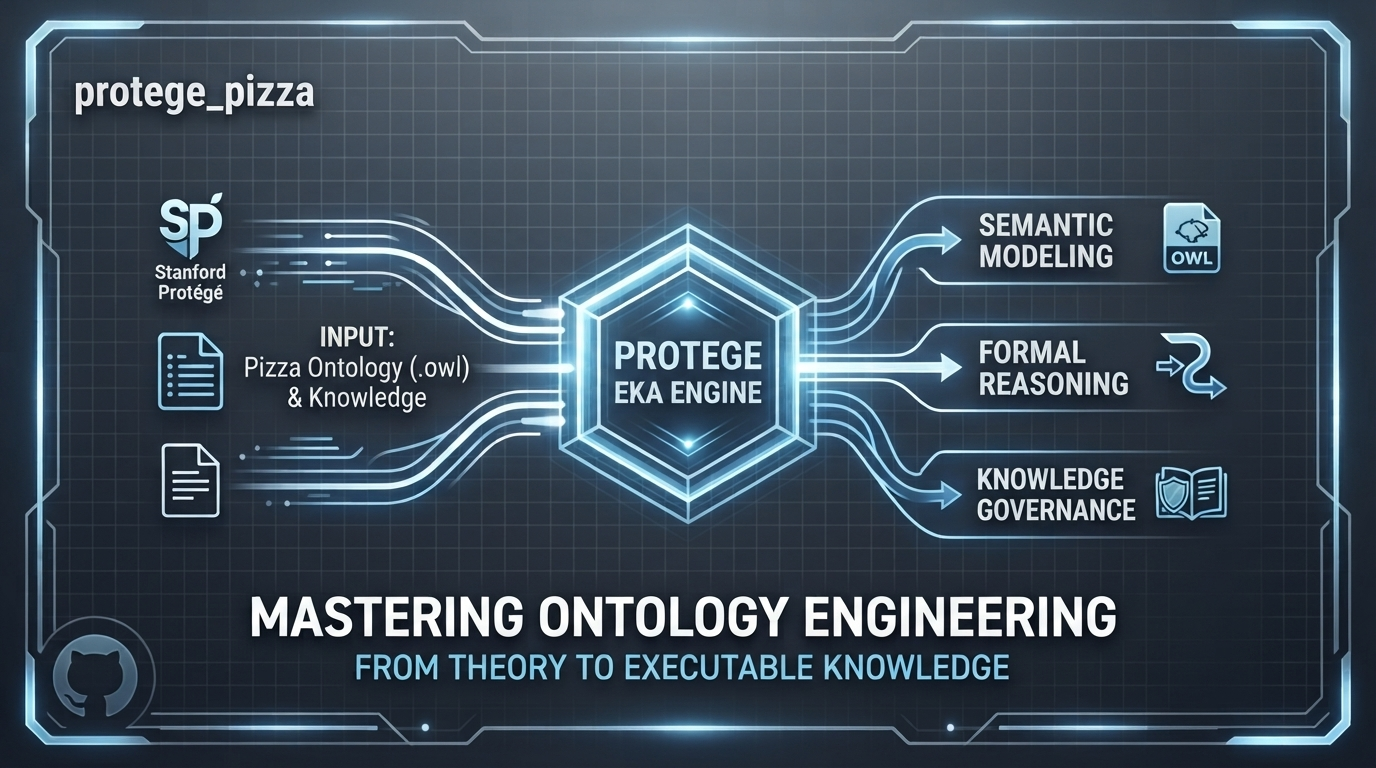
📢 Exciting News: Plan Protégé Going Global! 🌍
🎉 We’ve forked the official Protégé Desktop project — and we’re taking it multilingual!
To bring the power of Protégé to a much wider audience, we have forked the original Protégé Desktop project into our brand-new open-source organization:
👉 github.com/yasen-opensource — starting with yasen-opensource/protege
🗺 The Roadmap
- 🇨🇳 Chinese Edition First — a full Simplified Chinese localization of the Protégé Desktop UI
(menus, dialogs, the OWL editing views — classes, object/data properties, individuals, SWRL rules —
and more), implemented with standard Java internationalization (
ResourceBundle/.properties), so Chinese-speaking developers and ontology engineers can learn and work in their native language. - 🌍 Multilingual Branch Next — the Chinese edition is only the beginning. Our roadmap extends to further languages, growing a true multilingual branch of the tool.
- 🛠 Community-Driven — built by the community, for the community.
🤝 Contributors Welcome!
Whether you are a Java/Swing developer, a translator, a technical writer, or simply a passionate Protégé user — there is a place for you in this journey:
- 🐛 Report untranslated strings or UI glitches
- 🌐 Contribute translations — refine the Chinese edition, or kick off a new language
- 💻 Help with i18n engineering (ResourceBundle extraction, Maven packaging, Swing runtime support)
- 📖 Improve documentation and onboarding guides
⭐ Star yasen-opensource/protege to follow our progress, open a discussion to say hello, and jump into the issues to claim your first contribution!
🏛 What is EKA?
EKA stands for Executable Knowledge Architecture.
EKA is a practical framework for transforming human knowledge into machine-readable, machine-reasonable, and ultimately machine-executable intelligence.
The framework is represented as:
EKA = (K, R, Θ, Φ, Γ)

K = Knowledge
R = Reasoning & Rules
Θ = Triggers
Φ = Actions / Execution
Γ = Governance
EKA provides an architectural bridge between:
- Ontology Engineering
- Knowledge Graphs
- Semantic Governance
- AI Systems
- Agent Architectures
- Executable Intelligence
🌍 The EKA Journey
This project began as an exploration of the legendary Pizza.owl tutorial created by Michael DeBellis and the Protégé community.
Over time it evolved into a broader journey, I use Pizza.owl as a controlled environment for teaching ontology engineering as an engineering discipline:
Pizza.owl
↓
Ontology Engineering
↓
Knowledge Graphs
↓
Semantic Governance
↓
Reasoning
↓
AI-Ready Systems
↓
Executable Intelligence
The Pizza tutorial remains the educational foundation.
EKA is the destination.
🚀 Project Vision
This repository is the official engineering environment for the Executable Knowledge Architecture (EKA) initiative.
The objective is not simply to learn OWL or Protégé.
The objective is to learn how knowledge itself can become:
- Structured
- Governed
- Reused
- Reasoned
- Automated
- Executable
Through the EKA series you will gradually move from ontology fundamentals toward enterprise-scale knowledge architecture and intelligent systems.
🌟 Why Learn Ontology & Protégé?
In the era of AI and Large Language Models (LLMs), ontologies provide the formal semantic layer that machines need to reason reliably.
By following this repository and companion eBook series, you will learn how to:
- Build ontologies using Protégé
- Model domains semantically
- Design reusable ontologies
- Apply reasoning and inference
- Govern semantic knowledge
- Build knowledge graphs
- Prepare AI-ready semantic systems
- Understand executable knowledge architecture
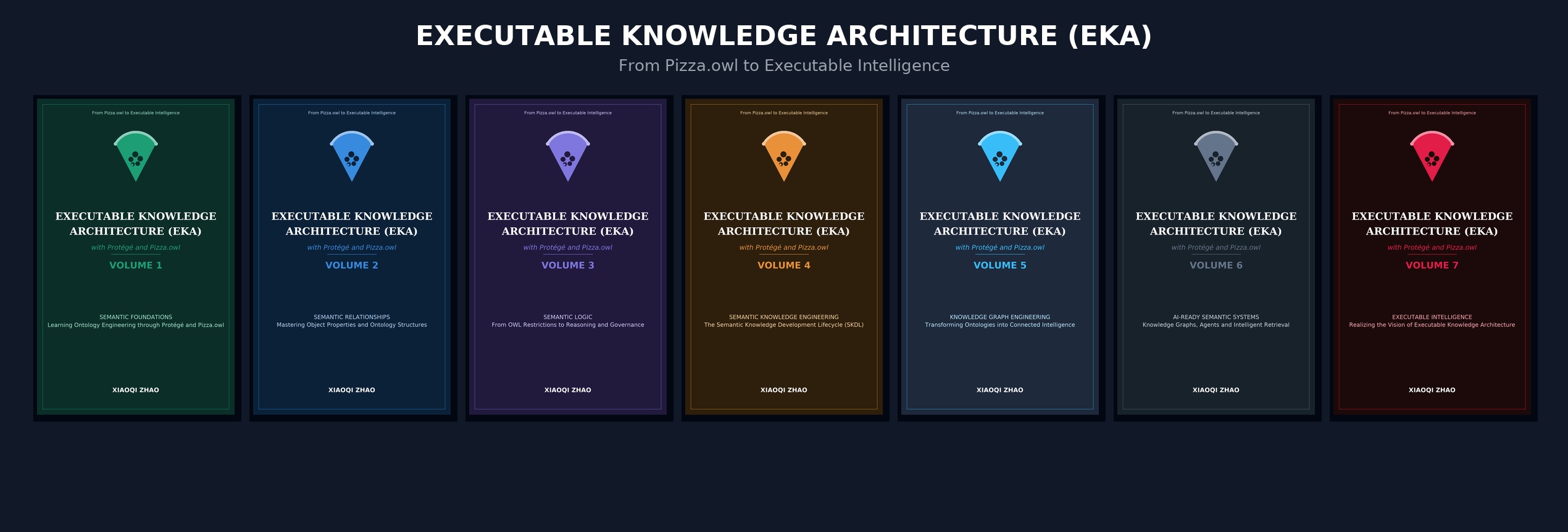
📚 Companion eBook Series
Executable Knowledge Architecture (EKA)
Mastering Ontology Engineering with Protégé and Pizza.owl
Volume 1 — Semantic Foundations
Learning Ontology Engineering through Protégé and Pizza.owl
Chapters 00-08
Introduces ontology engineering fundamentals, Protégé, RDF foundations, class hierarchies, semantic thinking, reasoning, and the EKA framework.
Volume 2 — Semantic Relationships
Mastering Object Properties and Ontology Structures
Chapters 09-13
Introduces object properties, inverse properties, property characteristics, domain, range, and semantic relationship design.
Volume 3 — Semantic Logic
OWL Restrictions, Reasoning and Governance
Chapters 14-16
Explores existential restrictions, universal restrictions, reasoning foundations, semantic requirements, and governance concepts.
Volume 4 — Semantic Knowledge Engineering
The Semantic Knowledge Development Lifecycle (SKDL)
Chapters 17-25
Introduces ontology engineering as a disciplined engineering process through the Semantic Knowledge Development Lifecycle.
Volume 5 — Knowledge Graph Engineering
Transforming Ontologies into Connected Intelligence
Chapters 26-30
Focuses on transforming ontologies into operational knowledge graphs and connected semantic systems.
Volume 6 — AI-Ready Semantic Systems
Knowledge Graphs, Agents and Intelligent Retrieval
Chapters 31-36
Connects ontologies, knowledge graphs, reasoning, retrieval, and agent-based architectures.
Volume 7 — Executable Intelligence
Realizing the Vision of Executable Knowledge Architecture
Chapters 37-42
Completes the transformation from semantic knowledge into executable intelligence systems.
👉 Read the Source Code & Markdown Files Directly
All raw chapters remain open-source and available under CC BY-NC-SA 4.0.
Read book source: /ebook/markdown/
🎓 Learning Path
This repository is a companion to the complete video series.
Recommended sequence:
Videos
↓
Repository Snapshots
↓
Markdown Chapters
↓
Companion eBooks
↓
Knowledge Graph Projects
↓
Executable Knowledge Architecture
🙏 Intellectual Heritage
This work stands on the shoulders of giants.
Special recognition goes to:
- Matthew Horridge
- Holger Knublauch
- Alan Rector
- Robert Stevens
- Chris Wroe
- Simon Jupp
- Georgina Moulton
- Nick Drummond
- Sebastian Brandt
and particularly:
Michael DeBellis
whose Pizza.owl tutorial remains one of the most influential practical introductions to ontology engineering ever created.
We are also honored to feature technical review and forewords from:
Timothy W. Cook Founder of SDC (Semantic Data Charter)
❤️ Final Thought
The journey begins with pizza.
But the real subject is meaning.
— Michael DeBellis
And in EKA:
The journey begins with Pizza.owl.
The destination is Executable Intelligence.
— EKA Project
Last updated at 2026-09-17