protege_pizza
Chapter 09 – Building Semantic Foundations Through Class Hierarchy
- Chapter Introduction
- 9.1 Why Class Hierarchy Matters in Ontology Engineering
- 9.2 Understanding Parent Classes and SubClasses
- 9.3 Creating Class Hierarchy in Protégé
- 9.4 Best Practices for Designing Semantic Hierarchy
- 9.5 Hierarchy and Reasoning: Why Structure Matters
- 9.6 EKA Perspective – Class Hierarchy as the Semantic Foundation of Knowledge Architecture
- 9.7 Practical Exercise – Building
Pizza.owlhierarchy - 9.8 Common Mistakes in Class Hierarchy Design
- Chapter (09) Summary
- Key Concepts
- Protégé Skills Learned
- Next Chapter (10) Preview
- Reference Demo Video
Chapter Introduction
After stepping beneath Protégé’s interface in Chapter 08 to understand RDF as the underlying language of semantic representation, we now return to practical ontology engineering with renewed perspective.
In earlier chapters, you gradually developed familiarity with Protégé, named classes, reasoning, and semantic integrity
However, one of the most important activities in ontology engineering still deserves deeper attention:
building a meaningful class hierarchy.
At first glance, creating class hierarchies may appear deceptively simple. In Protégé, it often feels like little more than creating folders or parent-child structure. Yet this dramatically under-estimates their importance.
In ontology engineering, a class hierarchy is not merely an organizational convenience. It represents the conceptual backbone of semantic meaning.
Hierarchy determines:
- How concepts inherit meaning
- How reasoners infer (new) knowledge
- How semantic consistency is maintained
- How knowledge graphs later organize relationships
- How enterprise concepts become machine-understandable
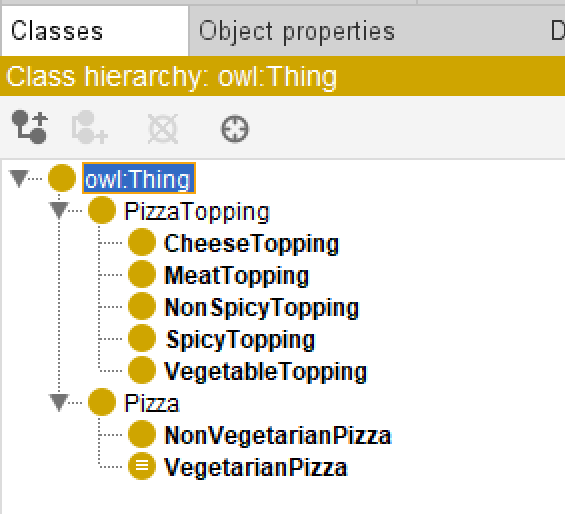
Within the Pizza ontology, hierarchy enables us to distinguish broad concepts such as Pizza and PizzaTopping, while progressively refining specialization into categories such as CheeseTopping, VegetableTopping, and MeatTopping.
The actual hierarchy in our ebook Pizza ontology so far shows like below:
This chapter aligns closely with the demonstration video and focuses on creating and refining class hierarchy in Protégé. Compared with Chapter 08’s theoretical detour into RDF specification, Chapter 09 intentionally returns to a practical modeling focus while integrating a broader EKA perspective.
From the viewpoint of Executable Knowledge Architecture (EKA), hierarchy design plays a foundational role in transforming conceptual models into executable knowledge.
Recall the EKA roadmap:
graph LR
A[Diagramming]-->B[Meta-Model]-->C[Ontology]
C-->D[Knowledge Graph]-->E[Executable Intelligence]
Hierarchy is where ontology begins transforming structure into semantic meaning.
Without meaningful hierarchy: knowledge becomes flat.
Without hierarchy: reasoning becomes weak.
Without hierarchy: knowledge graph loses semantic depth.
This chapter therefore focuses not merely on creating classes, but on understanding why hierarchy matters.
9.1 Why Class Hierarchy Matters in Ontology Engineering
One of the first questions ontology learners often ask is:
Why can’t we simply create all classes independently?
Technically, we could.
But doing so would eliminate one of ontology’s greatest strengths:
semantic inheritance.
Class hierarchy allows concepts to inherit characteristics from broader parent classes.
For example:
A CheeseTopping is also a PizzaTopping.
A MozzarellaTopping is also a CheeseTopping.
This means:
MozzarellaTopping inherits semantic meaning from both:
CheeseToppingPizzaTopping
This layered structure enables machines to understand categories naturally.
Without explicitly stating every rule repeatedly, hierarchy allows knowledge to scale efficiently.
Imagine an enterprise environment.
If every application, business, capability, value stream, process, regulation, and data object existed independently without hierarchy, enterprise knowledge would become chaotic.
Instead, semantic organization enables:
- Consistency
- Reuse
- Governance
- Reasoning
- Impact analysis
This explains why hierarchy becomes one of the most important modeling disciplines in ontology engineering.
Hierarchy is not decoration.
Hierarchy is semantic architecture.
9.2 Understanding Parent Classes and SubClasses
Ontology hierarchy operates through the relationship known as
subClassOf
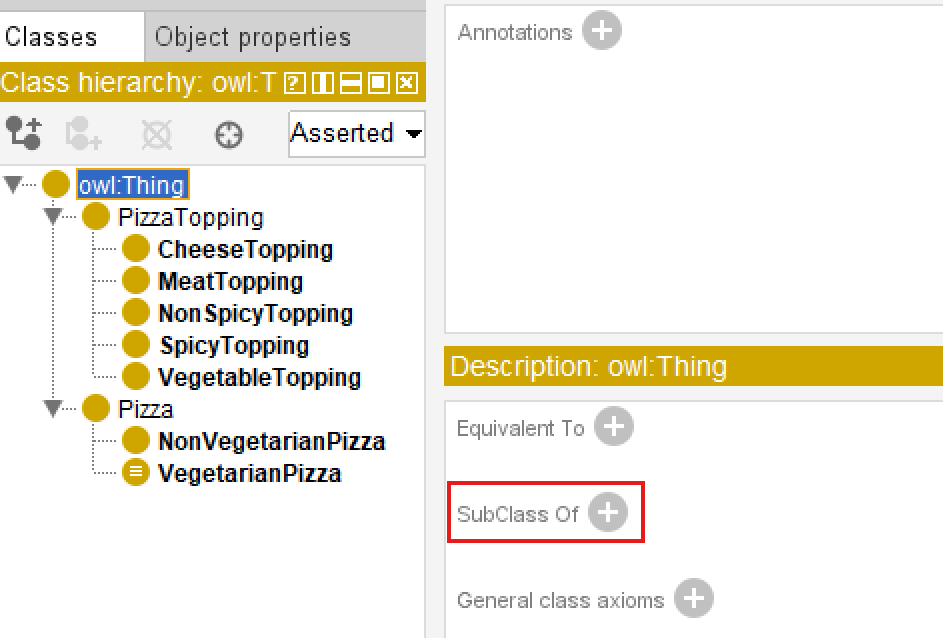
A subclass inherits characteristics from its parent class.
For example:
VegetarianPizza is a subclass of Pizza.
This means:
- Every
VegetarianPizzais also aPizza. - But not every
Pizzais necessarilyVegetarianPizza.
Visualizing with diagram often used in Set Theory, as below:
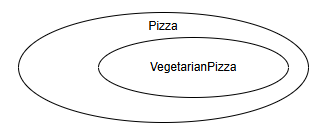
This directional logic is extremely important.
Hierarchy in ontology is not arbitrary grouping.
It represents formal logical specification.
Inside Protégé, this hierarchy becomes visible through nested structures in the Classes tab.
For example:
Pizza may contain:
NamedPizzaVegetarianPizzaNonVegetarianPizza
Meanwhile:
PizzaTopping may contain:
CheeseToppingMeatToppingVegetableToppingSeafoodTopping
Each level introduces progressively more specific meaning.
The reasoner later depends heavily on these hierarchical structures.
Poor hierarchy design often leads to weak semantic quality.
Strong hierarchy design strengthens inference capability.
9.3 Creating Class Hierarchy in Protégé
In the demonstration video, you focus on building hierarchy practically within Protégé.
The process appears simple:
- Select a parent class
- Create subclass
- Organize concepts under meaningful categories
However, ontology engineers should avoid rushing through hierarchy construction.
Good hierarchy design requires conceptual thinking.
Before creating subclasses, ask:
Is this truly a specialization?
Or:
Is this simply related information?
This kind of questions are more important when you are “reaching” the level of subclasses that would need to decide that should be individual instead.
For example:
MozzarellaTopping belongs under: CheeseTopping because mozzarella is a kind of cheese.
This represents as is-a relationship.
By contrast:
Pizza ingredients themselves are not subclasses of pizza.
They are separate concepts connected later through properties.
This distinction becomes critically important.
Ontology engineers frequently make mistakes by confusing:
- hierarchy relationships
- association relationships
Hierarchy means:
is-a
Association means:
connected-to
Understanding this difference dramatically improves ontology quality.
9.4 Best Practices for Designing Semantic Hierarchy
Professional ontology engineering requires hierarchy discipline.
Several practical guidelines can improve semantic quality.
Keep Hierarchy Meaningful
Every subclass should represent genuine specialization.
Ask:
Is the child concept genuinely a type of the parent?
If not, the hierarchy may be incorrect.
Avoid Flat Structures
Too many sibling classes under one parent create semantic chaos.
Instead of PizzaTopping containing dozens of direct subclasses, create intermediate categories.
For example:
- CheeseTopping
- MeatTopping
- VegetableTopping
- SeafoodTopping
This improves maintainability.
Think About Future Reasoning
Hierarchy impacts inference.
If reasoning will later classify pizzas according to toppings, hierarchy becomes strategically important.
Good hierarchy simplifies semantic intelligence.
Poor hierarchy limits automation.
Design for Reuse
Ontology is rarely static.
Future concepts should fit naturally into the hierarchy.
For example:
Adding ParmesanTopping later should be straightforward.
It naturally belongs under: CheeseTopping.
This scalability mindset becomes essential in enterprise ontology engineering.
9.5 Hierarchy and Reasoning: Why Structure Matters
Chapter 06 introduced reasoners.
At that stage, you observed how reasoners infer semantic relationships.
What now becomes clearer is this:
Reasoners are only as powerful as the hierarchy they operate upon.
Consider the following hierarchy:
MozzarellaTopping
↓
CheeseTopping
↓
PizzaTopping
A reasoner immediately understands:
MozzarellaTopping is also PizzaTopping.
This inherited understanding enables semantic inference.
Without hierarchy, every concept would require manual specification.
Reasoners would lose much of their intelligence.
This explains why hierarchy design should never be treated casually.
Hierarchy becomes the semantic infrastructure supporting inference.
9.6 EKA Perspective – Class Hierarchy as the Semantic Foundation of Knowledge Architecture
Within the EKA framework, hierarchy design represents a major transition point.
During:
Diagramming
Concepts remain visual.
Relationships are often informal.
During:
Meta-Modeling
Structural rules emerge.
Concept categories become clearer.
But once we enter:
Ontology
Hierarchy introduces semantic precision.
Now concepts gain:
- inheritance
- classification
- formal logic
- machine interpretability
This becomes foundational for:
Knowledge Graph
Why?
Because graph structure alone is insufficient.
Graphs without semantics become merely connected data.
While ontology hierarchy provides:
semantic depth
Knowledge graph implementation later depends heavily on these inherited semantic relationships.
For example:
In Neo4j, a hierarchy may later support:
- dependency tracing
- recommendation logic
- classification automation
- semantic search
- intelligent navigation
Without meaningful hierarchy: enterprise knowledge remains shallow.
With hierarchy: knowledge becomes executable.
This is exactly why hierarchy matters in EKA.
Ontology is not merely organizing concepts.
It is engineering semantic intelligence.
9.7 Practical Exercise – Building Pizza.owl hierarchy
To reinforce understanding, you should recreate the hierarchy demonstrated in the video.
Practical steps include:
- Open
Pizza.owlin Protégé - Review existing top-level classes
- Create subclasses under
PizzaandPizzaTopping - Organize topping categories logically
- Review whether each subclass represents a true “
is-a” relationship - Run the reasoner to observe inherited semantic meaning
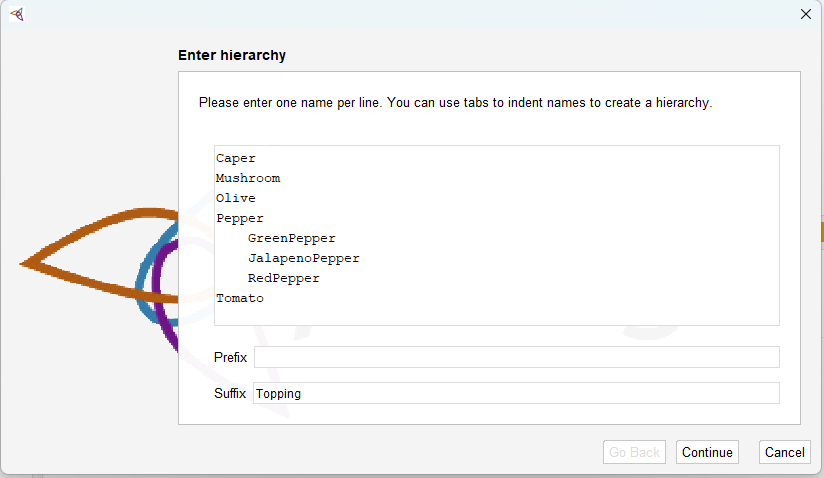
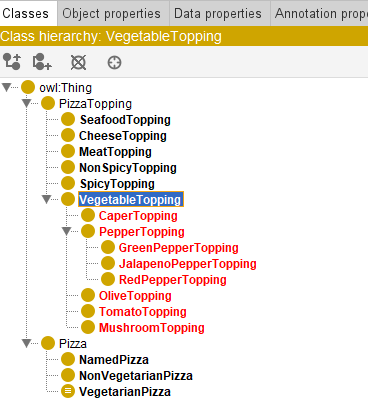
Using Tools > Create Class Hierarchy..., below screen creates subclasses of VegetableTopping, note you can use either Prefix or Suffix to save your time:
After above sample batch creation, below is the class hierarchy then:
During this exercise, avoid treating hierarchy as a simple tree.
Instead, think critically:
What semantic meaning is being inherited?
This mindset shift is essential for becoming a professional ontology engineer.
9.8 Common Mistakes in Class Hierarchy Design
Beginners frequently make several hierarchy mistakes.
Mistake 1 -- Confusing Relationship Types
Treating ingredients as subclasses of pizza.
This violates semantic logic.
Ingredients are associated with pizzas.
They are not types of pizza.
Mistake 2 -- Overly Flat Structures
Creating dozens of direct subclasses under one concept.
This reduces maintainability.
Think about how many direct reports recommended in real company organization hierarchy.
Mistake 3 -- Incorrect Specialization
Creating subclasses that are not genuine specializations.
Always ask:
Is this truly a kind of the parent?
Mistake 4 -- Ignoring Future Scalability
Hierarchy should anticipate future extension.
Enterprise ontologies constantly evolve.
Planning for extensibility improves long-term sustainability.
Chapter (09) Summary
In this chapter (09), you focused on one of ontology engineering’s most important foundations:
Class hierarchy design.
You explored:
- Why hierarchy matters in semantic systems
- How subclass relationships create inheritance
- How to create hierarchy in Protégé
- The distinction between hierarchy and association
- Best practices for semantic hierarchy design
- How hierarchy strengthens reasoning
- Why hierarchy matters in the EKA roadmap toward Knowledge Graphs
More importantly, you began seeing hierarchy not as visual organization but as:
semantic architecture.
This perspective becomes increasingly important as ontology complexity grows.
Strong hierarchy leads to strong reasoning.
Strong reasoning enables stronger knowledge graphs.
And stronger knowledge graphs ultimately support:
Executable Intelligence.
Key Concepts
| Concepts | Description |
|---|---|
| Class Hierarchy | A class hierarchy is the structured organization of ontology concepts into parent-child relationships, where broader classes are specialized into more specific subclasses to support semantic organization and reasoning. |
| subClassOf Relationship | A subClassOf Relationship defines an “is-a” relationship between classes, where a subclass inherits meaning from a parent class. For example, VegetarianPizza is a subclass of Pizza. |
| Semantic Inheritance | Semantic Inheritance is the ability of subclasses to inherit characteristics and meaning from parent classes, reducing redundancy and enabling consistent knowledge representation. |
| Parent Class vs Subclass | A Parent Class represents a broader concept, while a SubClass is a more specific specialization that inherits semantic meaning from it’s parent. |
| Ontology Structure | Ontology Structure refers to the overall organization of classes, relationships, rules, and hierarchy that together define semantic meaning in an ontology. |
| Hierarchical Reasoning | Hierarchical Reasoning is the process where reasoners infer knowledge through class hierarchies, automatically understanding inherited relationships between concepts. |
| EKA Ontology Foundation | The EKA Ontology Foundation represents ontology’s role in the EKA roadmap, transforming structured concepts into machine-understandable semantic knowledge for Knowledge Graphs and Executable Intelligence. |
Protégé Skills Learned
- Creating parent and child classes
- Designing semantic hierarchy
- Organizing ontology structures
- Applying hierarchy best practices
- Preparing ontology for object properties and reasoning
Next Chapter (10) Preview
In the next chapter (10), we introduce one of the most important ontology concepts:
Object Properties.
If hierarchy helps us classify concepts, object properties help us connect them.
You will begin defining meaningful semantic relationships such as:
Pizza hasTopping CheeseTopping
This marks an important transition in ontology engineering.
Until now, ontology has focused primarily on classification.
Beginning in Chapter 10, ontology becomes relational.
Concepts no longer exist in isolation.
They begin interacting through semantic relationships, laying an important foundation for reasoning, RDF triples, and future Knowledge Graph implementation in EKA.
Reference Demo Video
Demo video reference: Chapter 09 - https://youtu.be/FQdjYQMqfBI
Last updated at: 2026-06-25