protege_pizza
Chapter 11 – Strengthening Semantic Intelligence Through Inverse Properties
- Chapter Introduction
- 11.1 Why One-Way Relationships Are Not Enough Any More
- 11.2 What Are Inverse Properties?
- 11.3 Understanding Bi-directional Semantics
- 11.4 Configuring Inverse Properties in Protégé
- 11.5 Exercise 10 – Extending
Pizza.owlThrough Inverse Relationships - 11.6 How Reasoners Benefit from Inverse Properties
- 11.7 RDF Perspective – One Semantic Truth, Multiple Directions
- 11.8 Enterprise Architecture Analogy – Dependency Intelligence in EKA
- 11.9 Common Modeling Mistakes with Inverse Properties
- 11.10 EKA Perspective – From Connected Knowledge to Navigable Intelligence
- 11.11 Practical Exercise – Validating Inverse Reasoning in
Pizza.owl - Chapter (11) Summary
- Key Concepts
- Protégé Skills Learned
- Next Chapter (12) Preview
- Demo Video for this Chapter
Chapter Introduction
In the previous chapter (10), you have been introduced to one of ontology engineering’s most important capabilities:
Object Properties.
For the first time in the Pizza.owl journey, ontology evolved beyond isolated classification and began expressing meaningful semantic relationships.
Until Chapter 09, ontology was primarily concerned with:
what things are.
A pizza was classified as a pizza.
A topping belonged to a topping hierarchy.
A mozzarella topping inherited meaning from cheese topping.
Hierarchy enabled semantic organization.
However, beginning in Chapter 10, ontology shifted focus toward another important question:
How do concepts interact?
Instead of merely organizing concepts into categories, you began formally expressing relationships such as:
Pizza hasTopping CheeseTopping
This marked a significant transition.
Ontology no longer resembled a semantic dictionary.
It began behaving more like:
a semantic network.
Concepts starts becoming connected.
Relationships started becoming machine-readable.
And ontology started becoming increasingly intelligent.
Yet despite this important progress, an important limitation still exists.
Relationships currently operate in only ONE DIRECTION.
For example:
If ontology understands:
Pizza hasTopping CheeseTopping
Can ontology also automatically understand:
CheeseTopping isToppingOf Pizza?
For humans, this feels obvious. People naturally understand relationships from both directions.
However, machines require explicit semantic guidance.
Without additional semantic definition, ontology may understand only:
Pizza $\rightarrow$ hasTopping $\rightarrow$ CheeseTopping
But not necessarily:
CheeseTopping $\rightarrow$ isToppingOf $\rightarrow$ Pizza
This limitation introduces one of the next important maturity steps in OWL:
Inverse Properties.
Inverse properties enable ontology to understand relationships from opposite perspectives.
- They strengthen semantic navigation.
- They improve inference capability.
- They reduce modeling redundancy, and
- Perhaps most importantly: they help transform ontology from connected knowledge into navigable semantic intelligence.
From the perspective of Executable Knowledge Architecture (EKA), this chapter represents another important progression point.
Recall the EKA roadmap:
flowchart LR
A[Diagramming]-->B[Meta-Model]-->C[Ontology]-->D[Knowledge Graph]-->E[Executable Intelligence]
At the ontology stage, semantic relationships are becoming increasingly sophisticated.
Earlier: Hierarchy provided semantic organization.
Then: Object properties introduced connectivity.
Now: Inverse properties introduce:
bidirectional semantic meaning.
This matters enormously for future Knowledge Graph implementation.
Because graph intelligence often depends not merely on connections, but on:
traversable relationships.
In enterprise architecture, organizations rarely ask only:
What systems support this process?
They may also ask:
Which processes depend upon this system?
Likewise:
They rarely ask only:
Which application owns data?
They may also ask:
Which data domains are owned by this application?
This ability to move in multiple semantic directions dramatically improves intelligence, dependency analysis, and reasoning.
Chapter 11 therefore focuses not merely on how to configure inverse properties inside Protégé.
Instead, this chapter explores something deeper:
how bidirectional semantic thinking strengthens ontology intelligence.
11.1 Why One-Way Relationships Are Not Enough Any More
At first glance, object properties introduced in Chapter 10 may appear sufficient.
After all:
We already defined meaningful relationships.
For example:
Pizza hasTopping CheeseTopping
This seems complete.
A pizza contains toppings.
The relationship is clear.
So why introduce inverse properties?
The answer lies in understanding how machines reason.
Human thinking naturally interprets relationships from multiple perspective.
If someone says:
Alice works for Company X
People immediately understand:
Company X employs Alice
Even if the second statement was never explicitly spoken.
Humans infer meaning naturally, in human brain (minds).
Machines DO NOT!
Semantic systems require formal logic.
Without inverse relationships, ontology may understand only one semantic direction.
For example:
Ontology may know:
MargheritaPizza hasTopping MozzarellaTopping
But if a query asks:
Which pizzas use Mozzarella?
The system may struggle unless additional semantic information exists.
Inverse properties solve this problem elegantly.
They allow ontology to understand.
if A relates to B
then:
B relates back to A
This dramatically improves semantic flexibility.
Relationships become:
navigable.
And navigability is one of the defining characteristics of intelligent knowledge systems.
Consider enterprise architecture.
Imagine an application dependency model.
We may define:
Application supports BusinessProcess
But organizations frequently need the reverse question:
Which business process depend on this application?
Without inverse semantics, reverse analysis becomes difficult.
With inverse semantics: knowledge becomes easier to explore.
This is precisely why inverse properties matter.
They improve:
Ontology Usability.
11.2 What Are Inverse Properties?
An Inverse Properties is a semantic relationship that represents the opposite direction of another object property.
In simple terms:
If one property says:
A relates to B
An inverse property says:
B relates back to A
For example:
Inside Pizza.owl:
We may define:
Pizza hasTopping PizzaTopping
Its inverse may become:
PizzaTopping isToppingOf Pizza
Notice something important.
These are not separate meanings.
They represent:
the same semantic relationship
viewed from different perspectives.
This distinction matters!
Inverse properties are not duplication.
They are:
semantic mirrors.
A mirror does not create new reality.
It reflects an existing relationship from another angle.
Ontology engineers should think similarly.
The inverse property does not introduce a new business rule.
It enhances semantic accessibility.
This subtle idea is often misunderstood by beginners.
Some learners mistakenly believe inverse properties create new meaning.
In reality:
Inverse properties improve:
- navigation
- inference
- query capability
- semantic expressiveness
while preserving consistency.
From a reasoning perspective, this becomes extremely powerful.
For example:
If ontology understands:
SeafoodPizza hasTopping TunaTopping
And:
hasToppingis inverse ofisToppingOf
The ontology may automatically infer:
TunaToppingisToppingOfSeafoodPizza
without explicitly defining the second relationship.
This demonstrates one of OWL’s greatest strengths:
knowledge can be inferred.
Ontology does not merely store information.
Ontology produces additional meaning.
11.3 Understanding Bi-directional Semantics
To fully appreciate inverse properties, ontology engineers must shift their thinking.
Traditional systems often model relationships linearly.
A database foreign key points in one direction.
A UML arrow may imply a relationship.
But ontology thinking is fundamentally different.
Ontology models:
semantic meaning.
Meaning naturally exists in multiple directions (like human thinking in brain).
For example:
Suppose we define:
Employee worksFor Organization
Immediately:
Another meaningful perspective appears:
Organization employs Employee
Neither statement is incorrect.
Both, represent:
one semantic reality.
This bidirectional perspective becomes critically important in large knowledge systems.
Because intelligent systems rarely ask questions from only one viewpoint.
In enterprise environments, Stakeholders continuously ask reverse questions.
Examples include:
Which systems support this capability?
And also:
Which capabilities depend upon this systems?
When you build one management dashboard, information from both directions should be provided, as below sample we delivered in PowerBI:

Or:
Which regulations govern this process?
And also:
Which processes are impacted by this regulation?
These reverse navigation become essential for:
- impact analysis
- dependency tracing
- governance
- architecture intelligence
- operational visibility
This same logic exists inside Pizza.owl.
At first glance:
Pizza examples may appear simplistic.
However, Pizza.owl is teaching something much deeper.
It teaches:
semantic thinking.
Pizza simply acts as the learning vehicle.
The real lesson concerns how machines understand relationships.
And inverse properties represent one of the first major steps toward semantic maturity.
With those knowledge to machine, it is feasible to see one machine (robot) understand how to make one professional pizza for you, which already in real life nowadays.
11.4 Configuring Inverse Properties in Protégé
Inside Protégé, inverse properties are relatively straightforward to configure.
However, you should avoid treating this merely as software configuration.
Inverse properties are:
semantic modeling decisions.
Inside the Object Properties tab, ontology engineers can define:
- a property
- its inverse property
- semantic directionality
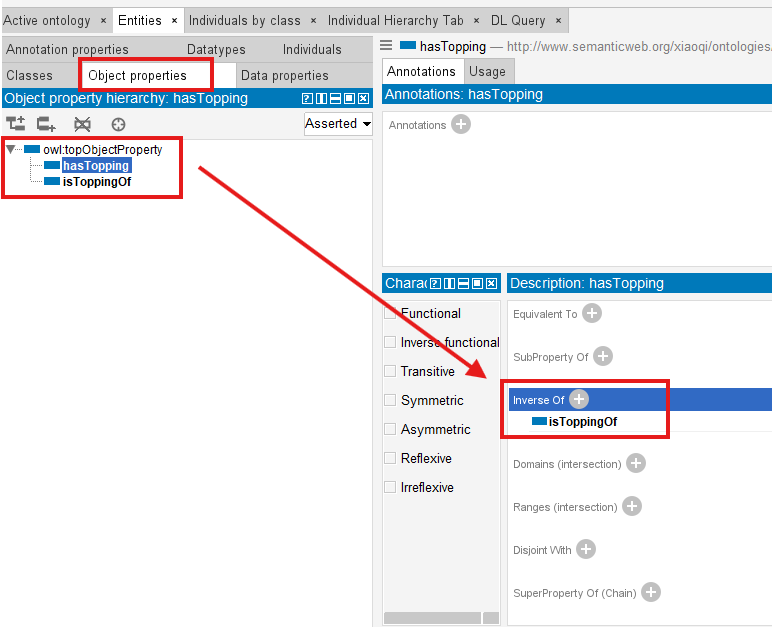
For example in above screenshot:
You may create:
hasTopping
And configure:
isToppingOf
as its inverse.
Once defined, Protégé and ontology reasoners begin understanding that both properties represent opposite perspectives of the same semantic relationship.
This dramatically reduces manual effort.
Without inverse properties, ontology engineers might repeatedly model both directions manually.
This creates:
- redundancy
- inconsistency risks
- maintenance complexity
Inverse semantics simplify the model.
And simplification improves maintainability.
This principle becomes increasingly important as ontology grows.
In enterprise-scale semantic systems containing thousands of relationships, maintainability matters enormously.
A poorly designed ontology quickly becomes difficult to govern.
Inverse properties therefore support:
scalable semantic architecture.
From an EKA perspective, this aligns strongly with enterprise knowledge governance.
Knowledge must remain:
- understandable
- maintainable
- reusable
Inverse properties contribute to all three.
11.5 Exercise 10 – Extending Pizza.owl Through Inverse Relationships
In Michael DeBellis’ Pizza.owl tutorial, Exercise 10 introduces you to inverse properties through practical modeling.
This represents an important learning milestone.
Until now, you have already explored:
- class hierarchy
- reasoning
- named classes
- object properties
Exercise 10 now extends semantic richness.
Rather than simply connecting pizzas and toppings, ontology begins understanding relationships bidirectionally.
Within the Pizza ontology, you revisit familiar semantic relationships and enhance them using inverse semantics.
For examples:
Instead of only:
Pizza hasTopping Topping
Ontology now understands:
Topping isToppingOf Pizza
This seemingly small enhancement introduces meaningful consequences.
Semantic queries improve.
Reasoning improves.
Navigation improves.
Ontology intelligence improves.
One of the greatest strengths of the Pizza.owl tutorial lies in its incremental learning design.
Michael intentionally introduces concepts progressively.
You first understand hierarchy.
Then relationships.
Only afterward: bidirectional relationships.
This learning sequence matters.
Because ontology engineering is cumulative.
Semantic complexity builds layer by layer.
From the EKA perspective, Exercise 10 also represents an important transition.
Ontology begins behaving more like:
a graph.
And graphs derive much of their power from:
traversal.
Traversal means:
moving through connected knowledge (node in a graph).
Inverse properties strengthen traversal capability.
This becomes especially important later for:
Knowledge Graph implementation.
Because graph systems frequently support:
forward exploration.
and:
reverse exploration.
For example:
A Neo4j knowledge graph may ask:
Which applications support this capability?
And also:
Which capabilities are affected if this application changes?
Inverse semantic thinking prepares ontology engineers for this future mindset.
11.6 How Reasoners Benefit from Inverse Properties
One of the most powerful aspects of OWL ontology is its ability to reason.
Reasoners do not simply validate consistency.
They infer knowledge!
Inverse properties significantly strengthen this capability.
When inverse relationships exist, reasoners gain additional semantic context.
For example:
If ontology explicitly knows:
Pizza hasTopping CheeseTopping
and:
hasTopping inverseOf isToppingOf
The reasoner may automatically infer:
CheeseTopping isToppingOf Pizza
Notice something important.
We never manually declared the second statement (triple).
The ontology inferred it.
This distinction illustrates one of the most powerful characteristics of semantic systems:
ontology generates knowledge.
Rather than acting only as storage, reasoners therefore become increasingly intelligent as semantic richness grows.
Inverse properties contribute significantly to this richness.
In practical enterprise contexts, this capability becomes transformative.
Imagine enterprise architecture reasoning.
If ontology knows:
Application supports Capability
And inverse semantics exist.
The system may automatically understand:
Capability supportedBy Application
This dramatically improves:
- dependency analysis
- architecture intelligence
- impact assessment
- semantic querying
Within EKA, this represents another important movement toward:
Executable Intelligence.
Because intelligent execution depends upon:
connected and inferable knowledge.
11.7 RDF Perspective – One Semantic Truth, Multiple Directions
In Chapter 08, you explored RDF as the underlying language behind OWL ontologies. At that stage, the focus was primarily theoretical:
understanding how semantic information is represented.
Now, inverse properties allow us to revisit RDF from a more practical perspective.
Every semantic relationship in ontology ultimately becomes:
an RDF triple.
Recall the fundamental RDF structure:
Subject $\rightarrow$ Predicate $\rightarrow$ Object
For example:
Pizza $\rightarrow$ hasTopping $\rightarrow$ CheeseTopping
At first glance, RDF appears directional.
And technically, it is.
The relationship (predicate) flows from subject to object.
However, semantic meaning often exists in multiple perspectives.
This is precisely where inverse properties become powerful.
Rather than manually redefining both directions, ontology allows semantic equivalence between relationships.
For example:
If:
Pizza $\rightarrow$ hasTopping $\rightarrow$ CheeseTopping
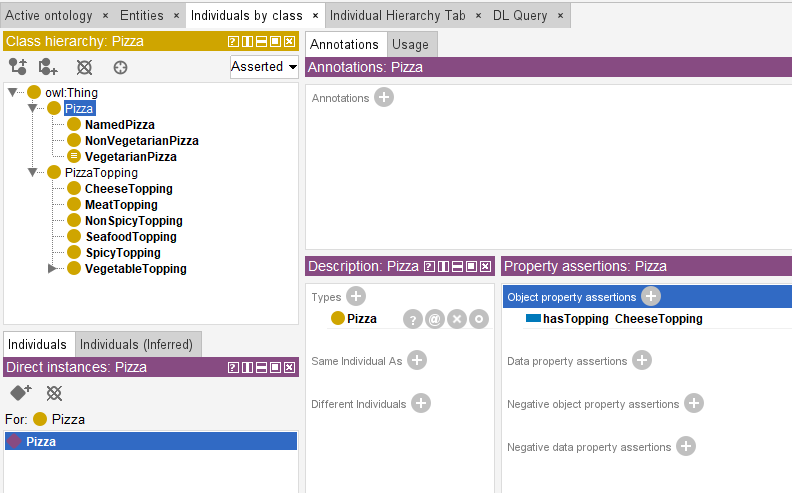
and:
hasTopping inverseOf isToppingOf
Ontology may semantically understand:
CheeseTopping $\rightarrow$ isToppingOf $\rightarrow$ Pizza
without manually asserting the second triple.
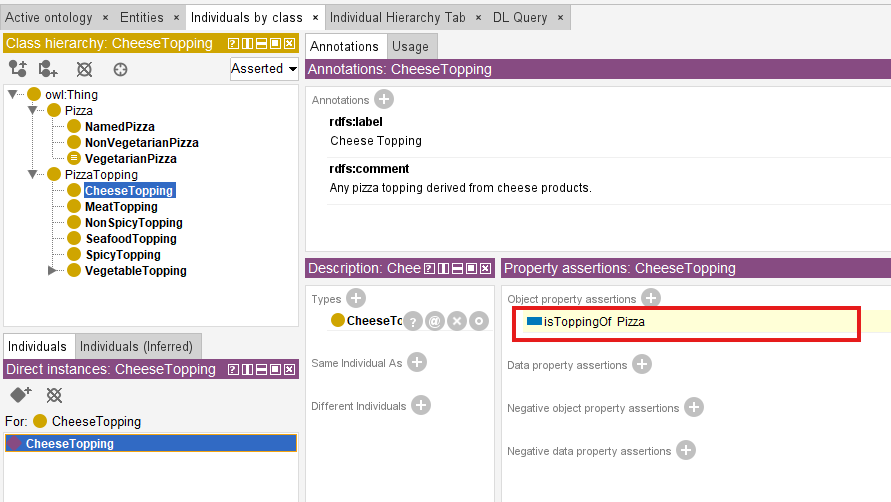
This distinction matters greatly.
Because semantic systems are not merely connected with storing statements.
They aim to support:
flexible knowledge navigation.
Ontology engineers should therefore begin thinking beyond simple RDF triples.
Instead, start thinking in terms of:
semantic movement.
Knowledge should be traversable.
Users should be able to move naturally through relationships.
This mindset becomes increasingly important when ontology evolve into:
Knowledge Graph implementation.
Because graph systems fundamentally depend upon traversal.
And traversal becomes dramatically stronger when semantic relationships can be explored from multiple directions. (means you can go from one node and back to it via inverse routing, romantic? Yes!)
This explains why inverse properties are not optional enhancements.
They are:
semantic accelerators.
11.8 Enterprise Architecture Analogy – Dependency Intelligence in EKA
Although Pizza.owl provides an approachable learning environment, the real value of ontology emerges when you transfer semantic thinking into enterprise-scale domains.
Inside EKA, inverse properties become extraordinarily valuable.
Why?
Because enterprise architecture depends heavily upon:
dependency intelligence.
Organizations constantly ask inter-connected questions:
For example:
- A business capability may depend upon an application.
- An application may depend upon a technology platform.
- A platform may host critical data/information.
- Regulations may govern business processes.
- Processes may support customer journeys.
- Customer journeys may drive value streams.
- Value streams leads to initiative (programme/projects)
Everything connects.
And importantly: relationships rarely matter in only one direction.
Consider a simple enterprise example.
Suppose ontology defines:
Application supports Capability
This immediately enables useful analysis.
Organizations can start asking:
Which applications support customer onboarding?
However, equally important reverse questions emerge:
Which capabilities are affected if this application fails?
Without inverse semantics, reverse analysis becomes cumbersome.
Ontology engineers may need redundant queries or duplicated modeling.
Inverse properties elegantly solve this challenge.
By defining:
supports inverseOf supportedBy
semantic navigation improves dramatically.
Now organizations gain:
bidirectional dependency intelligence.
This becomes especially important for:
- strategic planning
- impact analysis
- risk management
- architecture governance
- modernization roadmapping
- technical debt analysis
- business continuity assessment
For example:
Inside an EKA knowledge graph:
A deprecated application may automatically reveal:
- impacted capabilities
- impacted processes
- impacted business services
- impacted integrations
- impacted stakeholders
This ability to traverse semantic knowledge bi-directionally transforms enterprise architecture from:
static documentation
into:
executable intelligence.
And this is one of the deeper reasons Chapter 11 (this one) matters.
At first glance:
Inverse properties may seem like a technical OWL feature.
In reality:
They introduce an important architecture principle:
knowledge becomes more intelligent when relationships become navigable!
11.9 Common Modeling Mistakes with Inverse Properties
Because inverse properties initially appear simple, learners often underestimate their modeling importance.
Several common mistakes frequently emerge.
11.9.1 Mistake 1 – Treating Inverse Properties as Duplicate Relationships
Beginners sometimes mistakenly believe inverse properties create entirely separate business meaning.
For example:
They may define:
hasTopping
and
isToppingOf
as unrelated properties.
This weakens semantic consistency.
Remember:
Inverse properties represent:
one semantic truth
just seen from different perspectives.
They should remain conceptually aligned.
Ontology engineers should ask:
Are these relationships truly opposites of the same meaning?
If the answer is NO: they may not be inverse properties.
11.9.2 Mistake 2 – Overengineering Reverse Relationships
Not every property requires an inverse.
This is important.
Ontology engineers should avoid introducing unnecessary complexity.
Inverse properties provide value when:
reverse semantic navigation matters.
Inside our Pizza.owl: hasTopping naturally benefits from isToppingOf.
But not every semantic property requires such treatment.
Professional ontology engineering values:
purposeful modeling. (or say “good-enough modeling”)
Not maximal modeling.
11.9.3 Mistake 3 – Weak Semantic Naming
Inverse relationships should communicate meaning clearly.
For example:
Good semantic naming:
hasTopping $\leftrightarrow$ isToppingOf
Poor naming:
relationA $\leftrightarrow$ relationB
Meaningful names improve:
- readability
- governance
- maintainability
- collaboration
This becomes especially important in enterprise ontologies when hundreds, thousands or even millions of relationships may exist.
11.9.4 Mistake 4 – Forgetting Reasoner Validation
After defining inverse properties, you should always validate behavior through reasoning.
Ontology engineering is not merely configuration.
It requires:
semantic verification.
So keep asking:
Did this reasoner infer the reverse relationship correctly?
If not: review the inverse configuration.
Reasoners become essential partners in ontology quality assurance.
11.10 EKA Perspective – From Connected Knowledge to Navigable Intelligence
From the perspective of EKA, chapter 11 represents another meaningful evolution point.
Earlier chapters focused primarily on:
organizing knowledge.
Then:
connecting knowledge.
Now:
ontology begins supporting:
navigable knowledge.
This distinction matters.
Because enterprise intelligence depends heavily upon exploration.
Organizations rarely seek isolated facts.
Instead, they ask chains of connected questions.
For example:
Which application systems support this business capability?
Then:
Which teams own those application systems?
Then:
What kind of risks emerge if modernization occurs?
Then:
Which regulations govern affected processes?
This kind of semantic exploration depends upon:
relationship traversal.
Inverse properties dramatically strengthen traversal capability.
They make semantic network feel:
natural.
Within EKA, this becomes increasingly important during transition from:
flowchart LR
A[Ontology]-->B[Knowledge Graph]
Knowledge Graphs are valuable precisely because relationships become explorable.
Users can move through knowledge.
Patterns emerge.
Dependencies become visible.
Impact analysis becomes intelligent.
Without inverse semantics: graph navigation feels incomplete.
With inverse semantics: knowledge becomes bidirectionally traversable.
This helps transform ontology into:
connected operational intelligence.
And connected operational intelligence ultimately supports:
Executable Intelligence.
Thus, Chapter 11 quietly introduces something profound.
Ontology is beginning to think more like:
a living knowledge system.
11.11 Practical Exercise – Validating Inverse Reasoning in Pizza.owl
To reinforce understanding, you should revisit Pizza.owl and validate inverse semantics directly.
This practical exercise helps you bridge theory and implementation.
Suggested learning flow:
- Open
Pizza.owlinside Protégé - Navigate to the Object Properties tab
- Locate the
hasToppingrelationship - Define or review its inverse relationship
isToppingOf - Run the ontology reasoner
- Observe inferred semantic relationships
- Confirm whether reverse navigation appears correctly
During this exercise, pay close attention to reasoning behavior.
Ask yourself:
Did ontology infer the reverse relationship automatically?
If yes:
you are observing one of OWL’s most powerful capabilities:
semantic inference.
This moment is important.
Because ontology stops feeling static.
Instead: knowledge begins behaving dynamically (executable).
Relationships becomes intelligent.
Meaning becoming connected.
And ontology begins acting more like:
a semantic engine.
This shift in perception is one of the most valuable outcomes of the Pizza.owl learning journey.
Chapter (11) Summary
In this chapter (11), you explored one of OWL’s most important semantic capabilities:
Inverse Properties.
Building upon Chapter 10’s introduction to object properties, Chapter 11 extended semantic relationships into:
bidirectional meaning.
You learned:
- Why one-way relationships are insufficient
- What inverse properties are
- How bidirectional semantics improve ontology intelligence
- How to configure inverse properties in Protégé
- How Exercise 10 strengthens
Pizza.owlthrough inverse relationships - Why reasoners benefit from inverse semantics
- How RDF thinking supports semantic navigation
- Why inverse relationships matter in EKA and Knowledge Graph implementation
Most importantly, this chapter introduced a new ontology mindset.
Ontology is not simply about:
storing semantic relationships.
Ontology is increasingly about:
navigating meaning.
And navigable meaning becomes foundational for:
Knowledge Graph intelligence.
Within EKA, Chapter 11 marks another important transition:
from connected knowledge
toward:
navigable semantic intelligence.
Key Concepts
| Concept | Description |
|---|---|
| Inverse Property | A semantic relationship representing the opposite direction of another object property. |
| Bidirectional Semantics | The ability for ontology to understand relationships from multiple perspectives. |
| Semantic Navigation | The process of exploring knowledge through connected relationships, also called “semantic traversal”. |
| Relationship Traversal | Moving through ontology relationships to discover connected meaning. |
| Inferred Relationship | A relationship automatically generated by a reasoner rather than explicitly defined. |
| Exercise 10 Extension | The Pizza.owl learning step introducing inverse relationships for richer semantic modeling. |
| RDF Triple Perspective | Understanding semantic relationships through Subject $\rightarrow$ Predicate $\rightarrow$ Object structures. |
| EKA Navigable Intelligence | The stage in EKA where semantic relationships become explorable and operationally valuable. |
Protégé Skills Learned
- Creating inverse properties
- Configuring bidirectional relationships
- Working with
inverseOfsemantics - Validating inferred relationships using a reasoner
- Exploring semantic navigating in Protégé
- Strengthening ontology intelligence through relationship design
Next Chapter (12) Preview
In the next Chapter (12), you will explore another important OWL capability:
Object Property Characteristics.
If object properties define relationships and inverse properties strengthen semantic navigation, object property characteristics define:
how relationships behave.
You will explore semantic behaviors such as:
- functional relationships
- transitive relationships
- symmetric relationships
- inverse functional relationships
These characteristics significantly strengthen ontology intelligence and reasoning capability.
From the EKA perspective, this chapter (12) introduces another important maturity layer:
semantic behavior modeling.
Ontology will increasingly move from:
connected knowledge
toward:
behavior-aware semantic systems.
Demo Video for this Chapter
Chapter 11 - Inverse Properties - Demo Video:
- YouTube: https://youtu.be/cqQ8uqRjhNQ
Last updated at: 2026-06-26