protege_pizza
Chapter 14 – Semantic Requirements – From Existential Restrictions to Universal Rules
Table of Contents:
- 14.1 Chapter Introduction – From Semantic Boundaries to Semantic Requirements
- 14.2 Why RDF and RDFS Are Not Enough
- 14.3 Property Restrictions – Introducing Semantic Logic in OWL
- 14.4 Quantifier Restriction – Understanding Existential and Universal Logic
- 14.5 Existential Restriction in
Pizza.owl– Understanding Tutorial 4.10.1 and 4.10.2 - 14.6 Exercise 13 Walkthrough – Creating Semantic Requirements in Protégé
- 14.7 Understanding Reasoning Outcomes – Asserted vs. Inferred Semantics
- 14.8 Universal Restriction – Understanding
only - 14.9 Combining
someandonly– The ClassicVegetarianPizzaPattern - 14.10 Implementing
someandonlyin Graph Database - A Neo4j Perspective- 14.10.1 Implementing Existential Restriction (
some) in Neo4j - 14.10.2 Implementing Universal Restriction (
only) in Neo4j - 14.10.3 Combining
someandonlyin Neo4j - 14.10.4 Cypher Query vs. Pellet Reasoner vs. Open World Assumption
- Part 1: Existential Restriction (
some) – “At Least One Must Exist” - Part 2: Universal Restriction (
only) – “Everything Must Conform” - Part 3: Combining
someandonly– The Composite Pattern - Part 4: Integrated Comparison -
somevsonlyAcross Both Worlds - Part 5: Why the Difference Matters - From Query to Reasoning
- Part 6: Practical Guidance - When to Use Each Approach
- Summary: The Logical Bridge Between Sections 14.10.1~14.10.3 and True OWL Reasoning
- Part 1: Existential Restriction (
- 14.10.1 Implementing Existential Restriction (
- 14.11 EKA Perspective – Restriction as Semantic Governance
- 14.11.1 Restriction and the Knowledge Graph Layer ($K$)
- 14.11.2 Restriction and the Reasoning \& Rules Layer ($R$)
- 14.11.3 Restriction and the Trigger Layer ($\Theta$)
- 14.11.4 Restriction and the Execution Layer ($\Phi$)
- 14.11.5 Restriction and the Governance Layer ($\Gamma$)
- 14.11.6 Restriction as the Foundation of Executable Intelligence
- 14.12 EKA Learning Progression Across Chapters
- 14.13 Common Mistakes in Restriction Modeling
- 14.13.1 Confusing
somewith `only - 14.13.2 Assuming Closed World Behavior
- 14.13.3 Forgetting the Difference Between
EquivalentToandSubClassOf - 14.13.4 Misunderstanding Governance vs Validation – OWL vs SHACL
- === Interesting Reading: A First Look at SHACL ===
- 14.13.5 Overusing Restrictions
- 14.13.6 Enterprise Architecture Perspective – Why These Mistakes Matter
- 14.13.1 Confusing
- 14.14 Chapter Summary
- 14.15 Key Concepts
- 14.16 Protégé Skills Checklist
- 14.17 Looking Ahead – Creating Subclasses
- 14.18 References
14.1 Chapter Introduction – From Semantic Boundaries to Semantic Requirements
By the end of Chapter (13), you had already begun understanding an important truth about ontology engineering:
semantic relationships alone are not sufficient to fully describe meaning!
Through Property Domain and Range, ontology engineers learned how to establish:
semantic boundaries.
For example, hasTopping may define:
| Domain | Range |
|---|---|
Pizza |
PizzaTopping |
This tells ontology something important:
pizzas may have toppings.
Likewise:
topping belong to pizzas.
However, a subtle but important limitation still remains.
Consider the following question:
Does every pizza necessarily have toppings?
From the perspective of:
Domain and Range alone,
the answer is:
not necessarily.
Why?
Because Domain and Range describe:
where relationships are logically valid,
but they do not express:
what relationships are semantically required.
This distinction represents one of the most important maturity transitions in ontology engineering.
In earlier chapters, ontology primarily focused on:
semantic structure.
You created:
- classes
- subclass hierarchies
- object properties
- inverse properties
- property characteristics
- semantic boundaries
Ontology therefore answered questions such as:
- What things exist?
- How are concepts related?
- What semantic relationships are valid?
Chapter 14 now introduces a deeper semantic question:
What relationships must exist?
This shift is profound.
Because ontology is no longer merely describing:
allowable semantic connections.
Ontology now begins defining:
semantic obligations.
For example:
Saying:
Pizza
hasBasePizzaBase
describes:
a valid relationship.
But saying:
every Pizza must have at least one PizzaBase
introduces something fundamentally different:
a semantic requirement.
Ontology therefore begins evolving from:
connected semantics
toward:
logical semantics.
This chapter begins with one of OWL’s most powerful modeling constructs:
Existential Restriction
often expressed through:
someValuesFrom
At first glance, existential restrictions may appear technically simple.
Yet conceptually, they represent a major milestone!
Because this is the point where ontology starts moving toward:
machine-understandable logic.
Rather than merely storing knowledge, ontology begins expressing:
how knowledge should behave.
Within the broader direction of:
Executable Knowledge Architecture (EKA)
this chapter represents another maturity leap:
from:
governed semantic relationships
toward:
governed semantic requirements.
[!Note] Within this chapter, using
someValuesFromis interchangeable withsome;allValuesFromis interchangeable withonly.
14.2 Why RDF and RDFS Are Not Enough
To fully appreciate why existential restrictions matter, it is helpful to revisit a theme introduced earlier in:
Chapter 08 – RDF as a Language
As discussed previously, RDF provides a remarkably elegant mechanism for representing knowledge.
Through simple triple “subject $\rightarrow$ predicate $\rightarrow$ object”, RDF allows semantic relationships to be represented consistently.
For example:
MargheritaPizza $\rightarrow$
hasTopping$\rightarrow$ MozzarellaTopping
In Protégé, we model Pizza.owl as below screen:

This structure gives ontology an important foundation:
connected meaning.
Later, RDFS (RDF Schema) extends this capability by introducing:
- class hierarchies
- subclass relationships
- Domain definitions
- Range definitions
These additions improve semantic understanding considerably.
For example:
RDFS can express:
Pizza is a subclass of Food
or:
hasToppingconnects “Pizza $\rightarrow$ PizzaTopping”.
At this stage, ontology becomes:
semantically structured.
However, an important limitation still exists!
RDFS can describe:
semantic possibility.
But it cannot adequately express:
semantic necessity!
This distinction becomes critically important.
Consider the following statement:
Pizza
hasBasePizzaBase
What does this actually mean?
It tells ontology:
pizza may logically has pizza bases.
But does ontology know that:
every pizza must have a base?
NO!
RDFS alone cannot fully express this requirement.
Likewise:
MargheritaPizza
hasToppingMozzarellaTopping
does not automatically mean:
every MargheritaPizza requires mozzarella.
Ontology still lacks a way to formalize:
semantic obligation.
This limitation becomes increasingly problematic in real enterprise modeling.
Imagine an enterprise architecture ontology.
Suppose an organization defines:
Application
hostedOnInfrastructure
This relationship may be semantically valid.
However, enterprise architects often need stronger semantic meaning, like:
every production application must be
hosted oninfrastructure.
Notice the difference.
The first statement describes: possibility;
The second introduces: requirement.
This is precisely where:
OWL (Web Ontology Language)
extends semantic capability beyond RDF and RDFS.
OWL introduces:
logical expressiveness.
Ontology now becomes capable of describing:
- Rules,
- Requirements,
- Obligations, and
- machine-interpretable semantic logic.
This transition is important enough to view as a fundamental evolution:
- RDF - connected data - “Something is connected to something.”
- RDFS - structured semantics - “These kinds of things may be connected in these ways.”
- OWL - logical semantics - “These kinds of things must be connected in these ways.”
14.3 Property Restrictions – Introducing Semantic Logic in OWL
By the end of Chapter (13), ontology had already become significantly more expressive.
You could now model:
- classes and subclass hierarchies
- object properties and inverse properties
- property characteristics
- semantic boundaries through Domain and Range
However, ontology skill lacked an important capability:
the ability to formally describe semantic conditions.
Consider the following statement:
PizzahasToppingPizzaTopping
This tells ontology something useful already:
pizza may have toppings.
Yet, ontology still cannot answer a deeper semantic question:
what makes a pizza become a specific kind of pizza?
For example:
What semantically distinguishes:
MargheritaPizza
from:
AmericanPizza
or:
VegetarianPizza?
Either pizza above may have some topping, but merely defining classes and relationships like this way is insufficient.
Ontology now requires a mechanism capable of expression:
semantic constraints
and:
logical requirements.
This need introduces one of the most important constructs within:
OWL (Web Ontology Language)
knows as:
Property Restrictions.
Property restrictions allow ontology engineers to formally describe:
- how properties should behave?
- what relationships are expected? and
- what semantic conditions must hold?
In other words, property restrictions move ontology from:
semantic structure
toward:
semantic logic.
This distinction is fundamental.
Because until now, ontology primarily described:
what thinks exist
and
how things connect.
With property restrictions, ontology begins expressing:
what things mean.
This is one of the first moments where ontology becomes logically interpretable.
And consequently reasoner-friendly.
Within OWL, property restrictions are represented as:
logical class descriptions.
Meaning: A class can now be defined not merely through a name, but through semantic conditions.
For example:
Instead of manually declaring:
CheesyPizza
ontology can describe it logically as:
a
Pizzathat has at least oneCheeseTopping.
This subtle shift changes ontology dramatically.
Meaning is no longer manually assigned.
Meaning becomes logically inferable.
To better understand property restrictions, it is useful to view them as a family of semantic mechanisms.
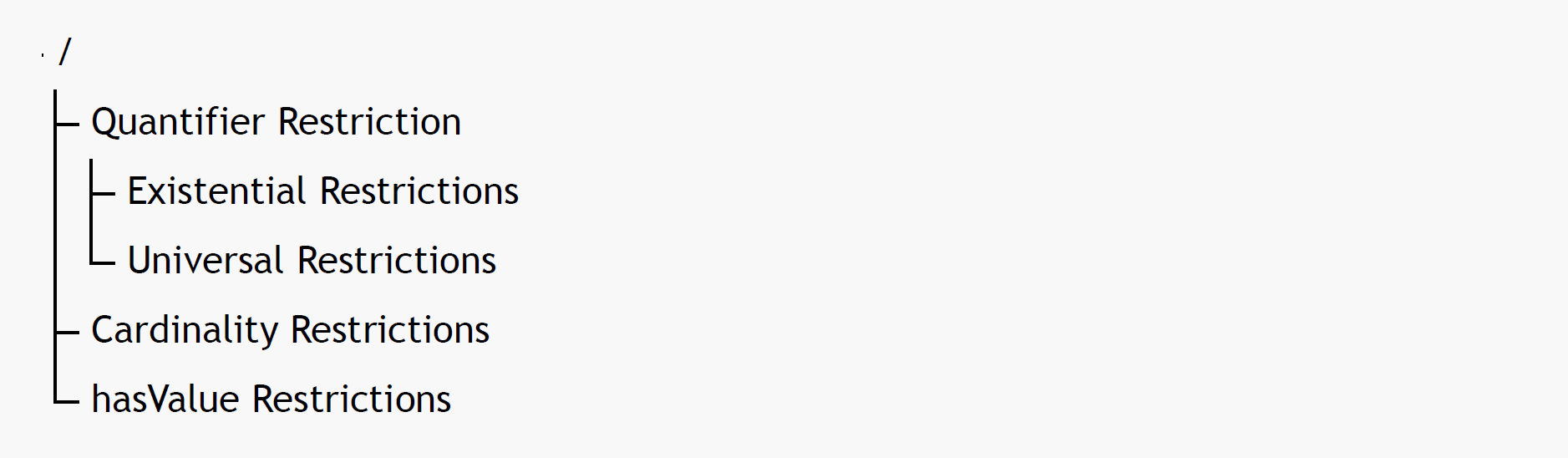
Broadly speaking as above tree-view, OWL property restrictions can be grouped into three major categories:
1. Quantifier Restrictions
Quantifier restrictions describes:
whether certain relationships exist
or:
whether relationships are restricted to certain types.
These restrictions focus on semantic existence and semantic scope.
Quantifier restrictions include:
Existential Restriction
(someValuesFrom)
Meaning: there exists at least one relationship satisfying a condition.
Example:
PizzahasToppingsomeCheeseTopping
Meaning:
every pizza must have at least one cheese topping.
Universal Restriction
(allValuesFrom)
Meaning: all (every) successor individual must belongs to a specified class.
Example:
PizzahasToppingonlyPizzaTopping
Meaning:
every topping of a pizza must be a
PizzaTopping.
Notice the important distinction.
- Existential restriction expresses: minimum semantic existence.
- Universal restriction expresses: semantic limitation.
These two concepts are frequently confused by beginners.
Yet they represent fundamentally different forms of semantic reasoning.
Chapter (14) begins with:
Existential Restriction
because ontology must first understand:
required existence
before learning:
restricted universality.
Do you see any similarity for this ontology (machine) learning approach with how human being learn? True, they are in the common approach.
2. Cardinality Restrictions
While quantifier restrictions focus on existence, cardinality restrictions focus on quantity.
Ontology may sometimes need to define:
how many relationships are permitted or required.
OWL therefore supports several forms of:
cardinality constraints.
Including:
(1) Minimum Cardinality
(minCardinality)
Meaning: at least N relationships must exist.
Example:
PizzahasToppingminimum 2
Meaning:
a pizza must have at least two toppings
(2) Maximum Cardinality
(maxCardinality)
Meaning: no more than N relationships may exist.
Example:
PersonhasBiologicalMothermaximum 1
Meaning:
a person cannot have more than one biological mother.
(3) Exact Cardinality
(exactCardinality)
Meaning: exactly N relationships are required.
Example:
Standard_BicyclehasWheelexactly 2
Meaning:
standard bicycles must have precisely two wheels.
Cardinality restrictions become particularly important in:
- enterprise governance,
- data quality validation, and
- business rule enforcement.
Within enterprise architecture, examples may include:
an
business_applicationmust have exactly onesystem_owner
or:
a
business_processmust involve at least oneresponsible_role.
Ontology therefore becomes increasingly capable of expressing:
operational logic,
rather than merely:
descriptive semantics.
3. Value Restrictions
The third major category involves specific required values represented through hasValue.
Unlike existential restriction, which asks for:
as least one qualifying relationship,
value restriction specifies:
a particular exact value.
For example:
Suppose an enterprise policy states:
all
production_applicationsmust belong to environment “Production”.
Ontology may express:
hasEnvironmentvalueProduction
This means:
the relationship must point to a specific predefined individual.
In Pizza.owl terms, imagine requiring:
a
NamedPizzamust always have a particular base.
Rather than merely saying:
some pizza base exists,
ontology would specify:
one exact expected value.
Value restrictions therefore introduce:
semantic precision
as well as:
semantic determinism.
Together, these three categories establish the foundation of:
OWL semantic logic.
They transform ontology from:
semantic modeling
into:
formal semantic definition.
Summarized view in below comparison table from also the evolution discussed in 14.2 from RDF/RDFS to OWL:
| Layer | Core Capability | Limitation |
|---|---|---|
| RDF | Triples (connected meaning) | No structure |
| RDFS | Class hierarchies, Domain & Range (structured semantics) | Can only describe possibility, cannot express necessity |
| OWL | Logical expressiveness (rules, requirements, obligations) | – |
Existential restrictions represent one of the earliest moments where you may begin seeing:
ontology as logic.
Rather than merely:
ontology as structure.
And this transition fundamentally changes how ontology can support:
- Reasoning ($R$),
- Governance ($\Gamma$), and eventually
- executable intelligence.
Among these restriction categories, quantifier restrictions are typically introduced first because they provide the conceptual foundation for semantic participation and logical class definition. We therefore begin with existential and universal restrictions.
14.4 Quantifier Restriction – Understanding Existential and Universal Logic
Among all OWL restrictions, the most foundational are:
Quantifier Restrictions.
These restrictions focus on a deceptively simple question:
what kind of relationships should exist?
Quantifier restrictions allow ontology to reason about:
semantic participation.
In other words:
ontology begins understanding not merely:
whether concepts are connected,
but:
how those connections should behave logically.
OWL provides two primary forms of quantifier restriction:
- Existential Restriction: represented by
someValuesFrom - Universal Restriction: represented by
allValuesFrom
Although these may appear similar at first glance, their semantic meaning differs significantly.
14.4.1 Existential Restriction – “At Least One Exist”
Existential restriction expresses:
there exists at least one qualifying relationship.
In Description Logic (DL), this is often represented conceptually as:
$\exists R.C$
Meaning: there exists at least one (some) relationship $R$ to something belonging to an individual belonging to class $C$.
=== Interesting Read: More mathematical notation ===
Expand above notation in DL, the concept of an existential restriction is formally defined using the following mathematical notation:
$\exists R.C = {x \in \Delta^\mathcal{I} \mid \exists y \in \Delta^\mathcal{I} : (x,y) \in R^\mathcal{I} \land y \in C^\mathcal{I} }$
Breakdown of this formula –
- $\Delta^\mathcal{I}$: The domain of interpretation, representing the set of all individuals in the ontology world.
- $x, y$: Individual elements within that interpretation domain.
- $R^\mathcal{I}$: The interpretation of the role (relationship) $R$, represented as a binary relation between individuals.
- $C^\mathcal{I}$: The interpretation of the concept (class) $C$, represented as the set of all individuals belonging to class $C$.
- $(x,y) \in R^\mathcal{I}$: Indicates that a relationship $R$ exists between individual $x$ and individual $y$.
- $y \in C^\mathcal{I}$: Indicates that individual $y$ belongs to class $C$.
- $\land$: Logical conjunction (AND), meaning both conditions must hold simultaneously.
Conceptual visualization –
To understand this mapping, let’s imaging a parentTo relationship connected to a Person class: $\exists parentTo.Person$
Meaning:
there exists at least one child connected through
parentToto aPerson.
In short, the expression $\exists R.C$ describes the set of all individuals $x$ that have at least one successor y through relationship $R$, such that $y$ belongs to class $C$.
=== END ===
Within our Pizza.owl ontology, consider:
hasToppingsomeMozzarellaTopping
Semantically, this means:
there exists at least one topping relationship to mozzarella topping.
This statement introduces something very important:
semantic necessity.
Ontology now expects:
at least one qualifying relationship.
This differs significantly from earlier chapters.
- Previously: relationship were optional.
- Now: relationships become logically meaningful (necessity).
A useful way to understand existential restriction is through the phrase:
AT LEAST ONE.
Not:
exactly one.
Not:
all toppings.
Simply: there exists at least one!
This distinction matters enormously.
Because ontology reasoning depends heavily on:
precise semantics.
Let’s see an example in Pizza.owl:
Suppose a class defines:
MargheritaPizza
as:
hasToppingsomeMozzarellaTopping
Ontology now understand:
mozzarella topping is semantically necessary by Margherita pizza.
Without satisfying this requirement:
the pizza cannot fully conform to the class meaning, semantically.
This introduces another important shift.
Ontology modeling now begins answering:
What makes something what it is?
A MargheritaPizza is not merely:
a pizza.
It becomes:
a pizza satisfying semantic conditions.
This distinction transform ontology engineering from:
classification
toward:
formal semantic definition.
Ontology therefore becomes increasingly capable of expressing:
adaptive domain knowledge.
In enterprise context, this becomes extremely valuable.
See another example:
A Critical_Application may require:
at least one
Disaster_Recovery_Mechanism.
Or:
Sensitive_Data_Process may require:
at least one
Compliance_Control.
Ontology can now formally describe:
mandatory semantic conditions.
Rather than merely:
possible relationships.
This marks another important maturity leap toward:
executable knowledge systems.
14.4.2 Universal Restriction – “Only These Are Allowed”
Universal restriction expresses:
all successor individuals must satisfy a condition.
Conceptually:
$\forall R.C$
Meaning: every relationship $R$ must point to class $C$.
=== Interesting Read: More mathematical notation ===
Expand above notation in DL, the concept of a universal restriction is formally defined using the following mathematical notation:
$\forall R.C = {x \in \Delta^\mathcal{I} \mid \forall y \in \Delta^\mathcal{I} : (x,y) \in R^\mathcal{I} \rightarrow y \in C^\mathcal{I} }$
Breakdown of this formula –
- $\Delta^\mathcal{I}$: The domain of interpretation, representing the set of all individuals in the ontology world.
- $x, y$: Individual elements within that interpretation domain.
- $R^\mathcal{I}$: The interpretation of the role (relationship) $R$, represented as a binary relation between individuals.
- $C^\mathcal{I}$: The interpretation of the concept (class) $C$, represented as the set of all individuals belonging to class $C$.
- $(x,y) \in R^\mathcal{I}$: Indicates that a relationship $R$ exists between individual $x$ and individual $y$.
- $y \in C^\mathcal{I}$: Indicates that individual $y$ belongs to class $C$.
- $\rightarrow$: Logical implication (IF…THEN), meaning if relationship $R$ exists, the target individual must satisfy class condition $C$.
Conceptual visualization –
To understand this semantic interpretation, same as previous example, imagine a parentTo relationship connected to Person, now as $\forall parentTo.Person$
Meaning:
all individuals connected through
parentTomust belong to the classPerson.
Importantly, this does not imply that a person necessarily satisfies parentTo relationship.
Instead, ontology expresses:
if a
parentTorelationship exists, it must only point to validPersonindividuals.
In short, the expression $\forall R.C$ describes the set of all individuals $x$ such that:
every successor individual $y$ connected through relationship $R$ must belong to class $C$.
This is why universal restriction expresses:
semantic limitation
rather than:
semantic existence.
In short, the expression $\forall R.C$ describes the set of all individuals x whose every successor y through relationship R must belong to class C.
=== END ===
For example:
PizzahasToppingonlyPizzaTopping
Meaning:
all toppings of a pizza must belong to PizzaTopping.
This does not guarantee toppings exist.
Instead, it governs:
semantic limitation.
This distinction is critically important.
Because beginners often mistakenly assume only means required.
But semantically, it means constrained.
A pizza may still have:
zero toppings.
Ontology here simply says:
if topping exist,
they must belong to:
PizzaTopping.
Understanding this distinction is one of the earliest maturity moments in ontology engineering.
Because ontology logic depends heavily on:
semantic precision.
14.4.3 Why Chapter 14 Begins with Existential Restriction
Michael intentionally introduces:
existential restriction
before universal restriction.
This teaching sequence is important.
Because ontology first needs to understand:
semantic existence
before introducing:
semantic limitation
In practical modeling:
it is usually easier to first ask:
what relationships are required?
before asking:
what relationships are allowed?
This chapter therefore focuses on:
Existential Restriction
using:
someValuesFrom
before later chapters gradually expand toward:
more advanced logical constraints.
14.4.4 OWL Restriction Syntax Pattern – Understanding the Grammar of Semantic Constraints
After understanding the conceptual difference between:
existential restriction (
someValuesFrom)
and:
universal restriction (
allValuesFrom),
you should pause briefly to recognize an important fact, from language perspective, that:
OWL restriction are not random syntax.
Instead, they follow a highly structured semantic grammar.
This is an important transition point in ontology learning.
Because many beginners mistakenly perceive expressions such as:
hasTopping some MozzarellaTopping
as:
Protégé-specific notation
or simply:
a software configuration format.
However, this interpretation is incomplete.
In reality, OWL restrictions represent:
formal semantic expressions
which are used to describe:
logical class conditions.
In other words:
OWL restriction statements behave more like:
semantic sentences
than:
user interface settings.
Understanding this grammar is important because future ontology modeling will increasingly depend upon:
composing semantic logic
rather than merely:
creating classes and relationships.
At a further high level, most OWL restriction expressions follow a common structural pattern:
$Object Property + Restriction Type + Target Class$
Conceptually:
$Relationship + Semantic Logic + Semantic Target$
This structure can be understood as a reusable language pattern for constructing:
semantic constraints.
Let us examine a common example from Pizza.owl:
hasTopping some MozzarellaTopping
This restriction can be decomposed into three semantic components:
| Component | Meaning | Semantic Role |
|---|---|---|
hasTopping |
Object Property | Defines the relationship |
some |
Restriction Type | Defines existential logic |
MozzarellaTopping |
Target Class | Defines the semantic requirement |
When interpreted together, ontology understands the expression as:
a pizza must have at least one topping belonging to the class
MozzarellaTopping.
Very importantly: the keyword some does NOT mean “several” or “an unspecified number”!
Within OWL semantics: some specifically represents existential quantification, meaning:
at least one qualifying relationship exists.
Now consider a second example:
hasTopping only PizzaTopping
This expression follows the exact same grammar pattern:
| Component | Meaning | Semantic Role |
|---|---|---|
hasTopping |
Object Property | Defines the relationship |
only |
Restriction Type | Defines universal logic |
PizzaTopping |
Target Class | Defines the semantic requirement |
However, the semantic interpretation changes significantly.
Ontology now understand:
all toppings associated with a pizza must belong to the class
PizzaTopping.
Notice what changed.
The relationship remains identical.
The target class also remains similar.
Only the restriction logic changes.
Yet this small syntactic variation completely transforms semantic meaning.
This illustrates an important principle in ontology engineering:
[!Note] small changes in OWL syntax may produce major differences in logical interpretation.
As ontology modeling becomes more advanced, you will encounter increasingly sophisticated restriction patterns.
For example:
- Existential Quantifier Restrictions:
hasTopping some CheeseTopping - Universal Quantifier Restrictions:
hasTopping only PizzaTopping - Cardinality Restrictions:
hasTopping min 2 - Exact Cardinality Restrictions:
hasWheel exactly 4 - Value Restrictions:
hasEnvironment value Production
Although these expressions appear different, they all follow a similar semantic grammar:
$Property + Restriction + Target$
Understanding this pattern is an important milestone!
Because ontology engineers gradually stop reading OWL as:
syntax
and begin reading OWL as:
semantic language.
This mindset shift is crucial.
Especially for enterprise ontology and knowledge graph engineering.
Since ontology increasingly becomes not merely:
a data model,
but:
a language for expressing machine-interpretable meaning.
With this grammar foundation established, you are now ready to begin applying existential restrictions practically inside **Pizza.owl** and Protégé.
14.5 Existential Restriction in Pizza.owl – Understanding Tutorial 4.10.1 and 4.10.2
14.5.1 A Detail Look at Existential Restriction
After introducing the conceptual foundation of property restrictions, Michael now transitions toward one of this most important practical modeling techniques in OWL:
Existential Restriction
through the construct someValuesFrom.
At this stage in the Pizza.owl tutorial, ontology modeling begins changing character.
Earlier chapters largely focused on describing relationships.
For example:
Pizza
hasToppingPizzaTopping
or:
Pizza
hasBasePizzaBase
These statements helped ontology understand:
semantic structure.
However, ontology still lacked the ability to describe:
semantic requirements.
This distinction is subtle but important.
Because knowing:
a pizza may have toppings
is fundamentally different from saying:
a pizza must contain at least one topping.
Ontology therefore begins transitioning from:
semantic possibility
toward:
semantic obligation.
14.5.2 From Semantic Requirements to Executable Queries: The EKA Knowledge Graph Bridge
This transition from “possibility” to “obligation” is not merely an academic logical exercise. Within the EKA framework, it has a very concrete and powerful implication for the $K$ - Knowledge Graph layer.
Recall the EKA formalization: $\large{EKA = (K, R, \Theta, \Phi, \Gamma)}$.
-
Without Existential Restrictions ($K$ is a “Descriptive Graph”): The knowledge graph can only answer “what is” queries. For example, you can ask: “Which pizzas have a
MozzarellaTopping?” This is a simple traversal of asserted relationships. -
With Existential Restrictions ($K$ becomes an “Intelligent Graph”): Because the ontology now contains logical rules about what must exist, the knowledge graph can answer “what should be” and “what is missing” queries.
Example in a Graph Query (e.g., Cypher or SPARQL):
You have defined that a CheesePizza must have at least one hasTopping relationship to a CheeseTopping. Your knowledge graph contains the following individuals:
PizzaA(type:CheesePizza) - has a relationshiphasToppingtoCheddarTopping.PizzaB(type:CheesePizza) - has nohasToppingrelationships.
=== Additional Reading, if you have Neo4j on-hand ===
Assume your Neo4j graph contains nodes labeled Pizza and CheeseTopping (Note: CheeseTopping could be member of parent node PizzaTopping), connected by a relationship :HAS_TOPPING.
Based on above individuals information.
Run this Query 1:
MATCH (p:Pizza {type: 'CheesePizza'})
RETURN p.name AS PizzaName
You may get result as:
| PizzaName |
|---|
| PizzaA |
| PizzaB |
Both pizzas are returned, even though PizzaB has no toppings.
Then run this Question 2:
MATCH (p:Pizza {type: 'CheesePizza'})
WHERE (p)-[:HAS_TOPPING]-(>:CheeseTopping)
RETURN p.name AS ValidCheesePizzaName
You should see the result now as:
| ValidCheesePizzaName |
|---|
| PizzaA |
Only PizzaA is returned. PizzaB is excluded because it does not satisfy the “must have at least one cheese topping” rule.
From knowledge graph perspective:
- Query 1 represents a descriptive knowledge graph: it simply tells you what is asserted, but it cannot distinguish between a valid
CheesePizza(with toppings) and an invalid or incomplete one. - Query 2 represents the existential restriction logic (
hasTopping some CheeseTopping) enhancing the knowledge graph: it queries only those individuals that satisfy the semantic requirement, this turns your ontology’s logical rules into powerful, executable data quality filters.
In an EKA-enabled systems, Query 2 would be the basis for generating trustworthy insights, while Query 1 might be used for auditing or identifying data quality issues (i.e., finding PizzaB to flag it for correction).
=== END ===
Without the existential restriction (i.e., using only RDFS/SHACL), both PizzaA and PizzaB are valid members of CheesePizza. A query would simply return both.
With the existential restriction (using OWL and a reasoner), the semantic layer within EKA ($R$) can first validate the graph. It would identify PizzaB as incomplete or inconsistent based on the logical rule you defined in the ontology.
This allows the Executable Intelligence ($\Phi$) layer to trigger actions. A governance workflow could automatically flag PizzaB for a data quality issue, or a smart query could be written to exclude it from results.
Therefore, Chapter (14) is the pivotal moment where your ontology stops being a mere “schema” for your knowledge graph and becomes its “logical guardian.” The existential restriction (someValuesFrom) is your first tool to enforce business rules (“a product must have a category”, “a critical application must have an owner”) directly within your executable knowledge architecture.
14.5.3 Visualized Examine on Tutorial 4.10.1 and 4.10.2
Michael introduces existential restriction through a very deliberate modeling progression.
Rather than immediately creating complicated class logic, you first explore a simple but powerful idea:
classes may be described through required relationships.
This introduces a major ontology engineering concept:
logical class definition.
See below steps which described in Exercise 13 and result Pizza hasBase some PizzaBase:
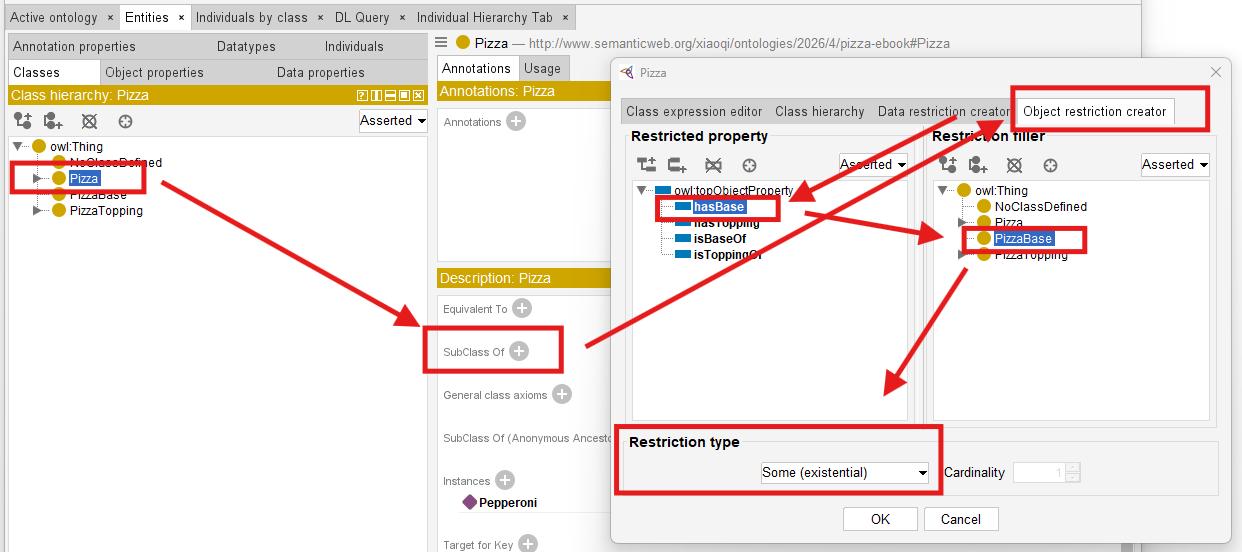
Previously, you manually create classes primarily through naming and hierarchy.
For example:
MargheritaPizza
may simply exist as:
a subclass of
NamedPizza.
However, ontology still does not truly understand:
what semantically makes a
MargheritaPizzaaMargheritaPizza.
Existential restriction changes this.
Ontology can now begin expression:
semantic identity.
For example:
Instead of simply naming:
CheesePizza,
ontology may define:
a pizza having at least one cheese topping.
See how to implement this in Protégé and resulting CheesePizza hasTopping some CheeseTopping:
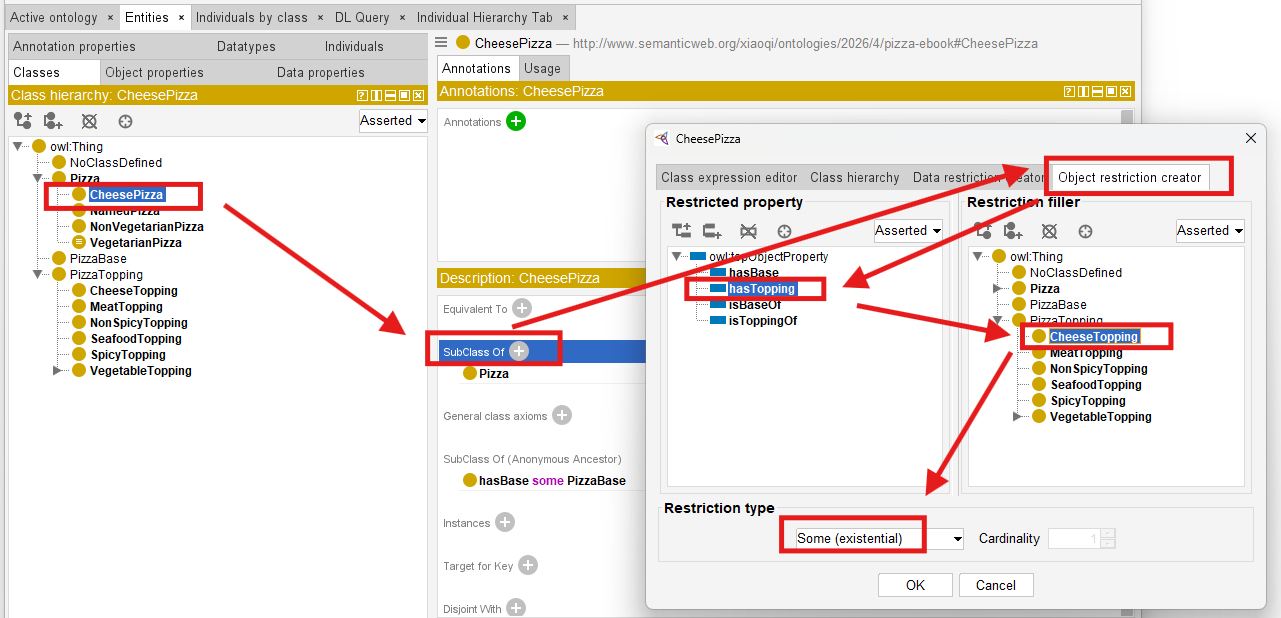
Since CheesePizza is SubClass Of Pizza, in the result Description screen, you may see the previous Pizza / PizzaBase existential restriction is inherited, as below:
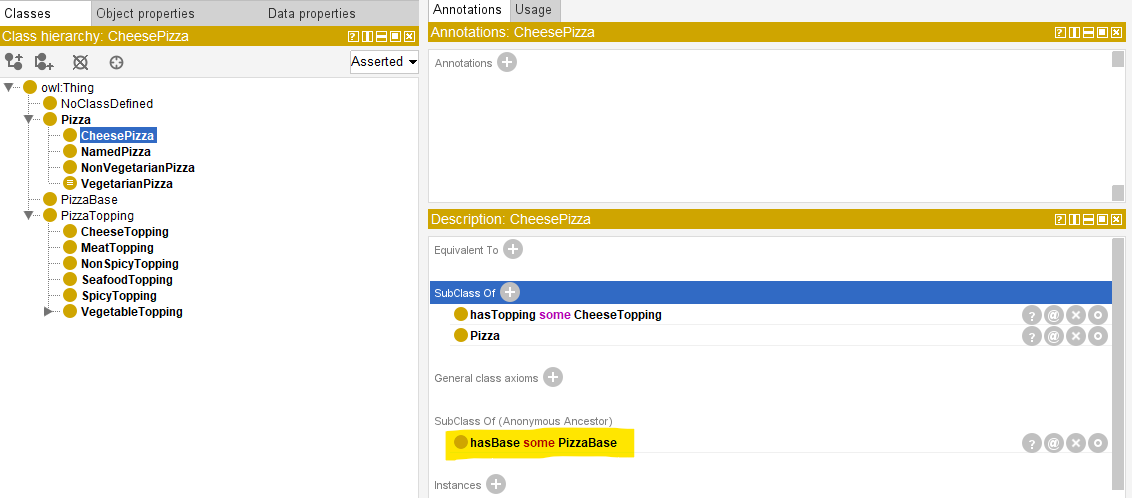
This ensure your ontology grows organically base on the known and true knowledge already have.
With such kind of configuration, your ontology is transformed fundamentally.
Meaning becomes:
computable.
Reasoners may now determine:
class membership automatically.
Ontology therefore becomes increasingly inferential rather than merely descriptive!
This represents one of the earliest moment where ontology begins feeling:
intelligent.
Because class meaning no longer depends entirely upon:
human categorization then manually configuration.
Instead:
logical semantics drive understanding based on machine-understandable rules.
Within our Pizza.owl, existential restriction is intentionally introduced before more advanced logical restrictions because it establishes the foundational reasoning pattern:
required existence.
Ontology first learns:
something must exist.
Later chapters will teach ontology:
- what is allowed,
- what is limited, and
- how many relationships are acceptable.
This gradual semantic progression is one reason the Pizza.owl tutorial remains such an effective learning path.
Because ontology maturity develops incrementally.
14.5.4 View from Open World Assumption (OWA)
Interestingly, OWL reasoners do not immediately assume that a restriction has been violated simply because a required relationship has not yet been observed. In many cases, the absence of information does not necessarily imply semantic inconsistency. This behavior is closely related to one of the most important principles in ontology engineering:
Open World Assumption (OWA)
which assumes that knowledge may still be incomplete.
We will explore this important concept in greater detail later in this chapter, as it fundamentally influences how OWL reasoners interpret existential restrictions and semantic requirements.
A quick example:
Suppose the ontology only knows PizzaA exists, with no hasTopping statements. Under OWA, the reasoner does not conclude PizzaA has no toppings. It concludes “unknown”. This is why PizzaA does not violate hasTopping some CheeseTopping — absence of evidence is not evidence of absence.
We will revisit OWA in detail when discussing vacuous truth (14.8.3) and reasoner behavior (14.7.4).
14.6 Exercise 13 Walkthrough – Creating Semantic Requirements in Protégé
With the conceptual foundation now established, you are fully ready to perform:
Exercise 13
inside Protégé.
This exercise represents an important turning point.
For the first time, you begin configuring:
semantic requirements
rather than merely:
semantic structure (hierarchies and relationships).
Inside the Pizza.owl tutorial, you create existential restrictions using:
someValuesFrom
through the Protégé interface (you already see screen samples in previous section).
At first glance, the interface interaction appears simple.
However, conceptually, something profound is happening.
Ontology is beginning to describe:
what a class must satisfy.
rather than merely:
what relationships may exist.
Inside Protégé, you first select the target class.
Typically, Michael demonstrates this through pizza subclasses that require particular toppings.
You then navigates to Equivalent Classes or **SubClass Restrictions** depending on modeling preference.
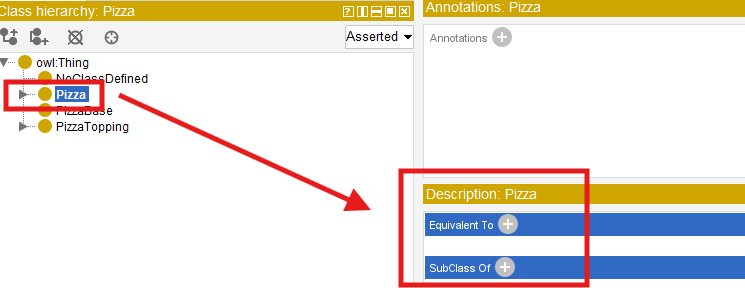
Next, Protégé provides access to:
Object Restriction Editor.
“Editor” may not the accurate word, see below screen, you may perform more configurations here, including:
- Class expression editor
- Class hierarchy
- Data restriction creator
- Object restriction creator
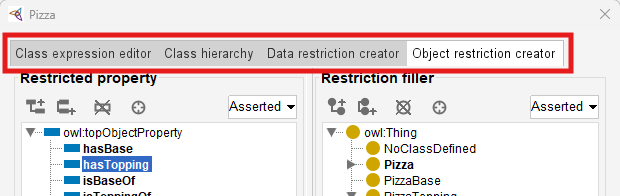
At this stage, switch to actual tab name “Object restriction creator”, you may perform following steps:
1) Select Restriction Type: Some (existential) means someValuesFrom, it’s the default selection when you come to this screen, then
2) Configure Property in “Restricted property”: hasTopping, and finally
3) Configure Target Class in “Restriction filler”
At first encounter, this may look like “Syntax”.
However, ontology engineers should resist thinking about this merely as notation.
Because what has actually been created is:
semantic logic.
Ontology now interprets this statement as:
there must exist at least one topping relationship pointing toward mozzarella topping.
This changes how ontology understands “pizza identity”.
A pizza now becomes classified not merely because:
a human named it,
but because:
semantic conditions are satisfied.
This subtle shift becomes extremely relies upon:
inferred meaning.
rather than:
manually asserted meaning.
=== Mathematical View ===
Let’s try to map what you’ve configured to the previous mathematical formula:
$\exists R.C = { x \in \Delta^\mathcal{l} \mid \exists y \in \Delta^\mathcal{l} : (x,y) \in R^\mathcal{l} \land y \in C^\mathcal{l} }$
The statement:
CheesePizzahasToppingsomeCheeseTopping
may have those elements referring to the variables as:
- $\Delta^\mathcal{l}$: the
Pizzaclass domain - $R$:
hasToppingrelationship - $C$:
CheesePizzaclass - $x,y$: instance of
Pizza(notCheesePizza)
[!Note] A subtle but important note on x and class definitions:
In the formula $\exists R.C = { x \in \Delta^\mathcal{l} \mid \exists y \in \Delta^\mathcal{l} : (x,y) \in R^\mathcal{l} \land y \in C^\mathcal{l} }$, the variable x ranges over instances of the class being defined. When you define
CheesePizzaasPizza and (hasTopping some CheeseTopping), the restriction is evaluated in the context ofPizza. This means x is an instance ofPizza(not necessarily an instance ofCheesePizza). The restriction then asks: does thisPizzainstance have at least onehasToppingrelationship to aCheeseTopping? If yes, the reasoner can infer that the instance is also aCheesePizza. This is why x is an instance ofPizzain the formula – the restriction acts as a membership test for the subclass, not as a property of the subclass itself.
=== END ===
Exercise 13 therefore marks another maturity transition.
Ontology is beginning to evolve from:
a semantic graph
toward:
semantic intelligence.
14.7 Understanding Reasoning Outcomes – Asserted vs. Inferred Semantics
After completing Exercise 13 and defining existential restrictions inside Protégé, learners may often encounter an interesting experience:
the ontology reasoner appears to “know” things that were never manually entered.
At first glance, this may seem surprising.
Especially for readers who are more familiar with transitional databases or graph databases.
Because in those environments, data generally behaves according to a straightforward principle:
what is explicitly stored is what exists.
Ontology reasoning behaves very differently.
Within OWL, semantic meaning is not limited only to:
manually asserted facts.
Instead, reasoners are capable of producing:
inferred knowledge
through logical interpretation.
This distinction represents one of the most important conceptual shifts in ontology engineering.
Because ontology gradually moves from:
storing semantic information
toward:
deriving semantic meaning.
To understand this transformation, you must first distinguish between:
Asserted Semantics and Inferred Semantics.
14.7.1 Asserted Semantics – Explicitly Modeled Knowledge
Asserted semantics represent:
information explicitly created by ontology engineers.
In other words:
there are semantic statements that humans intentionally model inside Protégé (or other ontology editors).
For example:
Suppose an ontology engineer manually creates (models):
PizzaA hasTopping MozzarellaTopping
This relationship becomes:
asserted knowledge.
Because it was directly entered into the ontology.
Similarly:
if the ontology engineer manually states:
PizzaA rdf:type NamedPizza
this classification is likewise asserted.
Ontology does not need to infer it.
The semantic meaning already exists because:
humans explicitly provided it.
From a modeling perspective, asserted semantics resemble:
manually curated knowledge.
This is conceptually similar to:
records stored in a database
or:
relationships stored in a graph database.
However, ontology does not stop there.
14.7.2 Inferred Semantics – Knowledge Derived Through Logic
Unlike asserted knowledge, inferred semantics are not manually entered.
Instead, they emerge through semantic reasoning.
[!Note] Scared? Does this mean machine starts dominating semantic creation? Terminator? Skynet?… No worry, this is still the governed logic, rooted from human’s initial design!
And, this is where existential restriction becomes especially important.
Consider the following ontology definition:
CheesePizza EquivalentTo
Pizza
and (hasTopping some CheeseTopping)
In Protégé, you may use below steps to add this definition:
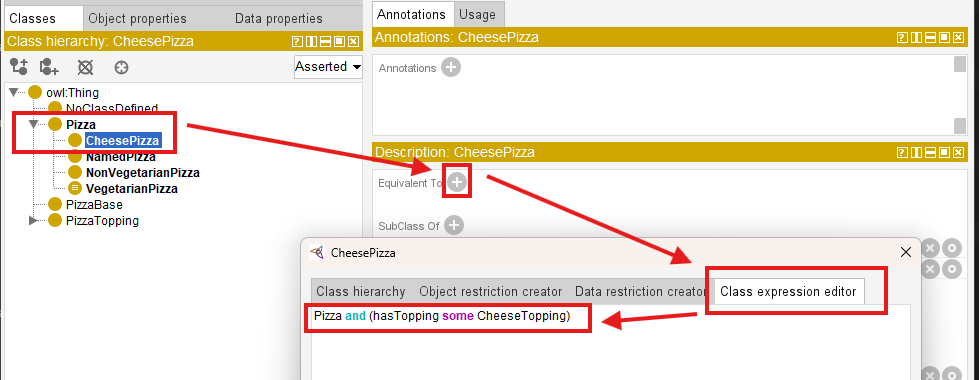
After confirm, you may see this definition under Equivalent To:
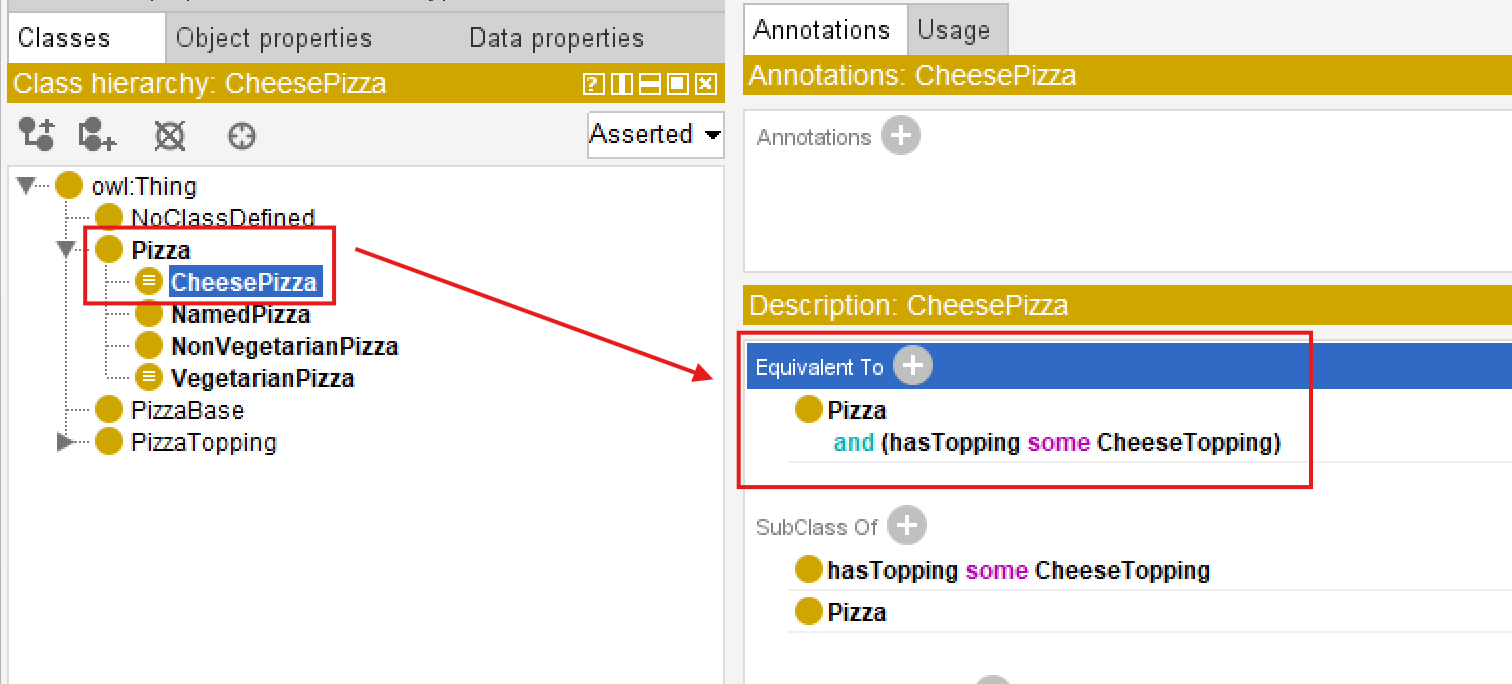
This statement establishes a semantic condition.
Meaning:
any pizza containing at least one cheese topping qualifies as a
CheesePizza.
Note here we have the combination of more than one conditions (restrictions).
Now suppose ontology engineers explicitly model:
PizzaA hasTopping MozzarellaTopping
And ontology already understand:
MozzarellaTopping SubClassOf CheeseTopping.
Interestingly, magic happens:
ontology engineers never explicitly declare:
PizzaA rdf:type CheesePizza
Yet after synchronizing the reasoner, Protégé may automatically infer:
PizzaA rdf:type CheesePizza
See from below comparison screen:
| Before Reasoning | 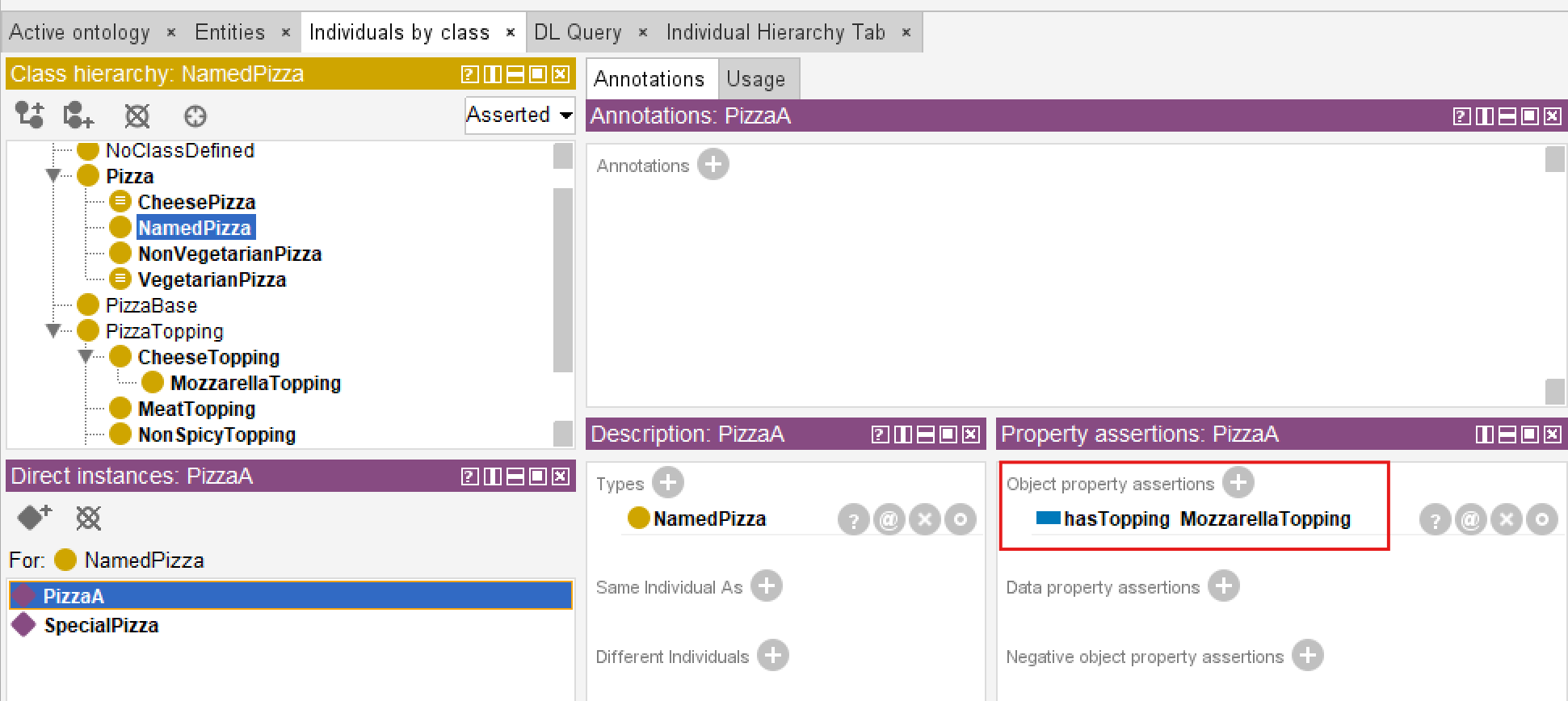 |
| After Reasoning | 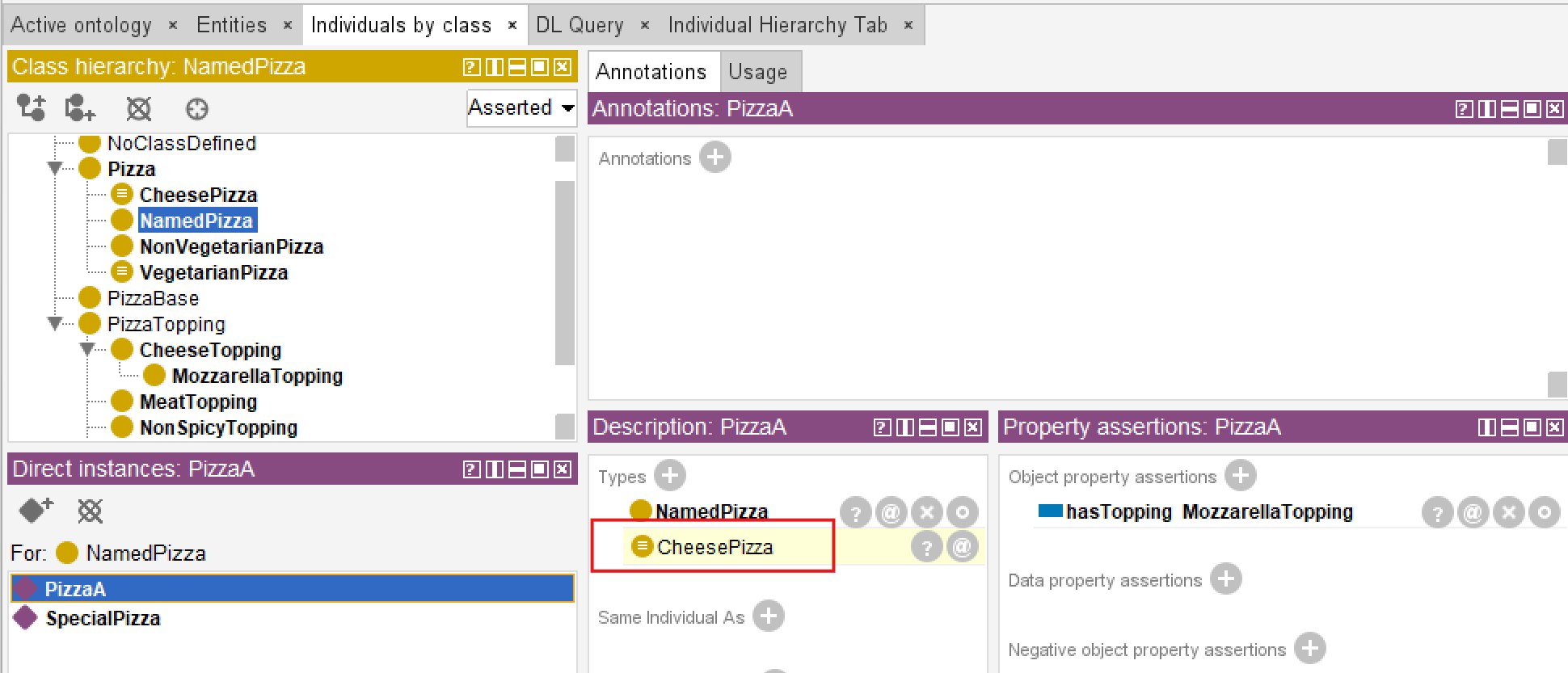 |
This is a significant milestone!
Because ontology has now moved beyond:
semantic storage
toward:
semantic interpretation.
Meaning becomes computable.
The ontology reasoner analyzes:
- subclass hierarchy
- property restrictions
- existential conditions
- logical consistency, and
- devices new knowledge
This capability is one of the major distinctions separating ontology from:
conventional graph data models.
Because ontology is capable of generating:
new semantic understanding
rather than merely retrieving stored relationships.
=== Interesting Read: Necessary vs. Sufficient Conditions ===
The inference you just witnessed (PizzaA automatically classified as CheesePizza) depends on a fundamental logical distinction: the difference between necessary and sufficient conditions.
In Description Logic (the formal language behind OWL):
- $\texttt{SubClassOf} (\sqsubseteq)$ defines a necessary condition.
- $\texttt{EquivalentTo} (\equiv)$ defines necessary and sufficient conditions.
Mathematical form:
| Concept | DL Notation | OWL Construct | Logical Direction |
|---|---|---|---|
| Necessary condition | $C \sqsubseteq D$ | SubClassOf |
$C(x) \rightarrow D(x)$ |
| Necessary and sufficient condition | $C \equiv D$ | EquivalentTo |
$C(x) \leftrightarrow D(x)$ |
Example from this section:
You defined:
CheesePizza EquivalentTo
Pizza
and (hasTopping some CheeseTopping)
This means:
- Necessary condition: If something is a
CheesePizza, it must have a cheese topping. - Sufficient condition: If something has a cheese topping, it can be inferred to be a
CheesePizza.
This is why the reasoner performed automatic classification. If you had used SubClassOf instead of EquivalentTo, the reasoner would not perform the reverse inference (from having a cheese topping to classifying as CheesePizza).
Why this matters for your modeling choices:
| If you want… | Use… |
|---|---|
| Only inheritance (one-way) | SubClassOf |
| Logical definition with automatic classification (two-way) | EquivalentTo |
This distinction is fundamental to ontology engineering. Choosing the wrong construct may lead to unexpected reasoning results (or missed inferences).
=== END ===
14.7.3 Why Existential Restriction Enables Inference
At this stage, you may naturally ask an important question:
Why does existential restriction enable automatic classification?
The answer lies in the semantic meaning of the keyword:
some
which represents:
existential quantification.
Without OWL semantics, the expression hasTopping some CheeseTopping does not merely describe:
a relationship.
Instead, it defines:
a logical test condition.
More specifically, ontology interprets this expression as:
there must exist at least one valid relationship through
hasToppingpointing to an individual belonging to classCheeseTopping.
This subtle distinction is important.
Because ontology is not longer simply storing:
semantic data,
but rather evaluating:
semantic conditions.
In practice, ontology reasoners perform a process conceptually similar to searching for evidence.
The reasoner examines individuals inside the ontology and asks a logical question:
“Can I find at least one relationship satisfying this existential condition?”
Suppose ontology contains:
PizzaA hasTopping MozzarellaTopping
and ontology already understands:
MozzarellaTopping SubClassOf CheeseTopping
The reasoner may then evaluate: hasTopping some CheeseTopping and conclude:
YES - at least one valid successor individual exists.
This reasoning process may feel surprisingly intelligent, since it makes machine alike human.
However, semantically, the reasoner is performing something conceptually similar to:
an automated semantic query.
Readers with graph databases experience may recognize an interesting parallel.
Inside Neo4j, a developer might write a Cypher query similar to:
MATCH (p:Pizza)-[:HAS_TOPPING]->(t:CheeseTopping)
RETURN p
or conceptually:
WHERE (p)-[:HAS_TOPPING]->(:CheeseTopping)
to locate pizzas having cheese toppings.
Ontology reasoners perform a related form of semantic evaluation.
However, instead of merely returning query results, the reasoner may additionally:
derive new semantic classifications.
Meaning:
if a pizza satisfies the logical condition: hasTopping some CheeseTopping, the ontology reasoner may automatically conclude:
this individual belongs to
CheesePizza(class).
This introduces an important distinction between graph traversal and semantic reasoning.
- Graph database primarily discover existing connections.
- Ontology reasoners additionally derive new meaning!
Another important factor enabling inference is EquivalentTo.
Consider the following ontology definition:
CheesyPizza EquivalentTo
Pizza
and (hasTopping some CheeseTopping)
The keyword EquivalentTo represents:
necessary AND sufficient conditions
This means the semantic rule works in both directions.
Ontology understands:
- If something is a
CheesePizza, it must satisfy the topping condition, and also - If something satisfies the topping condition, it may be classified as
CheesePizza.
This bidirectional logic is extremely important.
Because it enables:
automatic classification.
By comparison:
CheesyPizza subClassOf (hasTopping some CheeseTopping) would only define:
a one-way semantic rule.
Meaning:
every
CheesyPizzamust have cheese toppings,
but ontology would not automatically infer that:
every pizza with cheese toppings becomes
CheesyPizza.
This subtle modeling distinctions has major consequences for reasoning behavior.
And it highlights an important principles of ontology engineering:
small changes in logical constructors may produce significant different inference outcomes.
Existential restriction therefore becomes one of the foundational mechanisms enabling ontology to evolve from:
semantic structure
toward:
semantic intelligence.
14.7.4 Reasoners Think Logically – Not Intuitively
One of the most important mindset shifts in ontology engineering is learning that:
ontology reasoners think logically,
not:
intuitively.
From many learners, this initially feel unfamiliar and sometimes difficult to understand.
Because our humans naturally interpret missing information by making assumptions.
Ontology reasoners, however, do not (or we may also say “never”) make assumption.
They follow:
formal logical evidence.
This distinction becomes especially visible when working with existential restrictions.
Consider the following situation.
Suppose an ontology contains an individual PizzaB but no topping information has yet been defined.
A human reader may immediately think:
“If no topping exists, then
PizzaBis obviously not aCheesyPizza, although it hasPizzainside the name.”
This conclusion feels natural, to humans.
After all, human reasoning frequently relies on:
incomplete information and educated assumptions.
However, an OWL reasoner behaves differently.
The ontology reasoner does not infer:
PizzaB rdf:type CheesyPizza
Yet importantly: the reasoner also does not infer:
PizzaBis not aCheesyPizza.
Instead, ontology reaches a more conservative conclusion:
there is currently insufficient information to determine classification.
In other words, the ontology simply says:
“I do not know yet.”
This behavior often surprises beginners.
Especially those with experience in
relational databases,
business rules engines,
or:
graph databases.
Because many traditional systems implicitly follow a different assumption:
Missing information = false
Ontology reasoning, however, follows one of the most important principles in semantic modeling:
Open World Assumption (OWA)
Under OWA: missing information does not imply falsity.
Instead, ontology assumes knowledge may still be incomplete.
Meaning:
future information may still arrive, just not available for now yet.
For example:
The ontology may later receive PizzaB hasTopping MozzarellaTopping and ontology already understands MozzarellaTopping SubClassOf CheeseTopping.
At that moment, the reasoner may suddenly infer:
PizzaB rdf:type CheesyPizza
What has been changed?
Not the logical rule.
Only:
the available evidence (information).
Ontology reasoning therefore behaves less like:
guessing,
and more like:
evidence-based semantic evaluation.
This distinction becomes clearer when comparing Human Intuition vs OWL Reasoning:
| Human Intuition | OWL Reasoning Logic |
|---|---|
| No topping observed $\rightarrow$ probably not cheese pizza | No evidence observed (got) $\rightarrow$ classification postponed |
| Missing information suggest absence | Missing information may simply be incomplete |
| Infer based on assumptions | Infer based on formal evidence |
Notice the key difference?
OWL reasoners do not ask “What is most likely true?”
Instead, they ask “What can be logically justified?”
This distinction becomes especially important when working with:
existential restrictions.
Earlier in this chapter, we defined:
CheesyPizza EquivalentTo
Pizza
and (hasTopping some CheeseTopping)
The keyword EquivalentTo defines:
necessary and sufficient conditions.
Meaning:
ontology interprets the definition in both directions.
This enables the reasoner to conclude:
if a pizza satisfies the existential condition, then it may be classified as
CheesyPizza.
However, imagine the ontology instead used:
CheesyPizza SubClassOf (hasTopping some CheeseTopping)
This semantic meaning changes significantly.
Now ontology only understands:
every
CheesyPizzamust satisfy the topping restriction.
But ontology can no longer conclude:
every pizza satisfying the restriction automatically becomes
CheesyPizza.
The inference direction becomes one-way only.
This subtle distinction between EquivalentTo and SubClassOf has major consequences for ontology behavior.
It also highlights an important engineering lesson:
ontology reasoners execute logic exactly as modeled
while NOT:
as human intended.
For ontology engineers, this carries important practical implications.
Semantic models must be designed precisely with careful attentions to:
- logical meaning,
- restriction semantics, and
- inference consequences.
At the same time, Open World Assumption provides an important advantage.
Because enterprise knowledge is often:
- incomplete,
- distributed, or
- continuously evolving.
OWL therefore remains highly suitable for enterprise knowledge graphs, semantic integration, and executable intelligence systems when meaning must gradually emerge from accumulating knowledge rather than requiring perfect information from the beginning.
As you continue through this chapter, Open World Assumption will become increasingly important for understanding:
why ontology reasoners sometimes appear surprisingly conservative,
yet remain remarkably powerful in semantic interpretation.
14.8 Universal Restriction – Understanding only
In the previous sections, you explored:
existential restriction (
some)
and discovered one of the most important ideas in ontology engineering:
ontology can define not only what exists,
but also:
what must exist.
For example, the expression hasTopping some CheeseTopping allows ontology to express a meaningful semantic requirement:
every pizza must contain at least one cheese topping.
This is already a major conceptual shift.
Because ontology is no longer behaving merely as a relationship repository or a connected graph structure. Instead, ontology begins acting as:
a semantic rule system.
Meaning:
relationships are no longer interpreted only as:
stored facts,
but also as:
logical conditions.
At this point, you may reasonably feel:
“I understand how ontology can require something to exist.”
However, a second and equally important modeling problem soon appears.
Ontology engineers must also ask:
How can we control what kind of things are allowed to exist?
This distinction may initially appear subtle.
Yet it fundamentally changes how semantic system behave.
In real-world enterprise environments, data quality problems rarely emerge only because:
required information is missing.
More often, problems emerge because:
incorrect relationships are introduced.
For example:
An employee may accidentally be linked to:
a business application
instead of
a department.
A customer may mistakenly belong to:
a linux server infrastructure.
A business capability may incorrectly be realized by:
a physical office location.
In all these cases:
relationships exist,
but:
semantic (meaning) correctness is violated.
Ontology therefore requires more than participation rules, it also requires semantic boundaries.
Existential restriction helps ontology answer:
What kinds of things are semantically allowed?
To solve this challenge, OWL introduces another important semantic constructor Universal Restriction represented in Protégé using only and formally implemented through allValuesFrom.
First, have a look that it’s just under the existential (some) type in Protégé:
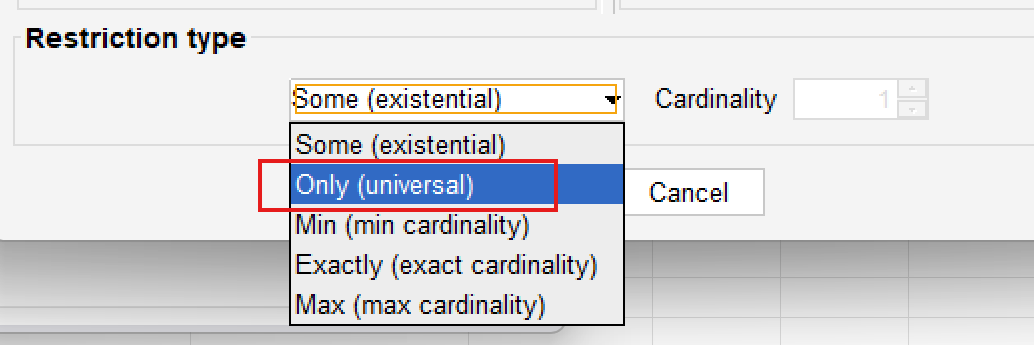
Unlike existential restriction, which focuses on:
existence (by its naming),
universal restriction focuses on:
constraint.
More specifically:
ontology moves from:
semantic participation
toward:
semantic governance.
This makes an important evolution in ontology engineering.
Because semantic systems gradually stop asking only:
“What relationships should exist?”
and being asking:
“Are existing relationships semantically valid?”
As ontology models scale toward:
- enterprise knowledge graphs,
- semantic integration platforms, and
- executable intelligence systems,
this distinction becomes increasingly important.
Ontology therefore evolves from:
connected knowledge
into:
governed semantic knowledge.
14.8.1 From Existence to Constraint – Why only is Needed
To understand why universal restriction exists, let us first examine an important limitation of existential restriction.
Suppose we define the following semantic requirement:
hasTopping some VegetableTopping
Ontology now understands:
a pizza must contain at least one vegetable topping.
At first glance: this may appear sufficient for describing a:
vegetarian pizza.
After all: ontology can already validate:
whether vegetable participation exists.
However, consider the following scenario.
Suppose ontology contains:
PizzaA hasTopping MushroomTopping
PizzaA hasTopping ChocolateTopping
Since MushroomTopping belongs to VegetableTopping, the existential condition succeeds.
Ontology correctly observes:
at least one vegetable topping exists.
Yet something still feels wrong.
Because the same pizza also contains ChocolateTopping which clearly violates:
common semantic expectations of vegetarian pizza.
This example reveals an important limitation.
Existential restriction successfully validates:
minimum participation
But it does NOT regulate semantic boundaries.
Ontology can confirm:
something acceptable exists.
But ontology still cannot answer:
are all relationships semantically appropriate?
This distinction becomes increasingly important in enterprise modeling.
Consider an ontology according to employee.
Suppose the architect define:
Employee SubClassOf (belongsToDepartment some Department)
Ontology now ensures:
every employee belongs to at least one department.
This is useful.
However, ontology still allows situations such as:
Employee_A belongsToDepartment Product_X
or:
Employee_A belongsToDepartment DataCenter_01
which are semantically incorrect.
The relationship exist, but the meaning becomes polluted.
Ontology therefore requires another mechanism.
Not merely to say:
something valid exists.
But to say:
everything involved must remain semantically valid.
This is where universal restriction (only) becomes necessary.
A useful way to think about the distinction is:
some$\rightarrow$ minimum semantic participationonly$\rightarrow$ semantic boundary enforcement
Or more simply:
some$\rightarrow$ something valid must existonly$\rightarrow$ everything must conform
This transition represents an important maturity step in ontology thinking.
Ontology is no longer merely asking:
“What should be present?” – by existential restriction
It now also asks:
“What should be permitted? – by universal restriction
In enterprise terms:
someensures a business rule: e.g. “Every application must have an owner.”onlyensures data quality: e.g. “Every owner must belong to the classEmployee(notDepartment, notSupplier).”
Both are needed.
One without the other leaves the ontology incomplete.
14.8.2 The Semantics of only – “All Must Be” vs. “Only Allowed”
Universal restriction introduces a very different form of semantic logic.
Consider the OWL expression: hasTopping only PizzaTopping
At first glance, many learners interpret this expression incorrectly.
A common misunderstanding is:
“This pizza must contain pizza toppings.”
However, this interpretation is semantically inaccurate.
The keyword only does NOT require existence.
Instead, it constraints:
the semantic type of relationship if they exist.
More precisely, ontology interprets the expression as:
IF toppings exist, every topping must belong to the class
PizzaTopping.
Notice the subtle difference?
Ontology is not saying:
toppings MUST EXIST.
Ontology is only saying:
whenever toppings exist, they must satisfy semantic expectations.
The hidden meaning is:
if toppings are not existed, I do not care since that’s not triggering inference.
This distinction is extremely important.
Because ontology engineers often unconsciously interpret only using:
natural language intuition.
In ordinary English:
“only pizza toppings” often sounds like mandatory presence.
But OWL semantics behave differently!
Ontology reasoners interpret:
hasTopping only PizzaTopping
as:
a semantic limitation,
not:
an existence requirement.
A useful mental model is to image only as:
a semantic type checker.
In programming languages, type systems help ensure:
data conforms to expected formats.
For example:
an integer field should NOT suddenly contain a text string.
Similarly:
universal restriction ensures ontology relationships remain:
semantically consistent.
Ontology therefore uses only to establish:
relationship type safety.
This idea connects naturally back to Chapter (13) – Domain and Range.
At first glance, Domain/Range and universal restriction may appear similar.
Because both attempt to improve:
semantic correctness. (kind of governance)
However, they operate at different levels.
| Domain and Range | Universal Restriction | |
|---|---|---|
| Definition | Define “structural expectations”. | Rather than describing “relationship design”, it evaluates “actual semantic behavior”. |
| Example | hasToppingDomain: PizzaRange: PizzaTopping |
hasTopping only PizzaTopping |
| Question Asked | “What relationship types are structurally expected?” | “Do all existing relationships remain semantically valid?” |
| Action | Act like “a schema-level semantic rule” | Evaluate “actual semantic behavior” |
| Meaning | Ontology expects “pizzas should connect to pizza toppings” | Ontology expects “whenever pizza toppings exist, the semantic expectations must be satisfied” |
This distinction is especially important for:
enterprise knowledge governance.
Because semantic quality is rarely protected by structure alone.
Instead, ontology must continuously evaluate relationship meaning.
Universal restriction therefore behaves like:
semantic runtime governance.
rather than merely structural design.
14.8.3 The Critical Difference – some vs. only
At this stage, you should clearly recognize that:
existential restriction (
some)
and:
universal restriction (
only)
are not interchangeable.
Although their syntax may initially appear similar, they represent fundamentally different forms of semantic logic.
Understanding this distinction is one of the most important milestones in ontology engineering.
Because many ontology beginners mistakenly assume some $\approx$ only and simply treat them as:
different OWL keywords.
In reality, they answer completely different semantic questions.
Existential restriction asks:
“Does at least one qualifying relationship exist?”
While universal restriction instead asks:
“if relationships exist, do they all satisfy semantic expectations?”
This distinction may appear subtle.
Yet it fundamentally changes:
- reasoning behavior,
- inference outcomes, and
- semantic interpretation.
The following comparison provides a useful summary:
| Characteristic | some (Existential Restriction) |
only (Universal Restriction) |
|---|---|---|
| Core Question | “Must at least one relationship exist?” | “If relationships exist, must they all belong to a certain class?” |
| Semantic Meaning | Minimum existence requirement | Semantic limitation / boundary |
| Creates | Requirement | Constraint |
| Logical Role | Participation condition | Semantic governance |
| Reasoner Behavior | Searches for valid evidence | Searches for invalid evidence |
| Behavior with No Relationship | Not satisfied | Satisfied (don’t care) |
| Example | hasTopping some VegetableTopping |
hasTopping only PizzaTopping |
One of the most powerful way to understand the distinction is through:
reasoner behavior.
When ontology evaluates hasTopping some CheeseTopping, the reasoner behaves almost like:
a semantic search engine.
Its task becomes finding evidence.
More specifically, the reasoner here asks:
“Can at least one topping be found that belongs to
CheeseTopping?”
If ontology identifies MozzarellaTopping or ParmesanTopping, then the condition succeeds.
Means ontology has found:
qualifying semantic evidence.
Universal restriction behaves very differently.
Consider hasTopping only PizzaTopping, here the reasoner is not searching for evidence of success.
Instead, it searches for evidence of violation!
The reasoner effectively asks:
“Do any topping violate semantic expectations?”
If ontology discovers ChocolateBar connected through hasTopping, while ChocolateBar does not belong to PizzaTopping, then semantic inconsistency may emerge.
A memorable mental model is:
some$\rightarrow$search for qualifying evidenceonly$\rightarrow$search for violating evidence
This distinction becomes extremely useful when ontology models grow larger, into the enterprise scale.
Because enterprise semantic systems increasingly depend upon:
automated validation
rather than:
manual review.
Another important difference appears when:
no relationship exists.
Suppose ontology contains Pizza_B with no toppings currently defined.
Would the following condition succeed?
hasTopping some CheeseTopping
The answer is:
NO.
Because ontology cannot find evidence showing:
at least one cheese topping exists.
Existential restriction therefore fails.
Now consider:
hasTopping only PizzaTopping
Surprisingly:
ontology still considers the restriction satisfied.
Why?
Because ontology now finds:
no invalid toppings.
Universal restriction asks:
“If toppings exist, are they semantically valid?”
When no toppings exist:
no violation can be observed.
In formal logic, this behavior is called vacuous truth.
Meaning:
a universal condition remains true unless a counterexample exists.
You do not need to memorize this mathematical term immediately. (see Interesting reading for reference)
However, understanding the behavior is extremely important.
Because it reveals something fundamental:
OWL reasoners think logically – not intuitively.
Human may instinctively say:
“A pizza without toppings should fail pizza rules.”
But ontology behaves differently.
Ontology instead says:
“No invalid topping exists, therefore no contradiction has been observed.”
This distinction becomes increasingly important as learners transition from:
data modeling
toward:
logical knowledge modeling.
A useful summary is:
some$=$at least one valid relationship must existonly$=$all relationships must remain semantically valid
Together, these relationships provide ontology with both:
participation logic
and:
semantic discipline.
==== Interesting Reading: Vacuous Truth in Formal Logic ===
The behavior of only when no relationship exists – i.e., it is automatically satisfied – is not an arbitrary design choice. It follows a fundamental principle in formal logic called vacuous truth.
What is Vacuous Truth?
In classical logic, a statement of the form:
“If $P$, then $Q$” (written as $P \rightarrow Q$)
is considered true whenever the condition $P$ is false – regardless of whether $Q$ is true or false.
This is not a convention.
It is a logical necessity to avoid contradictions and to preserve the integrity of implication.
Example in everyday reasoning:
“If it rains, then the ground will be wet.
If it does not rain, the statement is still considered true (vacuously true). It makes no claim about the ground’s wetness when it doesn’t rain. It only promises that whenever it rains, wetness follows.
How Vacuous Truth Applies to "only"
Recall the semantic meaning of only:
“If a pizza has a topping, then that topping must be
PizzaTopping.
This is a logical implication:
hasTopping(pizza, topping)$\rightarrow$PizzaTopping(topping)
| Scenario | Pizza has topping? | Topping is PizzaTopping? | Implication (Vacuous Truth) |
|---|---|---|---|
Pizza has MushroomTopping |
✅ True | ✅ True | True (satisfied) |
Pizza has ChocolateTopping |
✅ True | ❌ False | False (violated) |
Pizza has no toppings |
❌ False | (not evaluated) | True (vacuously satisfied) |
The third row is vacuous truth. Because the condition “pizza has a topping” is false, the overall only rule is automatically satisfied. The ontology does not complain about missing toppings.
Why Does Logic Include Vacuous Truth?
Without vacuous truth, logical implication would break down.
Consider the statement:
“All humans who can fly are astronauts.
If there are no humans who can fly, the statement is considered true still.
It does not falsely claim that some flying humans exist. It simply states a conditional relationship that happens to be trivially satisfied because the condition never occurs.
This same principle allows only to act as a pure constraint, not an existence requirement. It governs the type of relationships if they exist, without forcing them to exist.
Mathematical Form
In first-order logic, the universal restriction $\forall x \; (R(x) \rightarrow C(x))$ is vacuously true when there is no $x$ that satisfies $R(x)$.
This is written as:
$\forall x \in \phi, \; C(x)$ is always true.
Or equivalently:
$\neg \exist x \; (R(x) \land \neg C(x))$
No counterexample exists $\rightarrow$ the statement is true still.
Why This Matters for Ontology Engineering?
onlydoes not require existence – it only constrains what can exist.somerequires existence – it actively searches for at least one example.
Understanding vacuous truth prevents the common mistake of expecting only to behave like some.
“Vacuous truth is not a loophole! It is a logical feature that allow
onlyto be a pure constraint, not a disguised requirement.
==== END ====
14.8.4 Universal Restriction in Protégé – only as a Semantic Guardian
Have understood the semantic meaning of only from both “logical” and “mathematical” perspective, you are now ready to observe how universal restriction behaves inside Protégé.
At first glance, universal restriction may appear very similar to concepts introduced earlier in Chapter (13) – Domain and Range.
Because both mechanisms seems to control:
semantic correctness.
However, both their behavior and purpose are fundamentally different.
- Domain and Range primarily define structural expectations.
- Universal restriction instead evaluates logical consistency.
This distinction becomes easier to understand through experimentation, in our Protégé.
Suppose we define the following restriction for Pizza inside SubClass Of using:
hasTopping only PizzaTopping
Note: Since our common RDF workbook (pizza-ebook.rdf) had been already configured some when we practice existential constraint, to support this section without misleading, I’m clean unnecessary setting and create in one separate workbook called pizza-ebook_14.8.4.
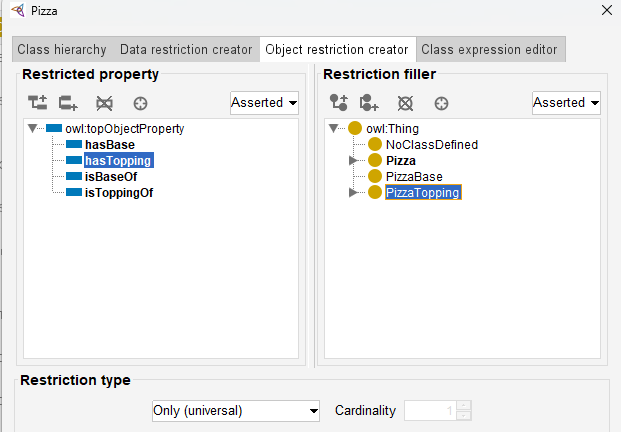
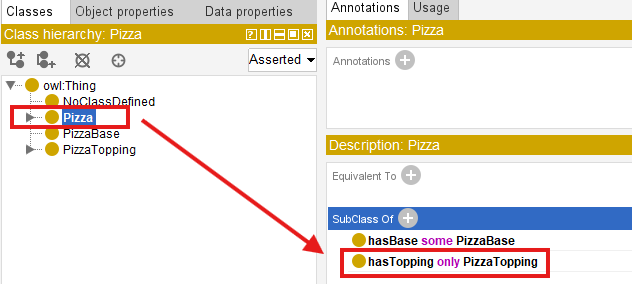
This expression tells ontology:
whenever a pizza contains toppings, all toppings must belong to
PizzaTopping.
Notice again: ontology is NOT requiring toppings to exist!
Instead, ontology governs:
the semantic validity of toppings if they exist.
To better understand this behavior, let us intentionally construct:
semantically problematic data.
Create an individual such as StrangePizza under NamedPizza:
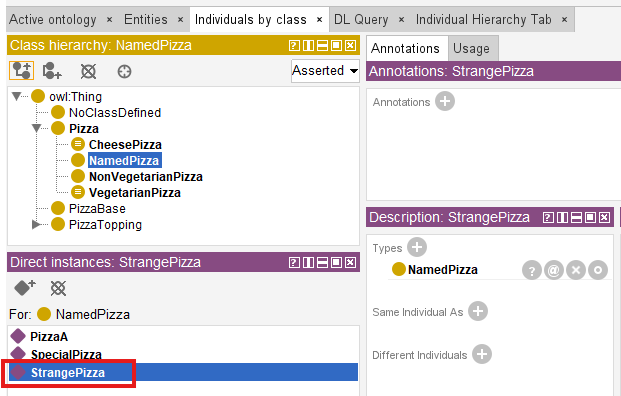
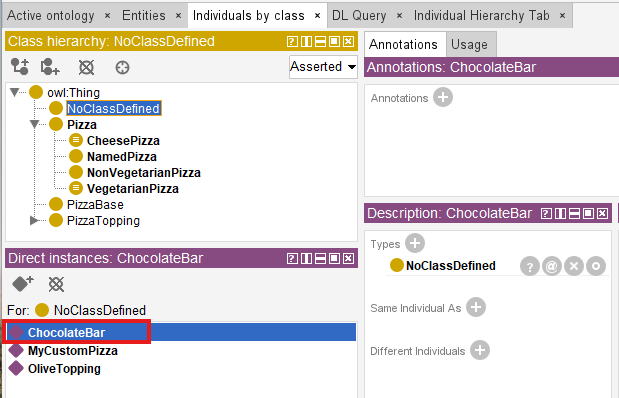
Then create another individual ChocolateBar that does NOT belong to PizzaTopping, let’s create under our previous class NoClassDefined for simplicity:
Now connect them through StrangePizza hasTopping ChocolateBar relationship:
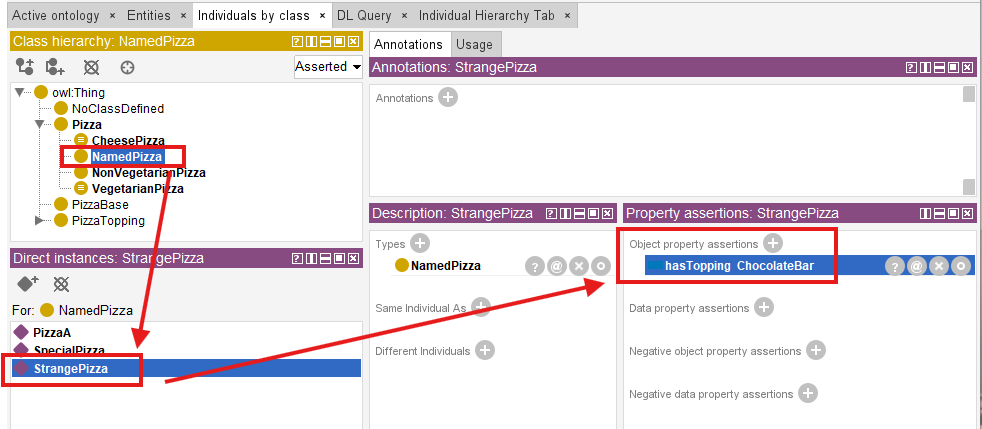
At first, Protégé may not immediately indicate a problem.
This sometimes indeed surprises beginners.
Because ontology editors often separate:
assertion
from:
reasoning.
Protégé first records:
stated knowledge.
Only after synchronization does the reasoner begin:
evaluating semantic consequences.
Once the reasoner executes:
ontology starts logically evaluating the restriction.
Importantly, the reasoner does NOT ask:
“Does this pizza have toppings?”
Instead, it asks:
“Do all toppings satisfy the expected semantic type?”
This distinction matters!
Because ontology validation focuses on meaning, not merely existence.
Depending on how the ontology is modeled, several outcomes may occur.
The reasoner may identify inconsistency, unsatisfied class membership, or classification failure.
The exact behavior depends upon whether disjointness, equivalent classes, or additional constraints exist elsewhere in the ontology.
This experiment reveals an important ontology engineering principle:
universal restriction behaves like a semantic quality monitor.
Rather than merely storing connected relationships, ontology continuously evaluates:
whether relationships remain semantically trustworthy.
For enterprise architects, this idea is particularly important.
Because many enterprise systems fail not because:
their relationships are absent,
but because:
relationships become semantically polluted.
Let us look at one example:
an enterprise graph may technically allow following relationship:
Employee belongsToDepartment Server01
The relationship exists.
The database accepts it. (Base on the schema design.)
Yet semantically, the meaning is incorrect.
Universal restriction provides a mechanism for ontology to detect such kind of:
semantic drift
before invalid meaning propagates throughout enterprise knowledge models.
A useful way to summarize the distinction is:
Range$\rightarrow$ relationship expectationonly$\rightarrow$ semantic validation
This is why only often behaves like:
a semantic guardian.
Protecting ontology not from missing data, but from “incorrect meaning.
=== Interesting Reading: Semantic Drift in Enterprise Knowledge Models ===
Universal restriction (only) provides a mechanism for ontology to detect semantic drift before any invalid meaning propagates throughout enterprise knowledge models.
Semantic drift occurs when a relationship gradually deviates from its intended meaning over time, often through incremental, seemingly harmless assertions.
For example, an ontology initially enforces:
Application hostedOn only Infrastructure
Over months of maintenance, a modeler adds:
Application hostedOn VendorContract
Because no only constraint was defined for hostedOn, the ontology silently accepts this new relationship. Over time, the semantic boundary erodes (“poisoned”). Queries that rely on hostedOn to locate infrastructure now return VendorContracts, breaking impact analysis, security compliance, and also dependency tracing.
Formally, semantic drift can be defined as:
A gradual violation of the universal restriction $\forall R.C$ where the set of observed relationships $R(x,y)$ expands to include individual $y$ that are not in the intended target class $C$, without the ontology detecting the violation.
Universal restriction acts as a semantic invariant.
The reasoner continuously evaluates:
$\forall x,y: (x,y) \in R \rightarrow y \in C$
If a counter-example appears, the ontology flags an inconsistency or prevents the invalid relation ship from being trusted. This transforms ontology from a passive schema into an active semantic guardian, capable of detecting and preventing meaning erosion at scale.
In an enterprise environment, where thousands or millions of relationships may be added/updated by different teams over years, universal restriction becomes an essential tool for maintaining semantic integrity across the entire knowledge graph.
=== END ===
14.9 Combining some and only – The Classic VegetarianPizza Pattern
At this stage, you may naturally being asking an important question:
If existential restriction (
some) and universal restriction (only) solve different semantic problems, can ontology combine them?
The answer is:
Yes – and this is where ontology becomes significantly more powerful!
In practical ontology engineering, meaningful concepts are rarely defined through a single restriction.
Instead, ontology begins expressing:
semantic identity through combinations of logical constraints.
One of the most well-known examples appears in VegetarianPizza.
Consider the following OWL definition:
VegetarianPizza EquivalentTo
Pizza
and (hasTopping some VegetableTopping)
and (hasTopping only VegetableTopping)
Reflect into Protégé, as below setting:
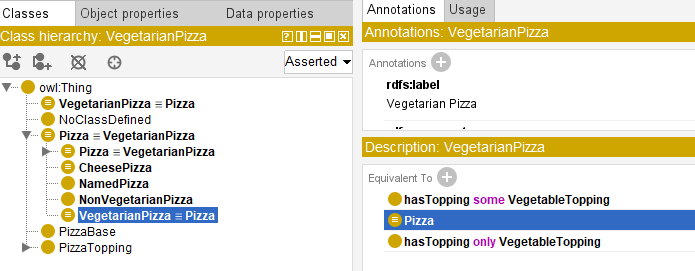
At first glance, this expression may appear repetitive.
After all, both restrictions reference VegetableTopping.
However, each restriction performs a completely different semantic role.
hasTopping some VegetableToppingensures that at least one vegetable topping exists.hasTopping only VegetableToppingensures that every topping must be a vegetable.
Neither alone is sufficient. Only the combination of some and only creates a complete semantic definition.
To understand why both are necessary, it would be helpful to first examine:
why isolated restrictions are incomplete.
14.9.1 Why some Alone Is Not Enough?
Suppose ontology only defines hasTopping some VegetableTopping, this means:
at least one vegetable topping must exist.
At first glance, this may seem sufficient to describing:
a vegetarian pizza.
However, consider the following situation:
PizzaA hasTopping MushroomTopping
PizzaA hasTopping PepperoniTopping
Ontology evaluates hasTopping some VegetableTopping and immediately succeeds.
Why?
Because ontology finds:
qualifying evidence.
The pizza contains MushroomTopping.
Then the existential condition therefore succeeds.
However, the pizza still contains PepperoniTopping, which clearly violates vegetarian meaning.
This illustrates an important ontology engineering lesson:
existential restriction validates participation – NOT semantic purity.
Or more simply, some ensures:
something acceptable exists.
But it does NOT ensure:
everything remains acceptable.
The reasoner asks:
“Can qualifying evidence be found?”
It does NOT ask:
“Are there any violations?”
Semantic meaning therefore remains incomplete.
14.9.2 Why only Alone Is Not Enough
Now consider the opposite situation.
Suppose ontology defines hasTopping only VegetableTopping.
This restriction states:
if toppings exists, they must all belong to
VegetableTopping.
At first glance, this appears semantically stronger.
However, a subtle logical problem emerges.
Image PizzaB with no toppings at all.
Surprisingly, ontology still consider hasTopping only VegetableTopping to be satisfied.
Why?
Because ontology searches for:
violating evidence.
and in this case:
no violating topping exists.
This follows the mathematical principle introduced earlier:
vacuous truth.
In formal logic, a universal statement remains true unless:
a counterexample exists.
Ontology therefore concludes:
nothing violates the rule.
However, from a human perspective, an empty pizza may not intuitively feel like:
a valid vegetarian pizza.
This highlights an important distinction:
reasoners think logically – NOT intuitively.
Universal restriction provides:
semantic discipline.
But it does NOT require participation.
14.9.3 Why Logical Composition Matters
Ontology becomes significantly more expressive when both restrictions are combined.
Consider again:
VegetarianPizaa EquivalentTo
Pizza
and (hasTopping some VegetableTopping)
and (hasTopping only VegetableTopping)
Together, the restrictions now express two independent requirements:
- At least one vegetable topping must exist, and
- All toppings must remain vegetable toppings.
The first restriction guarantees:
semantic participation.
The second restriction guarantees:
semantic consistency.
Only together do they express:
authentic vegetarian meaning.
This reveals one of ontology engineering’s most important principles:
meaning rarely emerges from a single rule.
Instead:
meaning emerges from the interaction of multiple logical restrictions.
A useful mental model can be thought as:
some$\rightarrow$ participationonly$\rightarrow$ discipline
Together, they produce:
semantic identity.
Ontology therefore moves beyond:
relationship storage
toward:
governed conceptual meaning.
This is one of the reasons ontology differs fundamentally from traditional databases.
Databases typically store facts.
Ontology additionally governs what facts mean.
14.10 Implementing some and only in Graph Database - A Neo4j Perspective
At this point, you may reasonably ask:
If existential and universal restrictions are so powerful, can similar logic be implemented in a graph database such as Neo4j?
The answer is:
Yes – but with important limitations.
This distinction is particularly important because many enterprise practitioners initially assume:
Neo4j = Ontology
or:
Knowledge Graph automatically means semantic intelligence.
In reality, graph databases and ontologies solve fundamentally different problems.
Neo4j primarily manages connected data.
Ontology additionally governs logical meaning. (note the “additionally” wording)
A graph database excels at:
- relationship storage,
- graph traversal, and
- connected querying.
However, Neo4j does not natively understand $\exist R.C$ or $\forall R.C$, nor does it automatically infer:
- class membership,
- semantic consistency, or,
- logical identity.
Instead, engineers must explicitly implement semantic behavior through:
Cypher queries.
This becomes easier to understand using VegetarianPizza.
Suppose Neo4j contains below relationship:
(:Pizza)-[:HAS_TOPPING]->(:Topping)
You can use below Cypher to create these 2 nodes and 1 relationship (note: this is just for demo purpose, using below query you’ll create two actual instances as well):
CREATE (:Pizza)-[:HAS_TOPPING]->(:Topping)
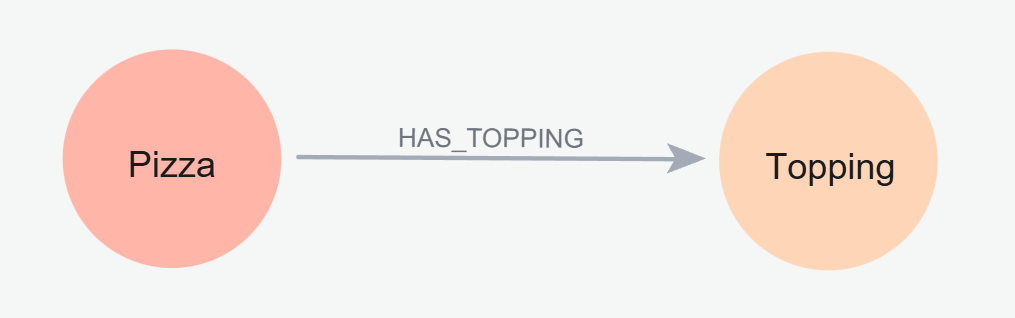
A pizza may connect to MushroomTopping, TomatoTopping, or PepperoniTopping.
Following Cypher queries are used to create these new relationships:
MERGE (p1:Pizza {name:"MyPizza1"})
MERGE (p2:Pizza {name:"MyPizza2"})
MERGE (p3:Pizza {name:"MyPizza3"})
MERGE (t1:Topping {name:"MushroomTopping"})
MERGE (t2:Topping {name:"TomatoTopping"})
MERGE (t3:Topping {name:"PepperoniTopping"})
MERGE (p1)-[:HAS_TOPPING]->(t1)
MERGE (p2)-[:HAS_TOPPING]->(t2)
MERGE (p3)-[:HAS_TOPPING]->(t3)
Then you may extract them as below:
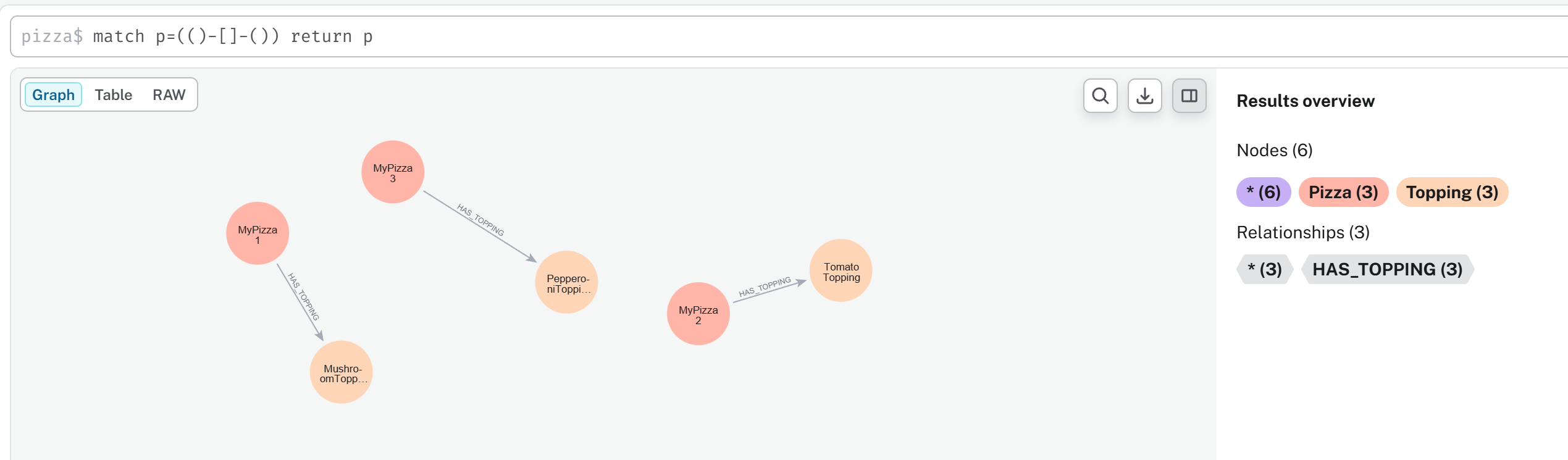
Neo4j itself does not automatically determine:
whether the pizza qualifies as vegetarian.
Instead, semantic interpretation must be manually implemented.
Tip: You may find the working Neo4j dump database in ebook’s neo4j subfolder.
14.10.1 Implementing Existential Restriction (some) in Neo4j
Recall earlier hasTopping some VegetableTopping means:
at least one vegetable topping must exist.
In mathematical notation:
$\exist : \text{hasTopping}.\text{VegetableTopping}$
This expression asks:
“Can qualifying evidence be found?”
Inside Neo4j, this behavior can be approximated using:
MATCH (p:Pizza)
WHERE EXISTS {
  MATCH (p)-[:HAS_TOPPING]->(:VegetableTopping)
}
RETURN p.name AS Pizza
To practice above query, we need to add VegetableTopping as another node in Neo4j, then double assign MushroomTopping and TomatoTopping to this new node:
MATCH (n:Topping {name:"MushroomTopping"}), (m:Topping {name:"TomatoTopping"})
SET n:VegetableTopping
SET m:VegetableTopping
RETURN m, n LIMIT 25;
After above preparation, using CALL db.schema.visualization, you can see below schema:
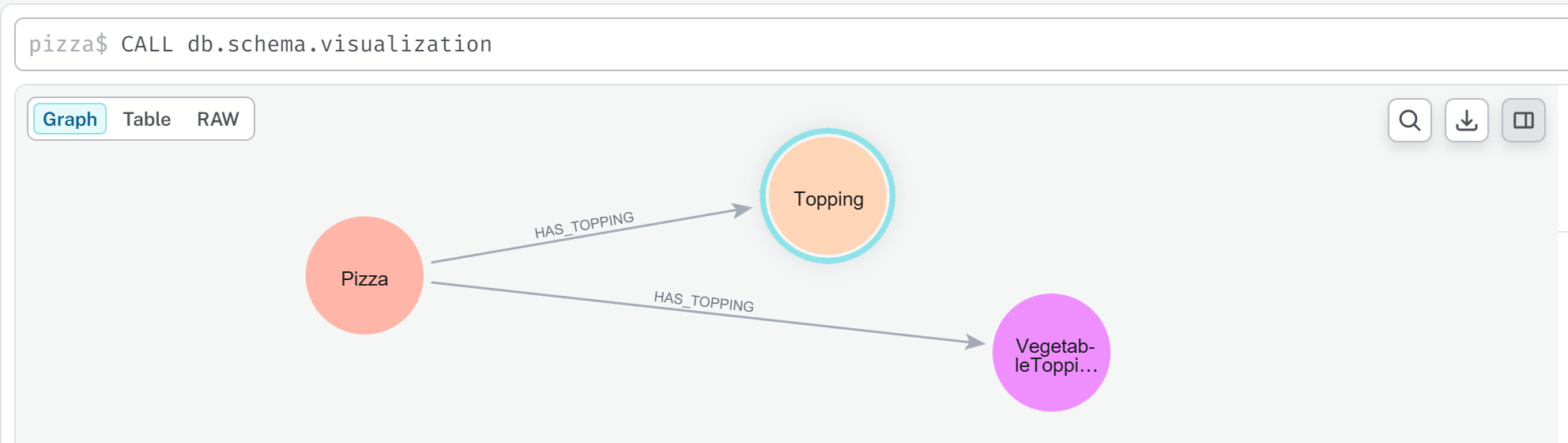
Now, you may execute previous Cypher query, and get result MyPizza:
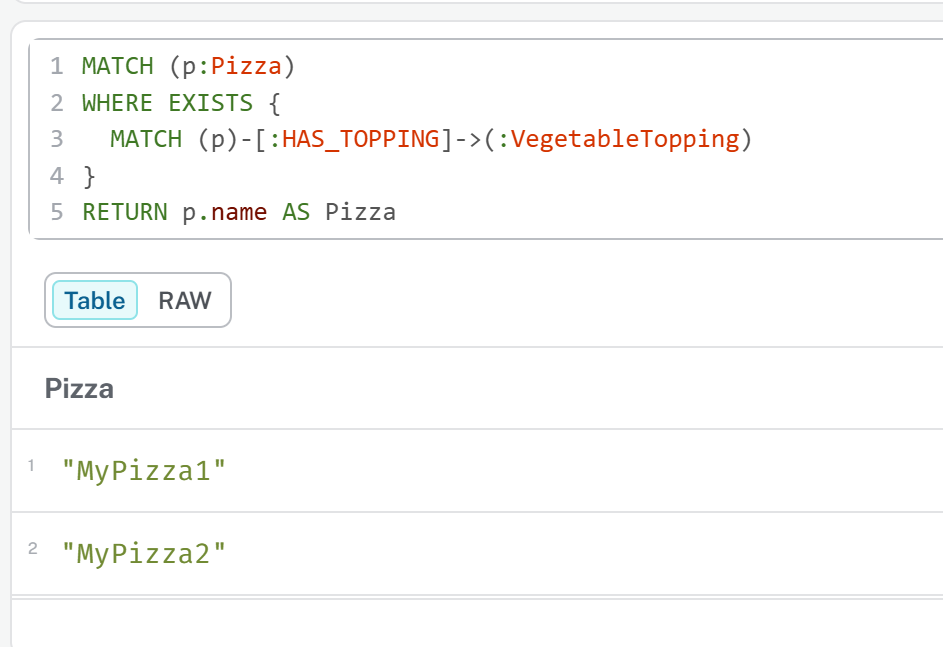
Notice the similarity.
The Cypher keyword EXISTS functions conceptually like:
existential search.
Neo4j asks:
“Does there exist at least one path to
VegetableTopping?”
If answer is Yes, the pizza satisfies the condition.
However, an important difference remains.
Neo4j executes an explicit query.
While ontology instead performs automatic reasoning.
Once semantic restrictions are defined, the reasoner continuously evaluates:
logical consequences.
Not require engineers repeatedly writing validation logic like in Neo4j.
14.10.2 Implementing Universal Restriction (only) in Neo4j
Now consider: hasTopping only VegetableTopping.
In mathematical notation: $\forall : hasTopping.VegetableTopping$.
Unlike existential restriction, universal restriction asks:
“Are all relationships semantically valid?”
This creates an interesting challenge.
Neo4j has no direct equivalent for $\forall$, instead, universal semantic are typically approximated through:
violation detection.
Rather than proving everything is valid.
Neo4j attempts to prove nothing invalid exists (or say “nothing is not invalid”)
For example below Cypher query:
MATCH (p:Pizza)
WHERE NOT EXISTS {
  MATCH (p)-[:HAS_TOPPING]->(t)
  WHERE NOT t:VegetableTopping
}
RETURN p.name AS VegetarianCandidate
You may see below result:
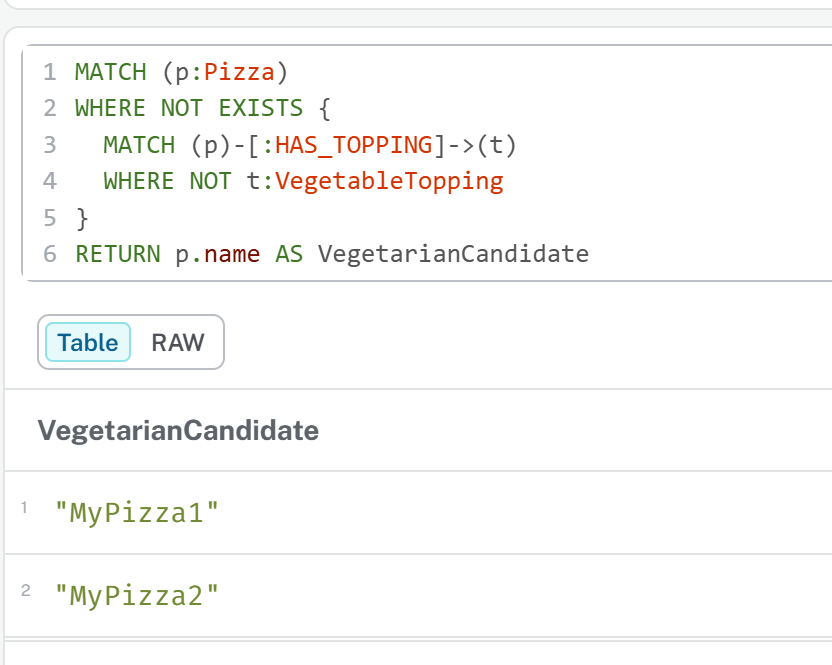
[!Note] Why here still
MyPizza1andMyPizza2?
This query asks:
“Can any invalid topping be found?”
If no violating topping exists, the pizza passes validation.
This logic closely resembles $\forall : hasTopping.VegetableTopping$ where semantic correctness is evaluated through:
absence of contradiction.
Notice how this aligns perfectly with the reasoning distinction discussed earlier:
some$\rightarrow$ for qualifying evidenceonly$\rightarrow$ for violating evidence
Ontology and Cypher therefore share:
similar logical goals.
But they implement them differently.
14.10.3 Combining some and only in Neo4j
To simulate:
VegetarianPizza EquivalentTo
Pizza
and (hasTopping some VegetableTopping)
and (hasTopping only VegetableTopping)
Neo4j must manually combine both logical conditions.
Below is the Cypher query:
MATCH (p:Pizza)
WHERE EXISTS {
  MATCH (p)-[:HAS_TOPPING]->(:VegetableTopping)
}
AND NOT EXISTS {
  MATCH (p)-[:HAS_TOPPING]->(t)
  WHERE NOT t:VegetableTopping
}
RETURN p.name AS VegetarianPizza
Result as below:
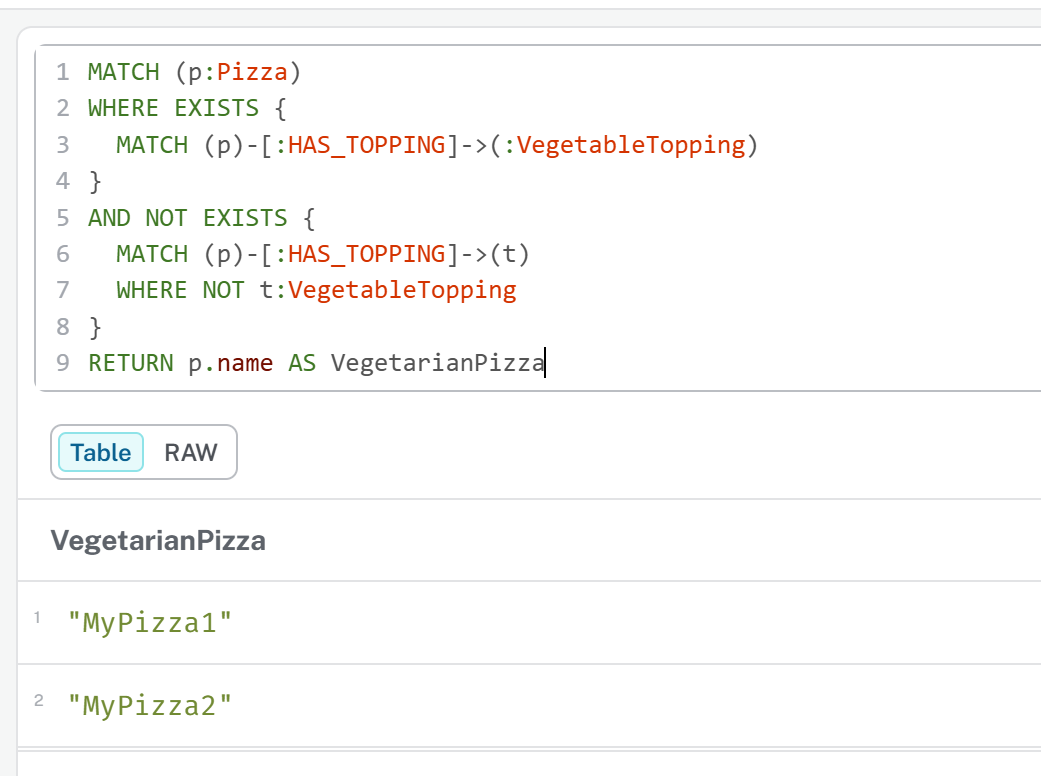
This query approximates ontology semantics by enforcing:
- At least one vegetable topping exists, and
- No invalid topping exists
The result may appear similar to OWL reasoning.
However, the implementation philosophy remains fundamentally different.
Neo4j performs procedural semantic checking.
Ontology performs declarative semantic reasoning.
In Neo4j, engineers must repeatedly write logic describing:
how validation should happen.
In ontology, meaning becomes:
part of the model itself.
The reasoner automatically performs inference, validation and classification.
This reveals an important architectural distinction:
- Neo4j $\rightarrow$ relationship intelligence
- OWL $\rightarrow$ semantic intelligence
Or more precisely:
- Graph Database $\rightarrow$ connected facts
- Ontology $\rightarrow$ governed meaning
This distinction becomes increasingly important as enterprise knowledge graphs scale.
Without ontology, semantic logic often becomes scattered across:
- Cypher queries,
- applications,
- APIs, and
- business rules.
Over time, semantic governance becomes fragmented.
Ontology instead centralizes:
meaning itself.
Meaning no longer lives only inside:
application code.
It becomes:
an explicit enterprise asset.
14.10.4 Cypher Query vs. Pellet Reasoner vs. Open World Assumption
Sections 14.10.1 through 14.10.3 established a practical bridge between OWL restrictions and Cypher queries in Noe4j:
- Section 14.10.1 demonstrated how to implement existential restriction (
some) using pattern matching withMATCHandWHEREclauses. - Section 14.10.2 showed the implementation of universal restriction (
only) usingNOT EXISTSto detect invalid relationships. - Section 14.10.3 then combined both restrictions, illustrating how complex semantic requirements – such as “a pizza must have at least one cheese topping and no non-pizza toppings” – can be expressed as graph patterns.
However, this pedagogical bridge – while valuable for initial understanding and hands-on experimentation – carries a significant risk:
it may obscure two foundational semantic differences that distinguish OWL reasoning from graph database querying.
First, as discussed in 14.7.4, OWL reasoners operate under the Open World Assumption (OWA), while Neo4j (like most property graph databases) operates under the Closed World Assumption (CWA).
Second, and more critically, the Cypher implementations in 14.10.1~14.10.3 treat some and only as query patterns that return results, whereas an OWL reasoner treats them as logical axioms that derive new knowledge.
To build truly robust executable knowledge architectures, an ontology engineer must understand how both restriction types behave under both world assumptions, and how they contrast with the property graph querying paradigm demonstrated in the previous three sections.
This section provides a two-dimension comparative analysis using a unified scenario. We keep extending our Pizza.owl knowledge base to evaluate both:
- Existential Restriction (
some):hasTopping some CheeseTopping– “At least one cheese topping must exist.” - Universal Restriction (
only):hasTopping only CheeseTopping– “If toppings exist, they must all be PizzaToppings.”
Example Scenario Definition
Ontology Definition:
Existential Rule (some):
  CheesePizza EquivalentTo: Pizza and (hasTopping some CheeseTopping)

Universal Rule (only):
  CleanPizza EquivalentTo: Pizza and (hasTopping only PizzaTopping)
Knowledge Base (Asserted Facts):
| Individual | Asserted Type | Asserted Relationships | Class Hierarchy |
|---|---|---|---|
| PizzaA | Pizza |
hasTopping MozzarellaTopping |
MozzarellaTopping $\sqsubseteq$ CheeseTopping $\sqsubseteq$ PizzaTopping |
| PizzaB | Pizza |
(no hasTopping assertions) |
— |
| PizzaC | Pizza |
hasTopping ChocolateTopping |
ChocolateTopping $\sqsubseteq$ CandyTopping (CandyTopping $\sqcap$ PizzaTopping = owl:Nothing) |
| PizzaD | Pizza |
<li>hasTopping MozzarellaTopping</li><li>hasTopping ChocolateTopping</li> |
(As above) |
Initialize ontology in Protégé:
New working ontology file: /ebook/rdf/pizza-ebook_14.10.4.rdf.
Base on above asserted facts, you may find following initialized knowledge:
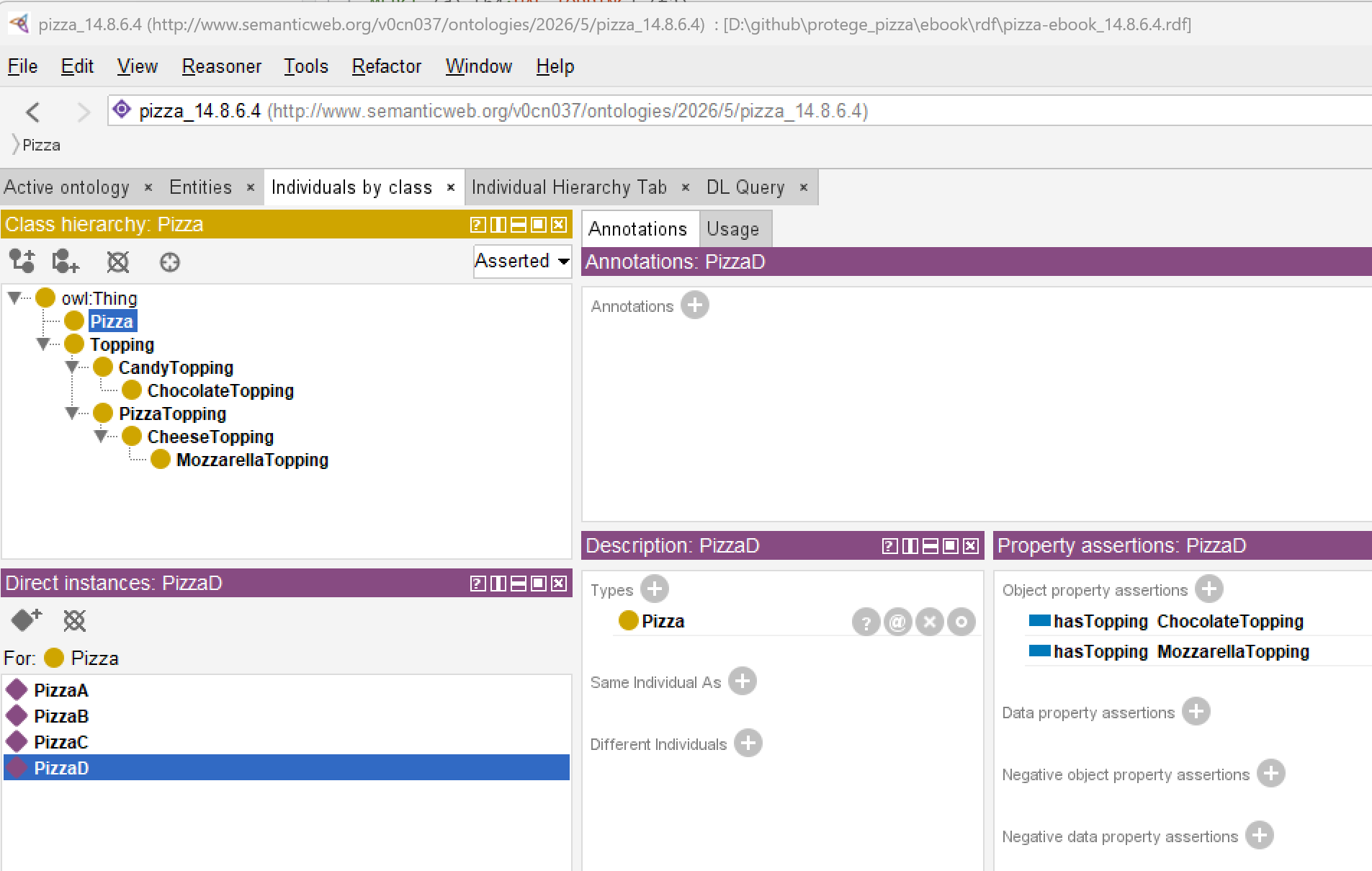
- Set
Disjoint WithbetweenPizzaToppingandCandyTopping - Set proper Domain and Range to relationship
hasTopping - Create necessary instances for building up the relationships.
Initialize graph database in Neo4j:
Using following Cypher query to create all asserted facts:
MERGE (a:Pizza {name:"PizzaA"})-[h1:HAS_TOPPING]-(t1:Topping {name:"MozzarellaTopping"})
MERGE (b:Pizza {name:"PizzaB"})
MERGE (c:Pizza {name:"PizzaC"})-[h2:HAS_TOPPING]-(t2:Topping {name:"ChocolateTopping"})
MERGE (d:Pizza {name:"PizzaD"})-[h3:HAS_TOPPING]-(t1)
MERGE (d)-[h4:HAS_TOPPING]-(t2)
MERGE (t3:Topping {name:"CheeseTopping"})
MERGE (t4:Topping {name:"PizzaTopping"})
MERGE (t5:Topping {name:"CandyTopping"})
MERGE (t1)-[c1:CHILD_OF]->(t3)-[p1:PARENT_OF]->(t1)
MERGE (t3)-[c2:CHILD_OF]->(t4)-[p2:PARENT_OF]->(t3)
MERGE (t2)-[c3:CHILD_OF]->(t5)-[p3:PARENT_OF]->(t2)
RETURN a,b,c,d,t1,t2,h1,h2,h3,h4,t3,t4,t5,c1,c2,c3,p1,p2,p3
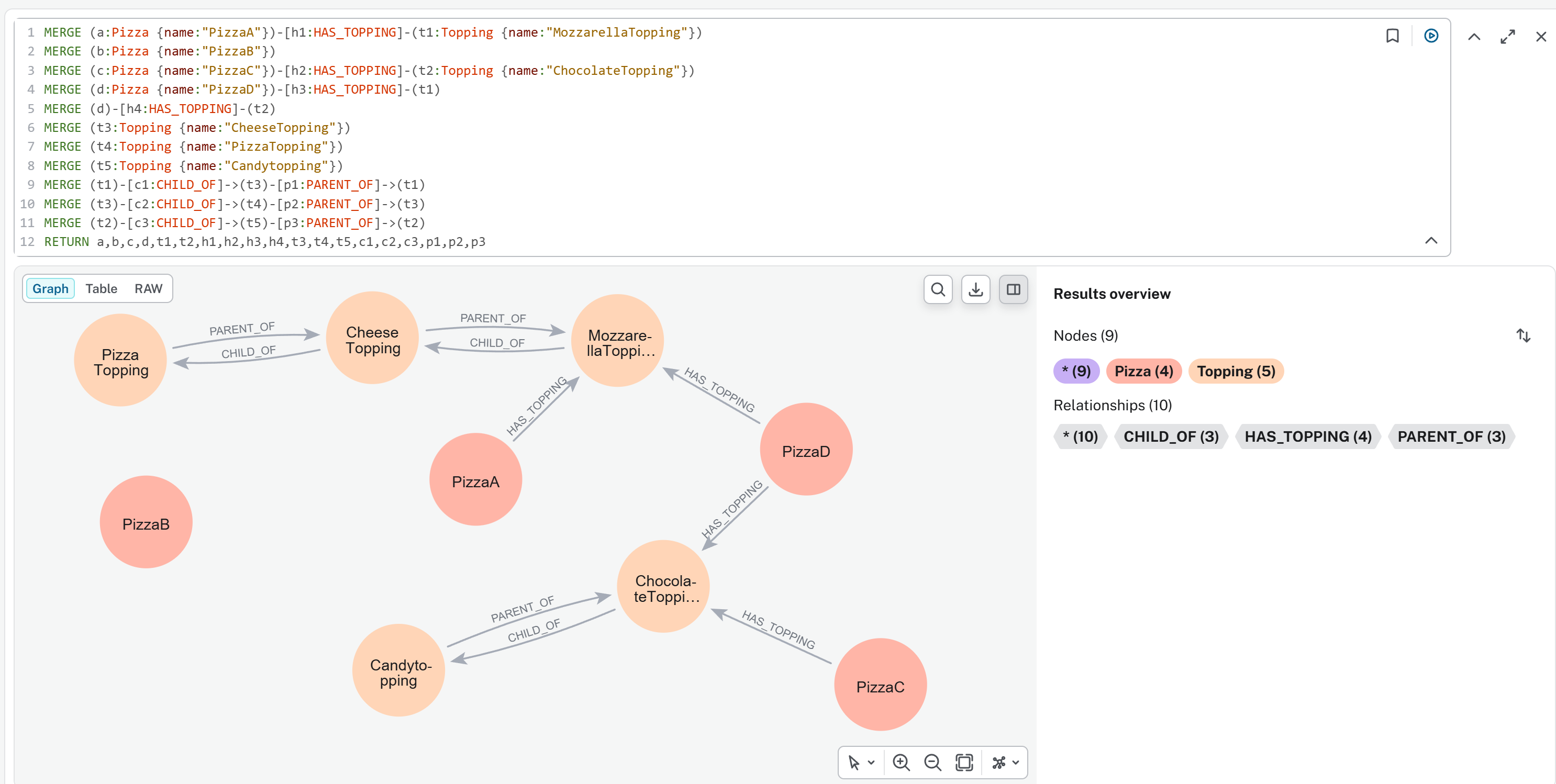
- Use two direction
PARENT_OFandCHILD_OFfor inverse class hierarchical structure
Since we have maximum two levels class hierarchy structure, to simulate the Protégé’s Parent/Child inferencing behavior into Neo4j, run below Cypher query twice:
MATCH (p:Pizza)-[r1:HAS_TOPPING]->(t1:Topping)-[r2:CHILD_OF]->(t2:Topping)
MERGE (p)-[r3:HAS_TOPPING]->(t2)
RETURN p,t1,t2,r1,r2,r3
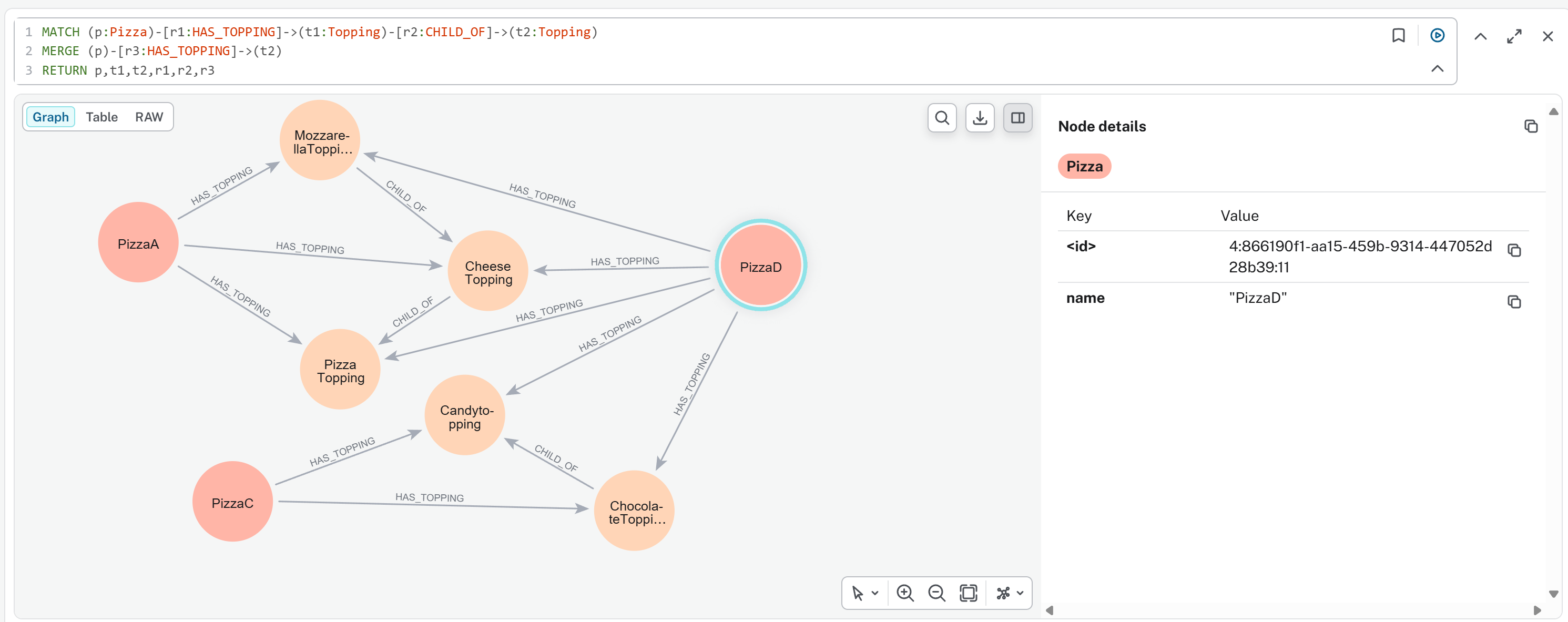
Note: here we don’t see PizzaB since it has no topping relationship.
Part 1: Existential Restriction (some) – “At Least One Must Exist”
Goal: Determine whether each individual satisfies hasTopping some CheeseTopping (i.e., is a CheesePizza).
Recall from 14.10.1 that the Cypher implementation of some uses a single pattern match:
MATCH (p:Pizza)-[:HAS_TOPPING]->(t1:Topping)
WHERE toLower(t1.name) CONTAINS "cheese"
RETURN p
You get PizzaA and PizzaD
Note: we don’t create CheeseTopping as another node in Neo4j, it’s one instance of Topping node and we use WHERE clause to filter that.
Now compare this closed-world query against OWL open-world reasoning:
| Individual | Cypher (CWA) - per 14.10.1 | Pellet Reasoner (OWA) | OWA Formal Conclusion |
|---|---|---|---|
| PizzaA | ✅ Returned - Pattern matches | ✅ Inferred as CheesePizza - Evidence found |
True - Sufficient evidence exists |
| PizzaB | ❌ Not returned - No matching relationship | ❌ Not inferred - Also not inferred as $\neg CheesePizza$ | Unknown - Missing information; future facts could change this |
| PizzaC | ❌ Not returned - Target is not CheeseTopping |
❌ Not inferred as CheesePizza - Condition false for known relationship |
False - Evidence exists and definitively fails the condition |
| PizzaD | ✅ Returned - At least one relationship satisfies pattern | ✅ Inferred as CheesePizza - MozzarellaTopping satisfies condition |
True - One valid relationship is sufficient; invalid relationships are irrelevant |
Key Insight for some:
- Under OWA, the existential restriction is monotonic. Once satisfied (
PizzaD), it returns satisfied regardless of additional assertions. The reasoner searches for at least one piece of validating evidence. - The Cypher query from 14.8.6.1 and customized here correctly identifies
PizzaAandPizzaD, but it cannot distinguishPizzaB(unknown) fromPizzaC(false) – both simply “not returned”. This conflation is the primary limitation of the closed-world emulation.
Part 2: Universal Restriction (only) – “Everything Must Conform”
Goal: Determine whether each individual satisfies hasTopping only PizzaTopping (i.e., has no topping outside the PizzaTopping class).
Recall from 14.10.2 that the Cypher implementation of only uses NOT EXISTS to detect violations:
MATCH (p:Pizza)
WHERE NOT EXISTS {
  (p)-[:HAS_TOPPING]->(t:Topping)
  WHERE NOT toLower(t.name) CONTAINS "pizza"
}
RETURN p
Result is PizzaB in the Neo4j graph; however, our testing graph doesn’t return PizzaA due to we don’t complicated query to check Parent/Child context here, in reality, PizzaA si also fulfill the CWA.
Now compare this against OWL open-world reasoning:
| Individual | Cypher (CWA) - per 14.10.2 | Pellet Reasoner (OWA) | OWA Formal Conclusion |
|---|---|---|---|
| PizzaA | ✅ Returned - No invalid topping found | ✅ Satisfies restriction - All relationships valid | True - All asserted relationships are valid |
| PizzaB | ✅ Returned (vacuously) - See vacuous truth discussion in 14.8.3 | True (vacuously) - No counterexample exists | |
| PizzaC | ❌ Not returned - Invalid topping detected | ❌ Violates restriction - Counterexample found | False - Definitive counterexample exists |
| PizzaD | ❌ Not returned - The ChocolateTopping is invalid, even though MozzarellaTopping is valid |
❌ Violates restriction - Universal quantifier requires all relationships to be valid | False - A single counterexample falsifies universal condition |
Key Insight for only:
- Under OWA, the universal restriction is falsified by a single counterexample. The reasoner searches for any violating evidence.
- The Cypher query from 14.10.2 correctly identifies valid pizzas (A and B) – has explained result of A – and excludes invalid ones (C and D). However, like the
somecase, it conflatesPizzaB(vacuously true) withPizzaA(genuinely true), and cannot represent the logical distinction between “no toppings yet” and “has only valid toppings.”
Part 3: Combining some and only – The Composite Pattern
Section 14.10.3 demonstrated how to combine both restrictions in a single Cypher query, identifying pizzas that satisfy both conditions: at least one cheese topping AND no non-pizza toppings.
MATCH (p:Pizza)
WHERE (p)-[:HAS_TOPPING]->(:CheeseTopping)
AND NOT EXISTS {
  (p)-[:HAS_TOPPING]->(t:Topping)
  WHERE NOT toLower(t.name) CONTAINS "pizza"
}
RETURN p
Note: it should have PizzaA returned.
The following table shows the integrated results across all four individuals, comparing the Cypher composite query against OWL reasoning for the combined definition:
Combined Definition:
GoodPizza EquivalentTo
Pizza
and (hasTopping some CheeseTopping)
and (hasTopping only PizzaTopping)
| Individual | Cypher (CWA) - per 14.10.3 | Pellet Reasoner (OWA) | OWA Formal Conclusion |
|---|---|---|---|
| PizzaA | ✅ Returned - Has cheese topping AND all toppings valid | ✅ Inferred as GoodPizza - Both conditions satisfied | True - Satisfies both existential and universal requirements |
| PizzaB | ❌ Not returned - Fails some condition (no cheese topping) |
❌ Not inferred - some unknown; only vacuous but insufficient |
Unknown - Mising information for condition |
| PizzaC | ❌ Not returned - Fails some (no cheese topping) AND fails only (invalid topping) |
❌ Not inferred - some false, only false |
False - Definitive failure on both dimensions |
| PizzaD | ❌ Not returned - Has cheese topping (passes some) BUT fails only (invalid topping exists) |
❌ Not inferred as GoodPizza - only condition violated |
False - Universal restriction fails despite existential satisfaction |
Critical Observation - PizzaD:
- This individual reveals the non-complementary nature of
someandonly. - A pizza can simultaneously satisfy an existential restriction (it has at least one cheese topping) and violate a universal restriction (it also has a non-pizza topping).
- In the composite query from 14.10.3,
PizzaDis correctly excluded. - However, an OWL reasoners provides additional insight:
PizzaDis aCheesePizza(from Part 1) but is NOT aGoodPizza(from Part 3). - This distinction – that an individual can belong to one inferred class but not another – is a form of logical nuance that Cypher’s flat pattern matching CANNOT express without explicitly modeling both classifications.
Part 4: Integrated Comparison - some vs only Across Both Worlds
The following table integrates both restriction types, showing the classification outcomes for each individual under each condition, comparing Cypher (from 14.10.1~14.10.3) against OWL reasoning:
| Individual | some CheeseTopping (Cypher/CWA) |
some CheeseTopping (Pellet/OWA) |
only PizzaTopping (Cypher/CWA) |
only PizzaTopping (Pellet/OWA) |
|---|---|---|---|---|
| PizzaA | ✅ True | ✅ True | ✅ True | ✅ True |
| PizzaB | ❌ False | ❓ Unknown | ✅ True | ✅ True (vacuous) |
| PizzaC | ❌ False | ❌ False | ❌ False | ❌ False |
| PizzaD | ✅ True | ✅ True | ❌ False | ❌ False |
Critical Observation – the Unknown Column:
- The most significant difference between the Cypher columns and the OWA columns appears in
PizzaBfor thesomecondition. - Cypher returns
False(the individual is excluded from results), while OWL returnsunknown(the individual cannot be classified yet). - The difference is not a bug or an implementation detail – it is the direct consequence of the Open World Assumption.
- In enterprise scenarios where data arrives incrementally (e.g., a pizza order system where toppings are added over time),
Unknownis often the correct and more useful answer thanFalse.
Part 5: Why the Difference Matters - From Query to Reasoning
The Cypher implementations in 14.10.1~14.10.3 are operational filters. They answer the questions:
“Given the data currently in the graph, which individuals match my explicit pattern?”
OWL reasoning, by contrast, answers a deeper question:
“Given the logical axioms defined in the ontology and the data currently available, what class memberships can be necessarily inferred – and which remain possibly true?”
| Dimension | Cypher in Neo4j (14.10.1~14.10.3) | OWL Reasoner (e.g. Pellet) |
|---|---|---|
| Work Assumption | Closed World: Missing = False | Open World: Missing = Unknown |
| Restriction Type | Written as explicit MATCH or NOT EXISTS patterns |
Declared as logical axioms in the ontology |
| Output | Query result set (individuals matching pattern) | Inferred class memberships (new rdf:type assertions) |
Handling of PizzaB |
Excluded from some query (False) |
Not classified as CheesePizza, but not classified as $\neg$CheesePizza either (Unknown) |
| Composability | Manual composition via AND / OR in query |
Automatic composition via logical conjunction in class expression |
| Maintenance | Query logic lives in application code | Logical axioms live in ontology; all queries benefit automatically |
Part 6: Practical Guidance - When to Use Each Approach
| Scenario | Recommended Approach | Rationale |
|---|---|---|
| Real-time filtering on stable complete data | Use Cypher patterns (14.10.1~14.10.3) directly on Neo4j | <li>High performance</li><li>Closed world assumption is valid when data is known to be complete</li> |
| Incremental data integration from multiple sources | Use OWL reasoner + materialize inferred types to Neo4j | <li>Open world prevents premature false negatives</li><li>Reasoner handles missing data gracefully</li> |
| Data quality validation (missing required fields) | <li>Use some restriction with OWL reasoner</li><li>Query for individuals not satisfying the restriction</li> |
Under OWA, missing data flags as “incomplete” (Unknown), not “invalid” (false) – more actionable for data stewardship |
| Compliance checking (forbidden relationships) | <li>Use only restriction with OWL reasoner</li><li>Any violation yields definitive False</li> |
<li>Universal restriction catch type violations directly</li><li>No ambiguity</li> |
Detecting “partially correct” data (like PizzaD) |
<li>Combine both restrictions</li><li>Query for individuals satisfying some but failing only |
Identifies data that has required components but also contains invalid elements – often signals need for human review |
| Production dashboards on stable data | Run Cypher queries on a materialized inference graph | First use reasoner to compute all inferred types, then export to Neo4j for high-performance operational queries |
Summary: The Logical Bridge Between Sections 14.10.1~14.10.3 and True OWL Reasoning
Let’s take a breathe before moving to next section.
The Cypher patterns in 14.10.1~14.10.3 answers: “What matches my explicit patter right now in this closed graph?”
An OWL reasoner answers: “What must be true given my logical axioms and available data – and what remains possibly true – under open-world semantics?”
The implementations in 14.10.1 (some as MATCH), 14.10.2 (only as NOT EXISTS), and 14.10.3 (composite patters) are excellent pedagogical (and self-learning) tools.
They allow developers familiar with graph databases to experience the filtering effect of OWL restrictions without immediately learning description logic.
However, as this section has demonstrated, these Cypher patterns are simulations, not equivalents.
- They cannot represent the open-world distinction between
FalseandUnknown(PizzaBforsome), - They cannot automatically derive new classifications without being explicitly written for each query, and
- They cannot capture the logical nuance that an individual like
PizzaDcan be aCheesePizza(satisfyingsome) while not being aGoodPizza(failingonly).
Understanding these differences – mastering the distinct behaviors of some and only under both closed-world and open-world assumptions – is a fundamental maturity milestone in ontology engineering.
As you move from writing Cypher queries (sections 14.10.1~14.10.3) to deploying OWL reasoners in executable knowledge architectures (EKA), this distinction will determine whether your semantic system merely filters data or truly understands it.
Congratulations for you to read through this chapter until here, this is a big long journey for myself as well to make existential and universal restriction clearer. If you feel any parts uncertain, read again and hands-on practice with your Protégé and Neo4j.
14.11 EKA Perspective – Restriction as Semantic Governance
Throughout this chapter, you explored one of the most important capabilities in OWL ontology engineering:
Property Restriction.
At first glance, restrictions may appear to be merely:
OWL syntax,
or:
Protégé modeling techniques.
Expressions such as:
hasTopping some CheeseTopping or hasTopping only VegetableTopping
may initially feel like technical notation designed only to support:
ontology classification.
However, from the perspective of:
Executable Knowledge Architecture (EKA),
property restrictions represent something far more significant.
They transform ontology from:
a passive relationship model
into:
governed executable semantic logic.
This distinction matters.
Because knowledge graphs alone rarely produce:
meaningful and trustworthy intelligence.
A graph can successfully connect:
Pizza $\rightarrow$ hasTopping $\rightarrow$ Mushroom,
yet, this relationship alone cannot explain:
- whether the pizza should be classified as vegetarian,
- whether semantic expectations are satisfied,
- whether governance policies/rules are violated, or
- whether downstream actions should occur.
In other words, relationships create:
connected knowledge.
Restrictions create:
meaningful semantic behavior.
Seen through the EKA perspective, property restrictions become an essential bridge between:
semantic knowledge
and:
executable intelligence.
Recall the formal EKA tuple introduced in Chapter (00):
$\large{EKA = (K, R, \Theta, \Phi, \Gamma)}$,
where:
- $K$ = Knowledge Graph layer
- $R$ = Reasoning & Rules layer
- $\Theta$ = Trigger layer
- $\Phi$ = Execution layer
- $\Gamma$ = Governance layer
Property restrictions contributes directly across every one of these layers.
14.11.1 Restriction and the Knowledge Graph Layer ($K$)
The first contribution appears in:
$K$ - Knowledge Graph layer.
Recall from Chapter (00):
$K$ represents a set of entities (nodes) and semantic relationships (edges) conforming to an ontology.
Without restrictions, knowledge graphs primarily describe:
connected facts.
For example:
` PizzaA hasTopping MozzarellaTopping`
simply tell us a relationship exists.
This is valuable, but semantically incomplete.
The graph itself cannot determine:
- whether this pizza qualifies as a
CheesePizza, - whether toppings violate semantic expectations, or
- whether business meaning should change.
Property restrictions enrich the knowledge graph by adding:
semantic interpretation.
The graph stops being merely:
connected information.
Instead, it becomes:
semantically meaningful knowledge.
For example:
CheesePizza EquivalentTo Pizza and (hasTopping some CheeseTopping)
adds semantic significance to the graph.
Now, the presence of MozzarellaTopping may imply CheesePizza.
This marks an important shift.
Knowledge graph becomes inferable.
Rather than manually asserted.
Within EKA, restrictions therefore improve:
semantic richness inside the Knowledge Graph layer.
14.11.2 Restriction and the Reasoning & Rules Layer ($R$)
The strongest contribution of Chapter (14) appears in:
$R$ - Reasoning & Rules layer.
As defined in Chapter (00):
$R$ represents a set of inference rules (OWL, SWRL, or custom rules) that derive new facts from $K$.
This chapter introduced one of the most important mechanisms for enabling reasoning:
property restriction logic.
Existential restriction hasTopping some CheeseTopping behaves as:
a reasoning rule.
It establishes a logical condition:
if evidence exists, then semantic consequences may follow.
Similarly,
universal restriction hasTopping only VegetableTopping acts as:
a semantic rule boundary.
It contains:
what relationships remain logical acceptable.
Together these two restrictions become:
executable semantic rules.
Unlike procedural code, restrictions express what must be true, not how to check it.
The reasoner no longer simply stores information.
Now it evaluates:
logical meaning!
Let’s see an example, suppose ontology contains:
CheesePizza EquivalentTo
Pizza
and (hasTopping some CheeseTopping)
and the graph contains PizzaA hasTopping MozzarellaTopping
with:
MozzarellaTopping SubClassOf CheeseTopping
The reasoner may automatically infer PizzaA rdf:type CheesePizza without manual classification.
This is an important maturity shift.
Ontology transitions from:
descriptive modeling
toward:
executable semantic logic.
This is precisely the purpose of:
$R$ - Reasoning & Rules
Knowledge begins producing:
NEW knowledge.
14.11.3 Restriction and the Trigger Layer ($\Theta$)
A less obvious, but highly important contribution appears in:
$\Theta$ - Trigger layer.
Chapter (00) defines:
$\Theta$ as a set of conditions (semantic events, queries, or time-based triggers) that initiate execution.
This perspective becomes particularly interesting when viewed through:
ontology restrictions.
Restrictions can behave as semantic trigger conditions.
Restrictions enable the execution layer to distinguish between ‘data missing’ (treatable) vs. ‘semantic violation’ (escalatable).
Recall different Pizzas we have modeled with restrictions in previous sections, putting them in below execution decision matrix bases on reasoning outcomes:
| Scenario | Data State ($K$) | Reasoning Conclusion ($R$) | Execution Action ($\Theta$) |
|---|---|---|---|
PizzaA |
Has cheese topping | CheesePizza (True) |
Normal processing |
PizzaB |
No topping information | Unknown | Trigger data quality workflow, request completion automatically |
PizzaC |
Has non-cheese topping | Not CheesePizza (False) |
Reject / Alert / Route to manual review |
Note: The $\Theta$ (Trigger) layer is responsible for emitting signals based on reasoning outcomes, while the $\Phi$ (Execution) layer carries out the corresponding actions. (Or in short: $\Theta$ signals, $\Phi$ executes)
Furthermore, let’s switch to enterprise environment, suppose an enterprise ontology defines:
HighRiskServer EquivalentTo
Server
and (hasExposure some CriticalVulnerability)
The moment semantic conditions becomes satisfied:
the trigger activates.
In our Pizza.owl ontology terms, the reasoner may infer PizzaA rdf:type VegetarianPizza once semantic conditions are met.
In enterprise architecture, the same pattern becomes significantly more powerful.
A semantic trigger might initiate when:
- a customer becomes high-value,
- a server becomes high-risk,
- a process violates governance rules, or
- a compliance breach is detected.
The important idea here is:
restrictions create semantic conditions.
These semantic conditions later become executable triggers.
Ontology therefore move beyond:
classification,
toward:
event-driven semantic behavior.
14.11.4 Restriction and the Execution Layer ($\Phi$)
Once triggers activate, knowledge may begin producing:
actions.
This connects directly to:
$\Phi$ - Execution layer.
Chapter (00) defines:
$\Phi$ as a set of actions (API calls, process invocations, alerts, graph updates) that change the real world or the knowledge graph.
This is where ontology begins becoming:
executable.
For example, suppose ontology infer HighRiskServer through property restrictions (see 14.11.2).
This classification may automatically trigger:
- a security alert,
- a ServiceNOW (or other ticketing system) incident registration,
- an API invocation, or
- an automated remediation workflow.
In Neo4j and enterprise knowledge graphs, ontology reasoning may therefore move beyond:
semantic understanding
toward:
operational execution.
Even in the Pizza.owl ontology example, we can imagine semantic outcomes.
A food recommendation engine might automatically suggest:
vegetarian menu options
after ontology infer VegetarianPizza.
This may sound simple.
Yet the architectural implication is significant.
Restrictions are no longer merely:
logic constraints.
They become:
executable decision conditions.
Ontology therefore evolves from:
passive knowledge
toward:
actionable (proactive) intelligence.
14.11.5 Restriction and the Governance Layer ($\Gamma$)
Finally, property restriction contribute strongly to:
$\Gamma$ - Governance layer.
Chapter (00) defines:
$\Gamma$ as constraints, validation rules (SHACL), and access policies that ensure semantic integrity.
This is one of the most important contributions of:
universal restriction (
only).
In earlier sections of this chapter, we observed hasTopping only VegetableTopping acting as:
a semantic boundary.
Rather than merely storing relationships, ontology begin governing:
acceptable meaning!
This becomes increasingly important as enterprise knowledge systems scale.
Because semantic drift naturally emerges.
Relationship continue existing, yet meaning gradually becomes corrupted.
For example, an enterprise graph may accidentally contain:
Employee belongsToDepartment Server01
Technically, the relationship exists.
The database accept it and queries still function.
Yet, semantically, the meaning becomes invalid.
Restrictions help prevent semantic pollution, before inconsistent meaning propagation into:
- reporting,
- automation,
- analytics, or
- decision-making systems.
This emphasis on semantic governance is increasingly recognized beyond ontology engineering communities.
For example, the emerging idea of the:
Semantic Data Charter (SDC)
highlights the importance of:
- trustworthy semantics,
- explainable knowledge,
- embedded semantic consistency, and
- responsible incremental governance of enterprise semantic ecosystems.
As discussed in the foreword by Timothy Cook, organizations must move beyond:
merely connected data
toward:
governed and trustworthy meaning.
This aligns closely with $\Gamma$ - Governance within EKA.
Readers interested in broader semantic governance practices may explore Semantic Data Charter for additional perspectives.
Ultimately, governance ensures semantic systems remain:
- trustworthy,
- explainable, and
- operationally reliable.
14.11.6 Restriction as the Foundation of Executable Intelligence
When viewed across the complete EKA perspective:
property restrictions (existential, universal as discussed) become much more than:
OWL syntax.
They actually become:
semantic execution logic.
The progression introduced throughout this chapter may be summarized as below end-to-end EKA implementation roadmap:
flowchart TD
A[Knowledge Graph - K]-->B[Reasoning & Rules - R]-->C[Trigger Conditions - Θ]
C-->D[Execution Actions - Φ]-->E[Governance Integrity - Γ]-->F[Executable Intelligence]
Chapter (14) represents an important maturity milestone in ontology engineering.
Earlier chapters focused on:
- concepts,
- classes,
- properties
- relationships, and
- semantic structure.
This chapter introduced something fundamentally different:
behavioral semantics.
Ontology no longer merely describes:
what exists,
it increasingly governs:
what should happen.
This transition marks the beginning of:
executable knowledge.
By this stage, you are no longer simply modeling ontology.
You are beginning to engineer:
governed executable semantics.
14.12 EKA Learning Progression Across Chapters
14.12.1 A Milestone Worth Recognition
Before continuing to the final sections of this chapter, it is worth recognizing something important:
Chapter 14 is intentionally longer than previous chapters.
By now, you have likely noticed that this chapter introduced:
- significantly more logical notation,
- more conceptual explanation,
- deeper semantic discussion, and
- more detailed reasoning examples.
This was deliberate.
Because Chapter (14) represents one of the most important conceptual transitions in ontology engineering.
Earlier chapters primarily focused on:
- concepts,
- classes,
- relationships,
- hierarchy,
- individuals, and
- semantic structure.
These ideas are foundational.
However, property restrictions introduce something fundamentally different:
formal semantic logic.
For the first time, ontology modeling moves beyond:
describing what exists.
Instead, you are beginning to model:
- what must exist,
- what is allowed to exist,
- what can be inferred, and
- what logical conditions govern semantic meaning.
This is also where ontology starts becoming:
executable!
In many ways, Chapter (14) marks the transition from:
“Learning Protégé”
toward:
thinking like an ontology engineer.
Concepts such as:
- existential restriction (
some), - universal restriction (
only), - open world assumption,
- semantic constraints, and
- reasoning behavior
form part of the intellectual foundation for nearly all advanced ontology modeling.
Without a strong understanding of these concepts, later topics often become:
- difficult,
- confusing, or
- semantically disconnected.
When I learned Pizza.owl tutorial the first time, I still remember how hard to me to graph the real theory behind those property restrictions.
Because follow the tutorial to play around in Protégé is one thing, but understanding the inter-relationships among those restrictions are the another layer of knowledge.
This is one of the reasons why Chapter (14) now intentionally contains:
- more explanation,
- more examples, and
- deeper reflection (especially I found from mathematic aspects).
The additional depth is not accidental.
It is
architecturally important.
Equally important: if you have reached this point in the book, you have already completed a substantial semantic journey.
You have learned how to:
- model classes,
- design hierarchies,
- define relationships,
- create individuals,
- distinguish types of property,
- apply reasoning,
- govern semantic meaning, and now:
- express formal logic through restrictions.
This is already significantly beyond what many introductory ontology learners experience.
So before moving forward, this may actually be a good moment to:
- take a short break,
- revisit earlier chapters,
- experiment again inside Protégé,
- reflect on what has been learned, or even simply
- celebrate how far you have already come!
Ontology engineering is rarely mastered in a single reading.
It develops gradually through:
- experimentation,
- reflection,
- mistakes, and
- repeated semantic refinement.
By reaching Chapter (14), you are already beginning to think more like:
a professional semantic architect.
With that milestone recognized, this is a good moment to step back and examine:
how all previous chapters collectively contributed toward building on:
Executable Knowledge Architecture (EKA)
14.12.2 Before Your Move Forward: A Quick Self-Assessment
Before continuing to the next section, take a moment to check your understanding of the core concepts introduced in this chapter.
If you can answer these four questions confidently, you have successfully internalized the most important ideas.
If not, no worry, I myself learned this chapter in tutorial for several times, so just consider revisiting the relevant sections before proceeding.
Question 1: What is the Core Difference between some (Existential Restriction) and only (Universal Restriction)?
Can you explain it in your own words, not just by reading the syntax?
Focus on what each restriction asks, what kind of evidence each searches for, and how each behaves when no relationship exists.
Related section: 14.4, 14.8.3
Question 2: Why is only Automatically Satisfied (Vacuously True) When No Relationship Exists?
This is one of the most counter-intuitive aspect of OWL reasoning for beginners.
Can you explain the logical principle of vacuous truth using a simple everyday example, and then connect it back to the Pizza.owl scenario?
Related sections: 14.8.3, Interesting Reading: Vacuous Truth in Formal Logic
Question 3: Why does PizzaB Return False in Cypher (Closed World) but Unknown in OWL Reasoning (Open World)?
PizzaB has no topping assertions.
- Under closed world assumption, missing information means false.
- Under open world assumption, missing information means unknown.
Can you explain why this distinction matters in enterprise environments where data arrives incrementally?
Related sections: 14.7.4, 14.10.4 Part 1, Part 4
Question 4: What is the Difference between EquivalentTo and SubClassOf in terms of Reasoning Behavior?
One defines a one-way inheritance rule.
The other defines a two-way logical equivalence.
Can you explain why using SubClassOf instead of EquivalentTo would prevent the reasoner from automatically classifying PizzaA as a CheesePizza?
Related sections: 14.7.2, Interesting Read: Necessary vs. Sufficient Conditions
=== How to use this checklist: ===
- If you can answer all four questions clearly and confidently, you are ready to continue to 14.12.3.
- If any question feels unclear, take a short break, revisit the indicated related sections, and experiment again in Protégé or Neo4j.
- If you find a mistake in your understanding while reviewing, this is not a failure. It is a learning opportunity! Ontology engineering is refined through iteration.
14.12.3 From Ontology Learning to Executable Knowledge Architecture
Let’s move, at first glance, the previous chapters of this book may appear to teach:
isolated Protégé features,
One chapter introduced:
class hierarchies.
Another focused on:
inverse properties,
domain and range,
or:
property characteristics.
Yet, from the perspective of:
Executable Knowledge Architecture (EKA),
an important pattern begins to emerge.
The book has never been merely teaching:
ontology syntax.
Instead, each chapter has progressively contributed toward constructing:
an executable semantic system.
Recall the formal EKA definition introduced in Chapter (00):
$\large{EKA = (K, R, \Theta, \Phi, \Gamma)}$
Where:
- $K$ = Knowledge Graph Layer
- $R$ = Reasoning & Rules Layer
- $\Theta$ = Trigger Layer
- $\Phi$ = Execution Layer
- $\Gamma$ = Governance Layer
Together, these components describe how semantic knowledge evolves from:
connected information
toward:
executable intelligence.
Seen through this perspective:
the Pizza ontology journey can be understood not simply as:
learning ontology modeling,
but rather:
progressively constructing the foundations of executable semantics.
14.12.4 EKA Tuple Mapping Across Chapters
The following table trying to summarize how each chapter contributed to the different layers of:
Executable Knowledge Architecture (EKA)
The contribution levels are interpreted as:
- $\bullet\bullet\bullet$: Strong contribution
- $\bullet\bullet$: Moderate contribution
- $\bullet$: Light contribution
- $-$: Minimal or not yet introduced
| Chapter | Main Focus | $K$ Knowledge Graph |
$R$ Reasoning & Rules |
$\Theta$ Trigger |
$\Phi$ Execution |
$\Gamma$ Governance |
|---|---|---|---|---|---|---|
| Ch00 | EKA Foundation | $\bullet\bullet$ | $\bullet\bullet$ | $\bullet\bullet$ | $\bullet\bullet$ | $\bullet\bullet$ |
| Ch01 | Entering Ontology Engineering | $\bullet$ | $-$ | $-$ | $-$ | $-$ |
| Ch02 | First Ontology in Protégé | $\bullet\bullet$ | $\bullet$ | $-$ | $-$ | $-$ |
| Ch03 | Protégé Workspace | $\bullet$ | $-$ | $-$ | $-$ | $-$ |
| Ch04 | Classes & Ontology Skeleton | $\bullet\bullet\bullet$ | $\bullet$ | $-$ | $-$ | $\bullet$ |
| Ch05 | Named Classes | $\bullet\bullet\bullet$ | $\bullet$ | $-$ | $-$ | $\bullet$ |
| Ch06 | Applying a Reasoner | $\bullet\bullet$ | $\bullet\bullet\bullet$ | $-$ | $-$ | $\bullet$ |
| Ch07 | Disjoint Classes | $\bullet\bullet$ | $\bullet\bullet$ | $-$ | $-$ | $\bullet\bullet\bullet$ |
| Ch08 | RDF File Structure | $\bullet\bullet\bullet$ | $\bullet$ | $-$ | $-$ | $\bullet$ |
| Ch09 | Class Hierarchy | $\bullet\bullet\bullet$ | $\bullet\bullet$ | $-$ | $-$ | $\bullet$ |
| Ch10 | Object Properties | $\bullet\bullet\bullet$ | $\bullet\bullet$ | $-$ | $-$ | $\bullet$ |
| Ch11 | Inverse Properties | $\bullet\bullet\bullet$ | $\bullet\bullet\bullet$ | $-$ | $-$ | $\bullet\bullet$ |
| Ch12 | Object Property Characteristics | $\bullet\bullet\bullet$ | $\bullet\bullet\bullet$ | $-$ | $-$ | $\bullet\bullet\bullet$ |
| Ch13 | Domain & Range | $\bullet\bullet\bullet$ | $\bullet\bullet\bullet$ | $-$ | $-$ | $\bullet\bullet\bullet$ |
| Ch14 | Property Restrictions | $\bullet\bullet\bullet$ | $\bullet\bullet\bullet$ | $\bullet$ | $\bullet$ | $\bullet\bullet\bullet$ |
At this stage of the learning journey, you may already begin noticing an important reality:
ontology engineering is becoming increasingly different from simply modeling data.
Earlier chapters primarily focused on:
- concepts,
- classes,
- hierarchies,
- relationships, and
- semantic structures.
The intellectual challenge was largely centered on:
how knowledge is represented.
Chapter (14) introduced something considerably deeper.
The challenge is no longer merely:
representing knowledge.
Instead, you are increasingly required to think about:
- semantic requirements,
- logical boundaries,
- reasoning behavior,
- incomplete information, and
- machine-interpretable meaning.
In other words, ontology is beginning to shift from:
structural modeling
toward:
semantic logic engineering.
This transition is both powerful and at times intellectually demanding.
Because formal semantic logic does not always behave according to:
everyday intuition.
What appears obvious to humans may not be logically inferable to a reasoner.
Likewise, what seems semantically restrictive may still remain logically valid under:
the Open World Assumption (OWA).
This is especially true when working with:
- existential restrictions (
some), - universal restrictions (
only), - necessary and sufficient conditions, and
- automated reasoning behavior.
As ontology models become increasingly expressive:
small misunderstanding may produce disproportionately large consequences.
A seemingly minor modeling choice may result in:
- unexpected inferences,
- missing classifications,
- semantic inconsistency, or
- unintended meaning propagation throughout a knowledge graph.
For enterprise semantic systems, such misunderstandings may eventually influence:
- governance quality,
- reasoning reliability,
- automation behavior, and ultimately
- trust in semantic intelligence.
For this reason, before concluding Chapter (14), it is valuable to step briefly away from:
what restrictions are,
and instead examine:
where ontology engineers most commonly make mistakes.
Understanding these modeling pitfalls is not simply about avoiding errors.
It is about strengthening:
- semantic precision,
- reasoning confidence, and
- professional ontology engineering practice.
With this perspective established:
we can now examine several of the most common misunderstandings encountered when working with:
OWL Property Restrictions.
14.13 Common Mistakes in Restriction Modeling
By this point in Chapter (14), you have explored one of the most powerful capabilities in OWL ontology engineering:
Property Restrictions.
You have learned:
- existential restriction (
some), - universal restriction (
only), - reasoning behavior,
- open world assumption (OWA), and
- semantic governance.
At first glance, restrictions may appear relatively straightforward.
After all, the syntax seems simple.
Expressions such as:
hasTopping some CheeseTopping or hasTopping only VegetableTopping
are visually concise and relatively easy to enter inside Protégé.
However, semantic simplicity in notation does not necessarily mean:
conceptual simplicity.
In practice, property restrictions represent one of the area where ontology learners most frequently encounter:
- misunderstanding,
- unexpected reasoning results, and
- semantic modeling mistakes.
Interestingly, many ontology problems do not originate from:
syntax errors.
Instead, they arise from:
misunderstanding semantic meaning.
The ontology technically works.
The reasoners runs successfully.
No visible errors appear
Yet, the resulting semantic behavior becomes:
- incomplete,
- misleading, or sometimes,
- logically unintended.
This is particularly important because ontology engineering increasingly influences:
- enterprise knowledge systems,
- graph intelligence,
- governance frameworks, and
- executable reasoning.
A small misunderstanding in restriction modeling may eventually affect:
- classification quality,
- semantic trust,
- automation behavior, or
- reasoning accuracy.
For this reason, before concluding Chapter (14), it is valuable to review several of the most common mistakes learners encounter when working with:
OWL property restrictions.
Understanding these pitfalls early will significantly strengthen:
- ontology engineering practice,
- semantic precision, and
- professional reasoning confidence.
14.13.1 Confusing some with `only
Perhaps the single most common mistake in ontology learning is confusing:
existential restriction (
some)
with:
universal restriction (
only).
At first glance: the two may appear similar.
- Both involve object properties.
- Both reference classes.
- Both influence reasoning behavior, and
- Both appear inside restriction expressions.
Yet semantically: they express fundamentally different logical ideas.
Recall the existential restriction: hasTopping some CheeseTopping
Semantically, this means:
at least one
CheeseToppingmust exist.
This creates:
a requirement (to the ontology).
It answers the logical question:
Must something exist?
By contrast:
the universal restriction: hasTopping only VegetableTopping
means:
if topping exist, all of them must belong to
VegetableTopping.
This creates:
a boundary.
It answers the question:
What is allowed to exist?
This distinction is critically important.
Many beginners incorrectly interpret: hasTopping only VegetableTopping as meaning:
the pizza must contain vegetables.
However, this interpretation is logically incorrect.
A pizza with no toppings at all still satisfies the restriction.
Why?
Because OWL evaluates the statement logically as:
if toppings exist, they must all be vegetables.
While, if NO toppings exist, there is no violation.
This behavior often surprises learners because:
human intuition
and:
formal semantic logic
do not always behave identically.
Humans tend to think:
“No vegetables means not vegetarian.”
The reasoner thinks differently:
“No evidence violates the restriction (boundary).”
A useful memory aid is:
some= requirementonly= limitation
Or more intuitively:
someasks: “What must exist?”onlyasks: “What is allowed to exist?”
Understanding this distinction is one of the most important milestones in mastering:
OWL restriction semantics.
14.13.2 Assuming Closed World Behavior
Another major misunderstanding occurs when learners unconsciously expect ontology to behave like:
a traditional database.
This expectation is understandable.
Most software systems, relational databases, and business applications implicitly operate under what is called:
Closed World Assumption (CWA).
Under CWA, missing information is typically interpreted as:
false.
For example, if a customer database contains no email address, the system may assume:
the customer does not have one.
OWL ontology behave differently.
As discussed earlier in this chapter, OWL follows the:
Open World Assumption (OWA).
Under OWA, missing information means:
unknown.
Not:
false.
This difference becomes especially important when working with:
restrictions.
Consider the following definition:
CheesePizza EquivalentTo
Pizza and
(hasTopping some CheeseTopping)
Now imaging PizzaB exists.
But no topping information has been added.
Then many learners instinctively conclude:
PizzaBis notCheesePizza.
The reasoner does not make this conclusion.
Instead, the reasoner says:
I do not know yet.
No evidence currently proves:
hasTopping some CheeseTopping
But equally, no evidence disproves it.
This distinction is subtle, yet extremely important!
OWL reasoners think:
logically.
Not:
intuitively.
A useful principle to remember is:
No evidence $\neq$ Evidence of absence
This idea becomes increasingly important in:
enterprise semantic systems.
Because enterprise knowledge is often:
- incomplete,
- delayed, or
- continuously evolving.
Ontology engineering therefore learns to tolerate:
uncertainty.
Rather than prematurely forcing conclusions.
14.13.3 Forgetting the Difference Between EquivalentTo and SubClassOf
Another very common mistake appears when learners misunderstand the difference between:
EquivalentTo
and:
SubClassOf.
This distinction becomes especially important when expecting:
automatic reasoning.
Earlier examples in this chapter used definitions such as:
CheesePizza EquivalentTo
Pizza and
(hasTopping some CheeseTopping)
Why use EquivalentTo instead of SubClassOf?
Because EquivalentTo establishes:
necessary and sufficient conditions.
Reasoning therefore works in both directions.
This means:
If something is CheesePizza, then hasTopping some CheeseTopping MUST hold true.
But equally important:
If a Pizza satisfies hasTopping some CheeseTopping, the reasoner may infer CheesePizza.
This enables:
automatic classification.
By contrast:
CheesePizza SubClassOf
(hasTopping some CheeseTopping)
only establishes a one-way semantic rule.
It means:
every
CheesePizzamust satisfy the condition.
However, the reasoner will not automatically infer CheesePizza simply because cheese toppings exist.
This misunderstanding causes many learners to think:
“The ontology is not working!”
In reality, the ontology behaves exactly as designed.
The issue lies in:
semantic expectation.
A useful mental shortcut could be:
EquivalentTo$=$necessary + sufficientSubClassOf$=$necessary only
Whenever automatic classification matters, carefully consider:
whether bi-directional reasoning is required.
Because this modeling decision strongly influences:
reasoning outcomes.
14.13.4 Misunderstanding Governance vs Validation – OWL vs SHACL
One of the most important distinctions for enterprise architects is understanding the difference between:
semantic governance
and:
data validation.
Many learners mistakenly assume restrictions behave like:
validation rules.
This is only partially true.
OWL restrictions do not behave exactly like:
database constraints.
Nor are they identical to:
validation frameworks such as SHACL.
For example: consider hasTopping only VegetableTopping, OWL interprets this semantically.
The reasoner evaluates logical meaning.
It may:
- infer knowledge,
- identify inconsistency, or
- preserve semantic coherence.
However, OWL does NOT necessarily reject incomplete information.
This reflects:
Open World Assumption.
By contrast, validation frameworks such as SHACL operate differently.
SHACL explicitly asks:
Does the data violate defined constraints?
This resembles:
governance enforcement.
Rather than:
semantic reasoning.
A simplified distinction is:
OWL$=$meaning and inferenceSHACL$=$validation and enforcement
Within:
$\Gamma$ - Governance layer
of EKA: both are valuable.
OWL restrictions help govern:
semantic meaning.
SHACL helps validate:
operational correctness.
Together, they strengthen:
- trustworthiness,
- semantic integrity, and
- governed enterprise knowledge.
This distinction becomes increasingly important when ontology evolves toward:
production-grade semantic systems.
=== Interesting Reading: A First Look at SHACL ===
At this point, curious readers may wonder:
If OWL focuses on semantic reasoning, is there a formal language specifically designed for validating graph data?
The answer is Yes - SHACL.
SHACL stands for:
SHApes Constraint Language
and is a W3C recommendation designed for validating RDF graphs against explicitly defined structural constraints.
Conceptually: SHACL introduces the idea of a shape.
A shape describes:
what a valid node in a graph should look like.
For example, a SHACL shape may specify rules such as:
- every
Pizzamust have at least one topping, - every topping must belong to
PizzaTopping, or - a
VegetarianPizzacannot containMeatTopping.
Unlike OWL, which primarily asks:
What semantic meaning can be inferred?
SHACL asks a different question:
Does this graph instance satisfy required constraints?
This difference is subtle but important!
- OWL is fundamentally inferential and descriptive.
- SHACL is fundamentally constraint-oriented and validation-driven.
From a mathematical perspective, SHACL can be viewed as form of:
predicate-based constraint evaluation over graph structures.
Given a graph: $G=(V,E)$, where
- $V=$
vertices (nodes) - $E=$
edges (relationships)
a SHACL shape can be interpreted as a constraint function:
$S(v) \rightarrow {true, false}$
where a node: $v \in V$ either satisfies the constraint or violates it.
In simplified mathematical terms:
SHACL behaves somewhat like a set of logical predicates evaluated over graph topology.
This makes SHACL especially useful in enterprise environments where semantic governance requires not only:
reasoning,
but also:
strict data quality validation.
Michael’s original Pizza tutorial formally introduces SHACL later in his Chapter 11 of the PDF.
In this book, we will revisit SHACL in much greater practical detail, including additional examples beyond the original tutorial to show how SHACL can complement OWL inside modern semantic architectures.
For now, the key takeaway is simple:
OWL helps machines infer meaning.SHACL helps engineers validate quality.
Both play important roles in building trustworthy semantic systems.
There is no need to master SHACL yet.
For now, simply remember:
semantic intelligence requires both reasoning and validation.
=== END Interesting Reading ===
14.13.5 Overusing Restrictions
After learners discover the expressive power of restrictions, another common mistake often appears:
over-modeling.
Restrictions are powerful.
They allow ontology engineers to express:
- requirements,
- boundaries,
- logical expectations, and
- inferential conditions.
Because of this, beginners sometimes attempt to model everything.
Every class becomes filled with nested restrictions, multiple logical conditions and excessive semantic detail.
This may initially appear:
sophisticated.
However, in practice, it often produces:
unnecessary complexity.
Large numbers of restrictions may eventually cause:
- reasoning slowdown,
- maintenance difficulty,
- conceptual confusion, or
- semantic rigidity.
A useful engineering principle is:
model only semantics that create VALUE.
Before introducing a restriction, ask:
Does this improve reasoning?
Does it strengthen governance?
Does it clarify business meaning?
Does it improve semantic precision?
Does it contribute to executable intelligence?
If the answer is unclear, then the restriction may NOT be necessary.
In enterprise architecture, this problem resembles:
technical debt.
Poorly designed semantic logic creates:
semantic debt.
Meaning, the ontology becomes:
- difficult to explain,
- difficult to maintain, or
- difficult to trust.
Professional ontology engineering values:
semantic clarity
over:
semantic complexity.
A good ontology is not necessarily:
the most expressive.
It is often:
the most understandable.
14.13.6 Enterprise Architecture Perspective – Why These Mistakes Matter
At this point, a reasonable question may emerge:
Do these mistakes really matter?
In small learning exercises: perhaps NOT.
In a Pizza ontology, the consequences remain limited.
However:
inside real enterprise semantic systems, these misunderstandings can become:
expensive!
Consider a semantic knowledge graph used for:
- financial risk,
- cybersecurity,
- healthcare governance, or
- enterprise architecture.
A misunderstanding of some vs. only may produce:
incorrect classification.
A misunderstanding of EquivalentTo may cause:
missing inference.
Incorrect expectations about “Open World Assumption” may lead to:
flawed analytics.
Weak governance design may create:
semantic inconsistency.
Over time, trust in semantic systems may decline.
This is one of the reasons why ontology engineering requires careful thinking.
Ontology is merely:
data modeling.
It increasingly becomes:
semantic engineering.
Viewed through:
Executable Knowledge Architecture (EKA),
the restriction mistakes may impact multiple layers simultaneously:
- $K$ $\rightarrow$
incorrect semantic relationships - $R$ $\rightarrow$
incorrect reasoning outcomes - $\Theta$ $\rightarrow$
incorrect trigger conditions - $\Phi$ $\rightarrow$
unreliable execution behavior - $\Gamma$ $\rightarrow$
weakened semantic governance
This demonstrates why semantic precision matters.
Because semantic systems increasingly influence:
- automation,
- trust,
- decision, and
- executable intelligence.
By understanding these common mistakes early, learners become better prepared to design ontology that is not only logically correct, but also explainable, governable and operationally trustworthy.
14.14 Chapter Summary
14.14.1 What We Learned
Chapter (14) marked one of the most important conceptual milestones in this ebook.
In earlier chapters, ontology engineering primarily focused on:
semantic representation.
You built knowledge structures through:
- classes,
- hierarchies,
- object properties,
- inverse properties, and
- semantic relationship constraints.
Those foundational components taught us how ontology represents:
structured meaning.
In this chapter (14), however, ontology became significantly more expressive.
We moved beyond simple structural modeling and introduced:
semantic requirements.
This shift occurred through the study of Property Restrictions.
Property restrictions allowed us to express logical conditions over relationships, enabling ontology to describe not only:
- what entities are,
but also:
- what relationships must exist,
- what relationships are allowed, and
- what semantic boundaries must be respected.
This marks a major conceptual transition in OWL modeling.
Ontology is no longer merely descriptive.
It increasingly becomes:
logical!
14.14.2 Why Restrictions Matter
Throughout this chapter (14), two major forms of restrictions were introduced.
First:
Existential Restriction (
some)
This restriction answers the question:
Must at least one relationship exist?
For example: hasTopping some CheeseTopping
This expresses a semantic requirement that at least one cheese topping must exist.
Second:
Universal Restriction (
only)
This restriction answers:
If relationships exist, what are they allowed to connect to?
For example: hasTopping only VegetableTopping
This creates a semantic boundary.
Together, these two restrictions form one of the most powerful modeling tool in OWL.
They enable ontology engineers to define concepts with far greater precision than traditional data models typically allow.
Restrictions therefore contribute to:
- stronger reasoning,
- improved governance,
- semantic consistency, and
- higher-quality knowledge graphs.
14.14.3 The Semantic Shift
Perhaps the most important lesson of Chapter (14) is philosophical rather than technical.
This chapter revealed a major distinction between:
storing data
and:
encoding meaning.
Traditional graph databases may store relationships such as:
Pizza $\rightarrow$ hasTopping $\rightarrow$ CheeseTopping
This records:
a fact.
However, OWL restrictions express something deeper:
Pizza and (hasTopping some CheeseTopping)
This describes:
semantic logic.
That distinction is fundamental.
A graph database primarily stores:
relationships.
An ontology describes:
logical meaning.
When reasoning is applied, ontology begins enabling:
machine-interpretable intelligence.
This is why Chapter (14) represents an important turning point toward:
Executable Knowledge Architecture (EKA).
Restrictions begin transforming semantic knowledge into:
actionable semantic logic!
14.15 Key Concepts
Before moving forward, ensure you are comfortable with the following key concepts introduced in this chapter (14).
| Concepts | Description |
|---|---|
| Property Restriction | Logical constraint applied to property relationships |
Existential Restriction (some) |
Requires at least one qualifying relationship |
Universal Restriction (only) |
Restricts all related values to a specified class |
| Open World Assumption | Missing knowledge is treated as unknown, not false |
EquivalentTo |
Defines necessary and sufficient conditions |
SubClassOf |
Defines necessary conditions only |
| Semantic Governance | Constraints that preserve semantic integrity |
| SHACL | Constraint language for graph validation |
These concepts will continue to reappear throughout later chapters.
14.16 Protégé Skills Checklist
By completing Chapter (14), you should now be able to confidently perform the following tasks in Protégé:
- Create existential restrictions using
some - Create universal restrictions using
only - Understand restriction syntax in OWL
- Distinguish between
EquivalentToandSubClassOf - Predict reasoning outcomes under
Open World Assumption - Interpret reasoner classifications involving restrictions
- Understand the conceptual distinction between OWL and SHACL
- Explain the governance role of semantic restrictions
If several items still feel unclear, revisiting the practical exercises before moving on is strongly recommended.
14.17 Looking Ahead – Creating Subclasses
14.17.1 Why Subclasses Matter
In the next Chapter (15), we will return to a concept that may initially appear simpler than restrictions:
subclasses.
However, subclass modeling is far more important than it may first appear.
Subclasses provide the hierarchical backbone of ontology.
They allow knowledge engineers to organize concepts into:
semantic taxonomies.
Without hierarchy, ontology quickly becomes:
- flat,
- difficult to reason over, and
- semantically weak.
14.17.2 Restriction and Hierarchy Together
An important insight for you moving into Chapter (15) is this:
restrictions and hierarchies are not separate modeling techniques.
They work together!
- Class hierarchy provides structural organization.
- Restrictions provide logical refinement.
Together, they enable ontology to express both:
semantic structure
and:
semantic intelligence.
This combination is central to advanced ontology engineering.
14.17.3 Preview of Exercise 14
In the next chapter (15), based on the continuation of the Pizza ontology tutorial, we will explore how subclass creation strengthens:
semantic specification.
You will see how increasingly specific concepts can inherit meaning from broader parent classes while simultaneously supporting more precise reasoning.
This continues the natural progression of ontology engineering:
flowchart LR
A[Class] --> B[Subclass] --> C[Specification] --> D[Inference]
As the ontology grows richer, semantic knowledge becomes increasingly structured, governed, and inferable.
This prepares us for the next major step in the journey toward:
executable semantic intelligence.
14.18 References
- DeBellis, Michael. Protégé 5 New OWL Pizza Tutorial (Version 3.2).
Foundational tutorial reference and exercise source for the Pizza ontology walkthrough expanded throughout this ebook.. - World Wide Web Consortium (W3C). OWL 2 Web Ontology Language Document Overview.
Official specification of the OWL ontology language. - World Wide Web Consortium (W3C). SHACL (Shapes Constraint Language).
Official recommendation for RDF graph validation and constraint modeling. - Zhao, Xiaoqi. Executable Knowledge Architecture (EKA).
A semantic architecture framework for transforming ontology and knowledge graphs into executable intelligence. - Semantic Data Charter (SDC). Principles for Semantic Governance and Trustworthy Data Ecosystems.
- Cook, Timothy. Foreword to Semantic Data Charter.
Perspectives on semantic governance, semantic trust, and responsible data stewardship.
Last Updated at: 2026-06-26